
HOME
ENGLISH

November 7, 2025
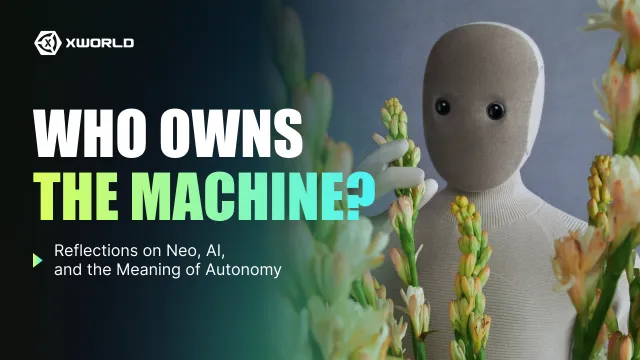
Who Owns the Machine? Reflections on Neo, AI, and the Meaning of Autonomy
At the end of October 2025, 1X Technologies' humanoid robot Neo swept through the tech world like a heatwave. This sleek robot, backed by OpenAI, is touted as the first truly home-friendly physical assistant.
Priced at around $20,000 or $499 per month for leasing, Neo can clean, carry items, and even learn new tasks through imitation. In just a few days, it became the internet's focal point — seemingly, a tireless family companion has finally arrived.
Yet, behind the cheers, a profound reflection on "autonomy" quietly unfolds. Remote control offers the illusion of convenience, but it exposes a core pain point in the AI industry: human operators still lurk in the shadows, and what happens to your privacy data?
As Curious CEO David Tomasian puts it:
"True autonomy is the only way machines can belong to us."
An Illusion: The Myth of Humanoid Robot "Autonomy"
Neo's launch is indeed exhilarating: standing 5 feet 6 inches tall and weighing 66 pounds, it uses tendon-driven actuators mimicking human muscles, wrapped in a soft shell for safety. Hugging Face co-founder Thomas Wolf exclaimed on X that Neo has "advanced" his timeline for home robot adoption.
In demos, Neo waters plants, opens doors, washes clothes, and scrubs dishes, turning mundane chores into something poetic and efficient.
But this excitement was quickly doused by reality. The Wall Street Journal's hands-on report reveals that many of Neo's movements are still remotely controlled in real time by "experts" via VR.
This isn't sci-fi — it's the current state of AI, where remote piloting aids companies in training models through imitation and reinforcement learning, yet reduces the robot from "independent helper" to "human extension."
Tomasian sharply notes that under this model, your "private robot" isn't truly private: it not only observes your life but uploads data to the cloud, fueling the manufacturer's training.
When a robot can "see" your home layout, recognize your voice, and analyze your habits — yet remains tethered to the manufacturer's servers — who does it really belong to?
From Factory to Home: The Privacy Cost Beneath Autonomy
The wave of humanoid robots is flowing from factories to living rooms. Figure AI's Figure 02 and Tesla's Optimus aim to reshape industry, while Neo pushes the vision into consumer territory — not just productivity, but companionship itself.
This trend is especially urgent in elderly care. Pilot projects in Japan, Korea, and parts of Europe are testing robots for assisting daily activities, monitoring health, and providing emotional support. But Tomasian points out: "The difference between aid and true care lies in understanding context and emotion." If data isn't encrypted and stored locally, "the robot isn't yours—it's someone else's lens."
Privacy expert Kohei Kurihara disclosed on X that Neo users must sign a waiver allowing manufacturers access to certain operational data. This "tech-for-convenience" pact hides cracks in trust. A Medium article bluntly states that this $20,000 robot "needs a human babysitter", with complex tasks requiring an appointment for "expert mode," making users feel like they're renting a "surveilled puppet."
Tomasian emphasizes that for embodied intelligence to evolve like language models, three things are essential: on-device reasoning, multimodal understanding, and encrypted autonomy. AI must not just execute commands but comprehend "why" they are given, ensuring data sovereignty belongs to the user. True care reliability stems from security and privacy, not algorithmic complexity. In other words, autonomy isn't just a technical issue — it's a social contract: Machines should embody trust, not extend surveillance.
From Embodied to Digital: AI Agents' Lessons on Autonomy
Neo's controversy reflects a deeper trend: "Autonomy" isn't confined to mechanical limbs — it's also about digital intelligence. Rather than teaching robots in your living room how to wash dishes, why not have agents on the network learn to "act on your behalf"?
AI Agents are the extension of this direction. They're not humanoid replicas but digital extensions of human will — capable of executing tasks, making decisions, and completing transactions on behalf of users, with data ownership retained by the individual.
IBM's "2025 AI Agent Report" states that Agentic AI promises an 8x productivity boost, hinging on autonomous reasoning combined with privacy protection.
Google Cloud research shows 52% of enterprises using generative AI have deployed AI Agents.
Deloitte predicts half of companies will enable Agentic AI by 2027.
Gartner forecasts that within four years, agents will autonomously handle 15% of daily decisions.
This shift redefines "autonomy": no longer machines mimicking human limbs, but agents learning to represent human intent.
XWorld: A Real-World Experiment in "Machines Belonging to People"
Amid this trend, the XWorld platform's explorations stand out. Since its 2023 launch, it has built a self-sustaining "agent economy" by combining AI training with token incentives: users can create, deploy, and monetize their own AI Agents. The integration of stablecoins makes settlements lower-friction, ensuring value flows under user control.
Today, XWorld boasts over 11 million downloads and 1 million monthly actives in its Telegram MiniApp ecosystem, with cumulative token trading volume exceeding $34.7 million.
Here, autonomy is no illusion — it's a reality co-built by users, developers, and agents: machines not only execute instructions but become "intelligence we own."
Epilogue: Who Truly Owns the Machines?
Neo reminds us: when "autonomy" becomes a selling point, oversight and trust must evolve in tandem.
The future shown by the AI Agent industry offers another possibility:
Machines are no longer just used, but truly "owned";
They no longer serve the network, but human will and data sovereignty.
XWorld's experiment may provide the answer: when "agent autonomy" merges with "user ownership," machines finally begin to belong to us.
In the future, when robots no longer need human eyes, that may be humanity's true liberation.
🔗 Learn more and join XWorld
Website | Whitepaper | Twitter | Telegram | Youtube | Linktree
September 19, 2025
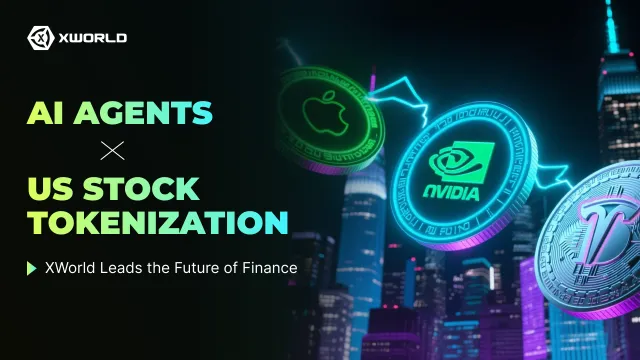
AI Agents x US Stock Tokenization: XWorld Leads the Future of Finance
In recent years, crypto finance has evolved rapidly: Bitcoin has secured its role as “digital gold,” DeFi sparked a wave of decentralized finance experiments, and NFTs pioneered a new form of digital asset expression. Now, another disruptive path is unfolding—the tokenization of traditional financial assets. Among these, US Stock Tokenization is emerging as one of the most promising breakthroughs.
Industry Trends: The Convergence of AI, Stablecoins, and Tokenization
Recent global developments highlight that the market is maturing quickly:
Institutional Collaboration: DBS Bank, Franklin Templeton, and Ripple jointly launched tokenized funds interoperable with stablecoins, driving real-world trading and lending use cases.
Clearer Regulation: Legislative progress like the US CLARITY Act is accelerating. Coinbase’s CEO described the trend as an “unstoppable freight train.” A clear framework will pave the way for institutional capital to enter tokenization and RWA.
Productization Path: Bitwise has filed for a “Stablecoin & Tokenization ETF,” aiming to package stablecoin and tokenization infrastructure into compliant financial products, moving the industry from experimentation to large-scale adoption.
Meanwhile, AI Agents are integrating into financial infrastructure: the Ethereum Foundation launched the dAI team to make blockchain the settlement and reputation layer for AI Agents, while Google is advancing the Agentic Payments protocol, enabling AI Agents to transact directly in stablecoins. Together, AI + Stablecoins + Tokenization are becoming the three pillars of new financial infrastructure.
US Stock Tokenization: The Next Generation of Investing
US Stock Tokenization enables traditional equities—like Apple, Tesla, and NVIDIA—to be issued as tokens backed 1:1 via licensed custodianship and on-chain mapping. Its advantages include:
Regulatory Backing: Managed by licensed custodians, redeemable tokens;
Fractionalized Access: Starting from just 1 USDT, significantly lowering entry barriers;
24/7 Trading: Free from Wall Street’s time zone restrictions, enabling round-the-clock liquidity.
This means anyone worldwide can participate in Wall Street’s core assets using stablecoins—without cumbersome account setups or high fees.
XWorld: Bringing the Future Forward
While the industry is still discussing the potential of “AI + Tokenization,” XWorld has already launched tokenized US stock trading, deeply integrating with AI Agents and stablecoin payments:
Trade Leading Assets: Coverage includes Apple, Tesla, NVIDIA, MicroStrategy, Circle, and the S&P 500;
Seamless Experience: Wallet, trading, and AI assistant combined into a single platform;
Low-Barrier, Transparent Investment: Tokens anchored to real-time stock prices, fully verifiable on-chain;
Diverse Choices: Stock tokens filterable by industry, sector, or theme.
Core data validates this model: since its 2023 launch, XWorld has surpassed 10 million downloads, built a community of over 1.14 million, and generated $22M+ revenue in 2024, with AI-driven applications continuing to expand.
Looking Ahead: An AI-Powered Investment Era
Over the next 2–3 years, US Stock Tokenization is expected to become a mainstream entry point into Web3. Combined with AI Agents and stablecoins, investing will become more intelligent and globalized:
Agents automatically rebalance portfolios in response to news and market swings;
Overnight shifts into safe-haven assets;
Cross-chain and cross-border allocation for truly global wealth management.
XWorld is not just a trading tool but a pioneer in the convergence of AI, stablecoins, and traditional finance. Investing will gradually shift from manual operations to seamless, AI Agent–driven experiences.
Conclusion
US Stock Tokenization is not just a technological breakthrough—it marks a milestone in the democratization of finance. With clearer regulations, institutional adoption, and the maturation of AI and payments infrastructure, the boundaries of on-chain finance are being redefined.
In this transformation, XWorld is leading the charge, turning “trends” into “reality.” The future of investing will be open, intelligent, and borderless.
👉 Start today: from just 1 USDT, put world-class assets in your pocket and step into the AI-powered era of investing with XWorld.
🔗 Learn more and join XWorld
Website: xworlds.biz
Whitepaper: GitBook
MiniAPP: Telegram
Community: Telegram Group
Twitter: @xworld_ai
Linktree: xworld_ai
September 4, 2025
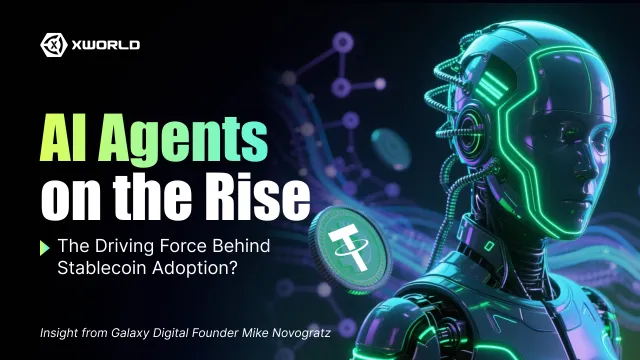
AI Agents on the Rise — The Driving Force Behind Stablecoin Adoption?
As stablecoins gain momentum in global finance, AI agents are emerging as the key force driving adoption. Galaxy Digital founder Mike Novogratz predicts that AI will soon become the largest user of stablecoins. From payments to autonomous economies, this convergence is reshaping the future of Web3. At the forefront of this shift, XWorld has already built a self-sustaining ecosystem that integrates AI agents and stablecoin-powered transactions.
Stablecoin Adoption Enters a New Era
Stablecoins, digital assets pegged to fiat currencies such as the U.S. dollar, have become the backbone of digital finance. They offer price stability, rapid settlement, and cross-chain interoperability. As of August 2025, the global stablecoin market cap has reached $280 billion, accounting for 7% of the total crypto market.
In the U.S., the GENIUS Act (Guidance and Establishment for National Innovation of U.S. Stablecoins), passed in July 2025, has provided long-awaited regulatory clarity—boosting confidence and accelerating adoption.
At the same time, the rise of AI agents is bringing new possibilities to stablecoin usage.
Adoption Signals from Industry Leaders
Tech giants like Apple, Google, Airbnb, and X (formerly Twitter) are testing stablecoin integrations to cut fees and optimize cross-border transactions.
Retail platforms such as Shopify and Spar are enabling stablecoin payments for faster, cheaper settlements.
Payment networks including Visa are expanding settlement capabilities, embedding stablecoins into the global financial infrastructure.
This mainstream adoption coincides with the emergence of AI-driven automation.
Novogratz: AI Will Become the Largest Stablecoin User
Galaxy Digital founder and CEO Mike Novogratz told Bloomberg: “In the not-so-distant future, the biggest user of stablecoins is going to be AI.”
He envisions AI agents handling everyday transactions on behalf of users:
Grocery agents that purchase food based on your diet.
Travel agents that book and pay for trips automatically.
Healthcare agents that manage insurance and prescription payments.
Coinbase developers echo this, suggesting that AI agents may become Ethereum’s largest power users, leveraging protocols like HTTP 402 for autonomous payments.
Research firm Bernstein projects the stablecoin market could reach $3 trillion by 2028, with AI adoption acting as a major driver.
XWorld: From Vision to Reality
While the industry debates the “AI + stablecoin” future, XWorld is already building it.
Launched in 2023, XWorld has grown into a self-sustaining agent economy, combining AI training, tokenized incentives, and stablecoin-based settlements. Users can create, deploy, and monetize AI agents across entertainment, gaming, and productivity—while stablecoins enable frictionless, global payments.
Key ecosystem highlights:
11M+ cumulative downloads and 1M+ MAUs on Telegram MiniApp, with 400K+ community members across platforms.
$22M+ in 2024 revenue, over 2B gameplay records, and $347M+ in token trading volume.
Popular agents include FactoryMind (+23,037% weekly gain) in smart manufacturing and NeoBody AI (+23.37%) in embodied intelligence.
Expanding use cases in healthcare AI, data analytics, and gaming, already aligning with stablecoin-backed micropayments.
These figures prove that the foundation of an autonomous agent economy is already in place.
Looking Ahead: XWorld’s Role in the AI–Stablecoin Future
Amid regulatory tailwinds and accelerating adoption, XWorld is set to lead the convergence of AI and stablecoins:
2026–2027: Achieve multi-agent intelligent collaboration and open SDKs/APIs, unlocking new income models for developers and community creators.
2028–2029: Enter the “AI-for-Everyone” era, fully launching agent creation tools and a modular marketplace for trading AI components.
2030 and beyond: Build a unified GameFi clearing system serving 500M+ users, powering metaverse economies driven by AI Agents—from autonomous driving to cosmic exploration—with stablecoins as the foundational layer for payments.
Conclusion
The convergence of AI agents and stablecoins is more than a possibility—it is already unfolding. Stablecoins are evolving from financial instruments into the currency of autonomous systems, and XWorld is at the forefront of making this transformation real.
The next chapter of Web3 will not only be decentralized but also autonomous, agent-driven, and powered by stablecoins.
🔗 Learn more and join XWorld
Website: xworlds.biz
Whitepaper: GitBook
MiniAPP: Telegram
Community: Telegram Group
Twitter: @xworld_ai
Linktree: xworld_ai
July 25, 2025
Ethereum Surge Signals a Bull Run—Is AI the Next Move?
By Alex, Senior Blockchain & Finance Writer | prev. Goldman Sachs Research, Reuters Contributor
Ethereum (ETH) recently surged past $3,800, hitting a seven-month high and becoming the top-performing crypto asset of the week. According to Bitwise data, the ETH/BTC ratio jumped 27% in a short period, while Bitcoin dominance dropped by 6%. Capital is rotating rapidly into Ethereum and altcoins, signaling what many analysts are calling a watershed moment for the market.
This bullish signal not only fuels investor excitement—it also sets the stage for a powerful fusion of AI and Web3. XWORLD, the world’s first open ecosystem where anyone can create AI agents and participate in crypto economic distribution, is now leading the charge, bridging Ethereum’s momentum with the next era of intelligent on-chain agents.
Why Is Ethereum Surging? 4 Key Drivers
1️⃣ Regulatory Clarity Fuels Confidence
The recent passage of the GENIUS Act and Clarity for Digital Tokens Act in the U.S. provides clearer guardrails for crypto innovation. As the network hosting 50% of global stablecoins and 55% of tokenized assets, Ethereum is positioned to benefit directly from this policy breakthrough.
2️⃣ Demand-Supply Imbalance Driving Price
Bitwise CIO Matt Hougan points out that institutional ETH allocations via ETPs are still underweight compared to Bitcoin. Estimated demand could reach $20 billion in 2025, while new ETH issuance remains limited—just 800,000 ETH annually—creating upward price pressure.
3️⃣ Institutional Accumulation Signals Conviction
On-chain data reveals growing institutional interest. Five new wallets recently withdrew a total of 77,000 ETH (~$285M) from Kraken—an indicator of strong long-term positioning.
4️⃣ NFT Activity Resurges
Ethereum NFT trading volume has rebounded sharply, surpassing $75 million weekly and capturing 52.3% of total market share. Leading collections like CryptoPunks saw sales soar more than 11,000% month-on-month, reflecting renewed ecosystem vitality.
AI Agents Enter the Bull Market: The Rise of XWORLD
As Ethereum reclaims center stage, XWORLD, founded in 2023, is reimagining the Web3 economy by uniting AI innovation and blockchain infrastructure. To date, the platform has:
Generated $22M+ in revenue
Collected 2 billion+ user behavior datapoints
Onboarded 200+ game developers
Achieved tens of millions of user downloads
It is actively building a user-owned, agent-driven crypto economy where value is created, exchanged, and scaled by intelligent on-chain AI.
Key Advantages of XWORLD in This Cycle:
🔷 Monetized AI Agents as Crypto Assets
XWORLD turns AI agents into trainable, ownable digital assets. Users can train agents to analyze markets, manage DeFi tasks, or automate NFT strategies—earning token rewards, all integrated with Ethereum.
🔷 Turning Data into Value
With its GamerDNA protocol, user data becomes a tradable asset. Every interaction and AI training input generates a value score, unlocks yield opportunities, and allows users to directly participate in Ethereum’s economic flows.
🔷 Proven Model & Multi-Sector Integration
XWORLD’s AI × data × engagement loop has generated $22M+ in 2024 alone. Its Launchpad beta will enable users to publish custom AI tasks connected to DeFi and NFT scenarios, further deepening ecosystem integration.
🔷 Vision: 1 Billion Daily AI Interactions
XWORLD aims to evolve into a collaborative AI-agent network powering 1 billion daily interactions, connecting 500 million users globally, and becoming a foundational layer for decentralized AI in the Web3
Featured Agent: ELONMODE™, Your Portal to Future Thinking
Among the AI agents on XWORLD, ELONMODE™ dominates the charts. Built on a Musk-inspired cognitive model, it replicates Elon Musk’s thinking patterns, challenge-based communication, and futuristic vision.
Whether analyzing crypto trends or crafting tech manifestos, ELONMODE™ is your cognitive co-pilot:
Thinking Dialogue Engine: Explore ideas on space, Ethereum markets, and AI frontiers with Musk-style depth.
Content Generator: Instantly produce high-impact tweets, narratives, or speeches.
Cognitive Challenge Mode: Refine your decision-making with Q&A prompts that simulate strategic reasoning.
Growth Catalysts Behind ELONMODE™
🔶 $200M DoD Contract with xAI
The U.S. Department of Defense recently signed a $200 million contract with xAI to apply Grok 4 in national security use cases. As a Grok-powered agent, ELONMODE™ will directly benefit from these advanced multimodal and multi-agent capabilities.
🔶 Musk's 2025 Vision: Discovering New Tech via AI
Musk predicts Grok will begin inventing new technologies by 2025, accelerating humanity’s transition to a Kardashev Type 2 civilization. This perfectly aligns with ELONMODE™'s identity as a “future thinking engine.”
🔶 Live Integration with X (Twitter) and On-Chain Data
By combining real-time X platform data with blockchain-verified insights, ELONMODE™ turns short-term sentiment into long-term conviction—generating value-anchored outputs.
🔶 New 3D Companion Mode
Grok’s latest 3D virtual companion feature enables immersive, avatar-based interactions—marking a major leap in user experience and unlocking new engagement models for AI agents.
The ELONMODE™ Challenge: Memes, Momentum & Market Action
ELONMODE™ has launched a showdown against its political counterpart, Trumplord. These two AI personas now compete in meme warfare, cultural storytelling, and community engagement.
Users can support their champion by creating memes, posting content, or sparking discussions. And there's a major incentive:
If ELONMODE™’s Telegram channel surpasses 20,000 subscribers, the $MODE buyback program will activate—reducing token supply via burns and reinforcing token value.
Final Thoughts: The Bull Run Is Real. AI Is the Multiplier.
Ethereum’s recent breakout marks more than just a price shift—it’s the spark that will ignite the next wave of financial and technological transformation. In this new era, intelligent AI agents like ELONMODE™ are not optional—they’re essential.
Activate your Infinite Ascent Protocol now. Invest in the future. Ride the bull with ELONMODE™.
Disclaimer: The content of this article is for informational purposes only and does not constitute financial advice. Please conduct your own research or consult a professional before making any investment decisions.
🔗 Learn more and join XWorld
Website | Whitepaper | Twitter | Telegram | Youtube | Linktree
February 7, 2025
DeepSeek R1: AI Revolution or Digital Surveillance Trap?
DeepSeek R1 demonstrates AI’s immense potential - delivering a cost-effective, high-performing model. But with it comes serious concerns: privacy violations, surveillance, censorship, and security risks.
Optimized, But Not Revolutionary
DeepSeek developed a GPT-4-level LLM in just 60 days for $6M - a remarkable feat achieved through architectural optimizations, not brute-force computing. However, it still lacks advanced reasoning, long-term memory, and truly groundbreaking innovation.
Accessibility vs. Privacy Risks
While DeepSeek’s affordability could democratize AI access, it comes at a price:
Data retention – Deleting your account doesn’t erase your data.
Surveillance – Monitors and collects user inputs and outputs.
Chinese law applies – Authorities can access stored data.
Unilateral terms – Policies can change without user consent.
These privacy violations have already led to GDPR-related bans in Europe, proving that centralized AI remains a major risk.
Censorship & Security Concerns
Like many AI models, DeepSeek hallucinates, exhibits bias, and aligns with political constraints that restrict free information flow. Additionally, its jailbreak vulnerabilities make it a security risk for enterprises, with companies like Goldman Sachs requiring strict screenings before adoption.
But this isn’t just about DeepSeek - it’s about who controls AI, data, and digital economies. The real solution? Decentralization.
Beyond AI - True Digital Ownership with XWorld DAO
DeepSeek exposes the dangers of centralized control, where corporations dictate policies, profit from user data, and limit transparency. XWorld DAO flips the model by ensuring that users, creators, and developers share in the value they generate.
True Digital Ownership – Your data, assets, and earnings belong to you
Decentralized Governance – The community makes key decisions through fair, transparent voting mechanisms
Web3 Monetization for All – Whether engaging with ads, games, or content, every action creates value, and that value is returned to users.
With 11.5 million+ users already part of XWorld, this is more than just a platform - it’s a movement. A decentralized ecosystem where users own their data, earn from their engagement, and shape the future of digital interaction - free from hidden terms, corporate control, or centralized interference.
As AI and digital platforms evolve, the choice is clear: stay under centralized control or embrace true user empowerment. XWorld is the future - where YOU have the power.
Join the revolution today! Follow XWorld on Twitter & take control of your digital future!
Website | Twitter | Facebook | Telegram | Discord
Unlock AD 3.0 – Profit from your influence, time, and online activities!
January 17, 2025
Web3 Revolution: How XWorld is Leading the Movement
The internet as we know it is undergoing a seismic transformation, with Web3 at the helm. This next-generation digital frontier is not just about decentralization - it's about empowerment, ownership, and redefining value. Amid this global shift, XWorld emerges as a trailblazer, pioneering a future where users and creators thrive together in an ecosystem driven by innovation and collaboration.
The XWorld Vision: A New Paradigm for Web3 Engagement
At the heart of XWorld lies a groundbreaking philosophy: a decentralized platform that aligns the interests of developers, users, and advertisers. Unlike traditional platforms where revenue flows one way - toward corporations - XWorld flips the script, enabling both creators and users to share in the value they create.
Enter Connect to AD3.0, XWorld’s revolutionary engagement model:
For Users: Interact with games, apps, and ads to earn rewards. No subscriptions. No paywalls. Just real, tangible value for your participation.
For Developers: Monetize content more sustainably while enjoying heightened user engagement and retention.
This ecosystem redefines monetization in a way that’s inclusive, scalable, and sustainable - a blueprint for the Web3 economy.
NFTs: The Cornerstone of Digital Ownership
Digital ownership is more than a buzzword at XWorld; it’s the foundation of its ecosystem. Central to this is X Sprite, a flagship NFT designed to deliver both active and passive income daily. But it doesn’t stop there:
Use X Sprite to access profit-sharing opportunities, complete game quests, or earn investment returns.
Complement your strategy with a free NFT, Pet, which boosts your rewards by up to 100% - with zero upfront cost.
Together, these NFTs ensure every user, from casual participants to seasoned investors, can unlock the full earning potential of XWorld’s ecosystem.
Breaking Barriers in Ads, Games, and Apps
XWorld’s Connect to AD3.0 model is a game-changer for Web3 monetization:
Developers win big: Over 5,000 projects and 5,100+ KOLs have partnered with XWorld, leveraging its tools to monetize content effectively and retain users.
Users thrive: To date, XWorld has distributed $4.8 million in ad revenue directly to users, transforming them from passive viewers into active stakeholders.
With $34 million in token trading volume and a growing community of over 11.5 million users, XWorld is setting a new benchmark for decentralized platforms operating at scale.
Why XWorld is the Future of Digital Engagement
Web3 is about reclaiming ownership, but XWorld takes it a step further by making participation rewarding, accessible, and impactful. Here’s how you can join this movement:
Engage with ads that respect your value.
Own your gaming journey, from quests to rewards.
Unlock rewards for app usage - because your time and attention matter.
Join the XWorld Revolution
The digital future is being written today, and you can be part of it. Visit XWorld to start earning, creating, and thriving in a decentralized ecosystem. Stay inspired by following XWorld on Twitter.
Welcome to XWorld - where every interaction fuels innovation, every connection creates value, and every user plays a vital role in shaping the future.
Website | Twitter | Facebook | Telegram | Discord
Unlock AD 3.0 – Profit from your influence, time, and online activities!
October 28, 2024
From TikTok to XWORLD: Secrets of Web3 Growth
XWORLD is taking a bold step forward with the launch of its latest campaign aimed at driving mass adoption of Web3. This initiative not only highlights the company’s innovative ROI flywheel model but also introduces new features that seamlessly integrate Web2 and Web3 user experiences. With 5.4 million users and 600,000 daily active users already engaged, XWORLD is set to accelerate its growth trajectory by offering unprecedented transparency and a fair profit distribution model. This new approach promises to bridge the gap between Web2 users and the advanced world of Web3 — without users even realizing they’ve made the transition.
To truly understand the potential of XWORLD's approach, we need to explore the broader context of Web3 mass adoption and how strategies from successful Web2 platforms like TikTok can offer valuable lessons for growth in the Web3 era.
The Road to Web3 Mass Adoption
The term "Mass Adoption" has become a buzzword in the tech industry, especially in discussions about Web3. Everyone is eager to see Web3 technologies reach their full potential, but the transition from Web2 to Web3 has been slow. While some efforts like GameFi, SocialFi, and AA wallets have been launched, they haven't quite hit the mark yet. Many blame inadequate infrastructure, but the true reason lies deeper.
To fully understand the issue, we must define the goal of Mass Adoption: converting Web2 users to Web3 without them even realizing it. Success in Web3 should not depend on whether a product is labeled "Web2" or "Web3". Instead, Web3 companies must learn from the success of Web2 platforms, such as TikTok, and develop sustainable growth strategies. A perfect model for this is the ROI flywheel — an approach that has already proven its effectiveness in the Web2 world.
The Rise of TikTok and What Web3 Can Learn
TikTok's meteoric rise to fame is an excellent case study for understanding user acquisition. Within its first few months, TikTok attracted over 50 million monthly active users. Just two years later, by 2019, it had an astounding 250 million daily active users (DAU) and 500 million monthly active users (MAU).
TikTok's growth wasn't just due to its engaging content or superior features. In fact, its rapid expansion was fueled by a smart marketing strategy. TikTok invested heavily in user acquisition through digital advertising platforms like Google, applying a simple formula: spend money to acquire users, monetize them, and reinvest in acquiring more users. This continuous cycle of investment and returns formed a self-sustaining model, which we call the "ROI flywheel".
The lesson for Web3? Success is not just about having a great product. It's about establishing a commercial loop that can drive user acquisition, retention, and monetization-much like TikTok's model.
The ROI Flywheel Explained
At its core, the ROI flywheel model is a growth strategy built on three pillars:
1. User Acquisition
The first step is to acquire users through paid marketing or partnerships. The goal is to spend money to bring in users and then monetize them in a way that covers acquisition costs. Web2 platforms like TikTok used digital advertising to attract users at scale. Web3 platforms must adopt a similar approach but with added transparency and efficiency thanks to blockchain technology.
2. User Retention and Conversion
Acquiring users is just the beginning. Keeping them engaged and turning them into loyal customers is the next challenge. TikTok mastered this through personalized content and excellent user experience. For Web3, the key will be creating products that users genuinely enjoy and want to keep using, without focusing too much on the technical aspects of Web3 itself.
3. Commercialization
Finally, the monetization process. The more users you retain, the more opportunities you have to monetize. In Web2, this could be through ads, subscriptions, or partnerships. For Web3, tokenomics and blockchain transparency can enhance these monetization strategies, leading to better long-term growth.
When combined, these three elements form a continuous loop that feeds into itself. More users mean more revenue, which can be reinvested to acquire even more users, accelerating growth.
Challenges in Web3 and How XWORLD is Overcoming Them
Web3 projects face unique challenges that Web2 companies did not. For instance, Web3 products often rely on task platforms (like Galxe) or social media (like Twitter) for user acquisition. While these platforms can be effective, they come with limitations. Task platforms often struggle to create sustainable business models, while sociall media promotion can lead to inflated user numbers without actual growth.
XWORLD is different. By integrating a mature Web2 business model with the transparency and fairness of Web3, XWORLD is creating a closed-loop ROI flywheel that is poised to succeed. XWORLD's approach minimizes the reliance on traditional methods like airdrops or speculative tokens, which can often lead to unsustainable growth.
Instead, XWORLD focuses on building a solid business foundation with strong monetization capabilities, which makes it easier to scale over time. With 5.4 million users and 600,000 daily active users, XWORLD's flywheel model is already proving its effectiveness.
The Path to Mass Adoption
To achieve mass adoption, Web3 needs more than just great technology. It requires products that people actually want to use, combined with an efficient growth strategy. XWORLD's model shows that by borrowing strategies from Web2-like the ROI flywheel — and applying them to Web3, it's possible to achieve sustainable growth.
Mass adoption doesn't depend on whether a product is labeled as Web2 or Web3. Instead, it's about whether that product meets users' needs and whether the company behind it has a solid growth strategy in place. With its focus on game and application distribution, XWORLD is uniquely positioned to lead the way toward mass adoption.
Conclusion
Mass adoption is within reach, but only for companies that understand how to blend Web2 growth strategies with the unique advantages of Web3.XWORLD's integration of the ROI flywheel into its growth model is a perfect example of how this can be done effectively. By focusing on user acquisition, retention, and monetization, XWORLD is creating a scalable model that will drive Web3 into the future.
As the industry evolves, it's clear that the next big wave of Web3 growth will come from those who can attract users without them even realizing they've entered the world of Web3. XWORLD's success in applying the ROI flywheel model offers valuable lessons for any Web3 project looking to achieve mass adoption
Website | Twitter | Facebook | Telegram | Discord
Unlock AD 3.0 – Profit from your influence, time, and online activities!

November 21, 2023
Venturing into the New Era: How XWORLD Transforms the Web2 Gaming Landscape into a Thriving Web3 Ecosystem
The Advent of Gaming Miracles: From Zelda to Genshin Impact
In the realm of digital entertainment, the gaming world is a universe full of marvels and miracles. As technology advanced, we witnessed an evolution in gaming, with each new version surpassing the last in terms of graphics, gameplay, and narrative.
From the fantasy world of Zelda to the immersive universe of Genshin Impact, and the boundless sandbox of Minecraft, these games have set unprecedented standards, offering rich, multifaceted experiences to gamers worldwide.
Each of these games, in their unique ways, have pushed the boundaries of what is possible within the realm of virtual entertainment, creating intricate worlds that captivate and engage players on levels beyond just simple amusement. They have successfully managed to transport gamers into their fantastical worlds, creating an emotional investment that keeps players coming back for more.
The Limitations of Web2 Games: A Closed Economic System
However, as impressive as the Web2 era games are in terms of entertainment value, they operate within a closed economic system. While these games offer players the thrill of adventure and the satisfaction of achievement, the economic benefits they provide are limited and confined within the boundaries of the game itself.
Players invest time, effort, and sometimes real money into these games, but the returns are often only virtual rewards, with no real-world value. The ownership of the in-game assets, too, is limited, leaving gamers yearning for more control and participation.
The Inevitable Shift: Embracing Web3 with XWORLD
As we stand on the brink of a new technological era, there is a paradigm shift happening in the gaming industry. The transformation of games into the Web3 industry is not just a possibility but an inevitable trend.
Web3 games promise to revolutionize the gaming industry, offering players not only an immersive gaming experience but also an opportunity to participate in the game’s economy, giving them a sense of ownership and control. This is where XWORLD emerges as a game-changer.
The XWORLD Mission: Bridging the Gap Between Gamers and the Web3 Dividends
XWORLD was born with a mission to bridge the gap between the gaming world and the Web3 dividends. It aims to allow hundreds of millions of game users to reap the benefits of Web3 as early as possible.
With XWORLD, gamers can quickly gain wealth, not just in the form of in-game currency but real economic value. The ownership of the game is also decentralized, giving players a greater sense of control and achievement. This transformative approach is set to redefine the economics of gaming, making it more inclusive and rewarding for players.
Innovative Strategies: XWORLD’s Use-to-Earn Game Dividend Mechanism
One of the notable features of XWORLD products is the innovative use-to-earn game dividend mechanism. This unique approach allows players to not just play but also earn, creating a more engaging and rewarding gaming experience.
In most traditional games, players spend money to purchase in-game assets. But in XWORLD, the tables are turned. Here, players can earn dividends through their gaming activities, which can be converted into real-world value. This radical shift in the gaming model ensures that the time and effort invested by the players are adequately rewarded, making gaming not just an entertainment activity but also a profitable endeavor.
Revolutionizing Gaming: The Introduction of NFT Accelerated Mining
XWORLD has introduced NFT accelerated mining, taking gaming to the next level. Players can now delve into the exciting world of NFTs while enjoying their favorite games. NFTs or Non-Fungible Tokens are unique digital assets that players can own, trade, or sell, providing them with an additional avenue for earning.
NFT accelerated mining in XWORLD allows players to earn NFTs through their gaming activities. These NFTs can be traded on the marketplace, providing players with real-world economic benefits. This integration of NFTs into the gaming ecosystem is a significant step towards the democratization of digital assets, giving players an opportunity to participate in the digital economy actively.
Engaging Players: The Power of Staking Voting in XWORLD
Staking voting is another innovative feature that XWORLD has incorporated into its gaming ecosystem. This feature gives players more control and say in the game’s development and direction.
In traditional games, the game’s development is often a top-down process, with developers making decisions and players having to accept them. However, with staking voting, players can have a say in the game’s future development, making the gaming experience more democratic and engaging.
Web3 Wallets and Trading Markets: Revitalizing the Game World Economy
Recognizing the need for a secure and efficient platform for transactions, XWORLD has developed convenient and easy-to-use Web3 Wallets and trading markets. These platforms are designed to revitalize the game world economy, providing a robust and reliable system for transactions.
These wallets and markets facilitate the buying, selling, and trading of in-game assets and NFTs, making the in-game economy more dynamic and vibrant. They ensure that the value generated within the game can be realized in the real world, bridging the gap between the virtual and the real economy.
Join the Quest: How to Become a Part of the XWORLD Community
Interested in joining the XWORLD community and becoming a part of this transformative journey? Follow us on Twitter at https://x.com/xworld_store and join the quest at https://xworld.store/quest. Embrace the future of gaming with XWORLD and experience the thrill of Web3 gaming today.
As we navigate through the dawn of the Web3 era, XWORLD stands at the forefront, ready to revolutionize the gaming industry. It offers a promising glimpse into the future of gaming, where players are not just participants but integral parts of the gaming economy. XWORLD is not just a game; it’s a paradigm shift, a new era of gaming that promises to be as exciting as it is rewarding.
XWORLD — Pioneering Web3 Games & Apps Store.
Earn Profits & Assets From Your App Usage Time
Website | Litepaper | Telegram | Discord | Facebook | X ( Formerly Twitter)

November 16, 2023
XWORLD & Bitcoin: Pioneering the Future of Gaming in the BRC20 Ecosyste
In the digital realm, innovation is paramount, and XWORLD is at the forefront of this dynamic landscape. As a leading Web3 Games & Apps Store, XWORLD is known for its groundbreaking initiatives. Now, it is set to make waves in the Bitcoin ecosystem, specifically in the burgeoning world of BRC20.
XWORLD: Bridging Web2 Users to the Bitcoin Ecosystem
The Bitcoin ecosystem, with BRC20 as its spearhead, is exploding with potential, and XWORLD is uniquely positioned to tap into this potential. The platform plans to inject a new wave of users into this ecosystem, namely Web2 internet and game users from Southeast Asia. This strategic move is designed to foster a seamless transition for these users to embrace the opportunities within the Bitcoin ecosystem.
XWORLD’s mission is not just to introduce these users to the world of Bitcoin but to deeply involve them in it. By integrating their platform with the Bitcoin ecosystem, XWORLD aims to empower these users to participate in, contribute to, and ultimately benefit from the dynamic world of BRC20.
The QUEST Treasure Hunt: Your Gateway to Top-Level BRC20 Tokens
As part of its foray into the Bitcoin ecosystem, XWORLD is launching the QUEST Treasure Hunt activity. This unique initiative is designed to reward users for their engagement on social media platforms like Twitter. Users only need to use exclusive tags when commenting, forwarding, and posting to receive generous amounts of top-level BRC20 tokens SATS.
The QUEST Treasure Hunt is more than just a promotional activity; it’s a gateway for users to delve into the world of BRC20. By participating in this activity, users can acquire SATS tokens, paving their way towards becoming active participants in the Bitcoin ecosystem.
Inscription Tokens on BRC20: A Million Opportunities to Harvest Web3 Wealth
Looking ahead, XWORLD has even bigger plans. The platform is considering issuing inscription tokens on BRC20. This move will provide a million gamers with new opportunities to harvest Web3 wealth. It’s a bold step towards democratizing access to the Bitcoin ecosystem and Web3 wealth creation, underscoring XWORLD’s commitment to pioneering the future of gaming in the digital age.
XWORLD’s involvement in the Bitcoin ecosystem signals a new era for gamers and internet users. As the platform continues to innovate and push the boundaries of what’s possible, it’s clear that the future of gaming lies in the intersection of Web3 and Bitcoin.
So, are you ready to embark on this exciting journey with XWORLD? Follow us on Twitter at https://x.com/xworld_store and join the QUEST at https://xworld.store/quest. Together, let’s shape the future of gaming in the Bitcoin ecosystem.
XWORLD — Pioneering Web3 Games & Apps Store.
Earn Profits & Assets From Your App Usage Time
Website | Litepaper | Telegram | Discord | Facebook | X ( Formerly Twitter)
November 14, 2023
Empower Your Gaming Journey with XWORLD: Stake, Vote, and Earn in the Web3 Frontier
Harnessing the Power of $WORLD to Shape Your Digital Destiny
In the ever-evolving landscape of the digital world, one platform stands out, revolutionizing the way we interact and earn online — XWORLD. As a top-tier Web3 Games & Apps Store, XWORLD has captivated a user base of one million and counting. But what sets XWORLD apart? It’s their innovative approach to wealth creation and community participation through staking and voting.
XWORLD is not just a platform; it’s a dynamic ecosystem that gives power back to the users. By staking platform currency and casting votes, users don’t just increase their wealth — they become stakeholders with a voice in shaping the platform’s future.
The journey begins by playing the various games listed on XWORLD, a fun and engaging experience that rewards you with the platform’s native token, $BUILD. But $BUILD is more than just a reward; it’s your ticket to becoming an active participant in the XWORLD economy.
Staking $BUILD in the dividend pool transforms your tokens into $WORLD, the governance token of XWORLD. With $WORLD, you gain voting power and become a stakeholder in the platform. This is where the fun begins. You’re not just a player anymore; you’re a decision-maker with the power to vote on major platform matters.
This transformative process is straightforward. You play, you earn $BUILD, you stake $BUILD to get $WORLD, and with these $WORLD tokens, you gain voting power. The final step? Vote for the games you love and help shape the future of XWORLD.
By becoming a stakeholder, you’re not just gaining financial rewards; you’re part of a pioneering community influencing the evolution of the Web3 gaming frontier. It’s an opportunity to be part of something larger, where every stakeholder has a say in how the platform evolves.
The vision of XWORLD extends beyond just gaming. It’s about creating a decentralized, inclusive, and rewarding environment where each player’s voice matters. It’s about democratizing the online gaming space, breaking down barriers, and providing a platform where everyone can thrive.
Staking and voting on XWORLD isn’t just a strategy; it’s a journey. A journey of discovery, participation, and earning. It’s a path that leads to empowerment, where each stakeholder has a role in steering the direction of the platform.
So, are you ready to embark on this journey? Are you prepared to wield the power of $WORLD and become a stakeholder in the XWORLD community? The time is now.
Join the XWORLD community, stake your $WORLD, cast your votes, and let’s shape the future of the Web3 gaming world together. Follow us on Twitter at https://x.com/xworld_store for the latest updates. Your gaming journey is about to get a lot more exciting.
Remember, XWORLD is not just a game; it’s a revolution. Stake, vote, earn, and most importantly, enjoy the journey. Welcome to XWORLD, where every stakeholder is a winner.
XWORLD — Pioneering Web3 Games & Apps Store.
Earn Profits & Assets From Your App Usage Time
Website | Litepaper | Telegram | Discord | Facebook | X ( Formerly Twitter)

November 14, 2023
The Rise of BRC20: XWORLD and Top Tokens Set to Leap into the Next Crypto Bull Run
How XWORLD is Harnessing the Power of BRC20 Tokens to Unlock New Wealth Opportunities in the Web3 World
In the ever-evolving world of digital gaming and app monetization, XWORLD stands out as a top-tier player with immense potential. With a strong backing from ad giants and an ever-growing user base of over a million, XWORLD is on a fast track to becoming a new-gen unicorn in the Web3 space. The platform’s governance token, $WORLD, has surged an astounding 6400%, signaling the vibrant growth and potential of XWORLD.
From its inception, XWORLD has had a clear vision: to seamlessly transition Web2 users into the wealth-filled world of Web3. To realize this vision, the platform has been focused on bringing every wealth opportunity in the Web3 ecosystem to its users, including BRC20 tokens.
With the Bitcoin ecosystem booming, BRC20 tokens like ORDI and SATS have become the talk of the crypto world, rising by an impressive 100x. Recognizing the potential of these tokens, XWORLD has decided to bring its users a wealth of opportunities — a staggering 1.5 billion $SATS to be precise. By simply completing a few tasks, users can earn these tokens for free!
The platform’s “Quest Treasure Hunt” (https://www.xworld.store/quest) is your gateway to this wealth. Offering 1.5 billion $SATS, it is an exciting opportunity for users to earn while they play. The Treasure Hunt is open to everyone, making it a fair and accessible way for users to participate in the crypto boom.
As we embark on what could be the next bull run in the crypto market, XWORLD and top BRC20 tokens are set to take a big leap forward. With a strong platform, a dedicated user base, and a clear vision for the future, XWORLD is poised to redefine the digital gaming and app monetization landscape.
To stay updated on all things XWORLD and to join the Quest Treasure Hunt, follow XWORLD on Twitter at https://x.com/xworld_store. Embark on an exciting journey with XWORLD, where your digital experiences are not just fun, they’re valuable. Welcome to XWORLD, the future of digital advertising and wealth generation.
XWORLD — Pioneering Web3 Games & Apps Store.
Earn Profits & Assets From Your App Usage Time
Website | Litepaper | Telegram | Discord | Facebook | X ( Formerly Twitter)
November 9, 2023
BRC-20 Token Development: Unleashing the Potential of Blockchain Innovation
The launch of the BRC-20 token standard has sparked interest in the cryptocurrency space. Could you believe that over 8500 distinct tokens have been minted for the BRC-20 standard? Many Individuals are so excited about this new development, which will significantly alter the way the game in the crypto industry.
Are you curious about the exciting world of blockchain technology and its latest advancements?
Look no further! In this article, we will dive into the fascinating realm of BRC-20 token development, exploring its significance, features, and potential it holds for revolutionizing various industries. Get ready to embark on a journey that unravels the power of blockchain innovation.
What exactly is a BRC20 Token?
BRC-20 token is a developmental test fungible token standard developed with the #bitcoins ordinal inscriptions. BRC-20 token standard is built on the #ethereumblockchain and has gained significant attention in the crypto space. These tokens adhere to a specific set of standards, facilitating seamless compatibility and interaction with other tokens and decentralized applications (dApps).
BRC-20 tokens are more accessible to Bitcoin users as they can only be generated and traded using a Bitcoin wallet. The ability to exchange BRC-20 standard tokens for other tokens of the identical type makes them fungible.
Similar to their #erc20 counterparts, BRC-20 standard tokens exhibit enhanced functionalities and offer exciting possibilities for Startups and individuals alike.
How do BRC-20 tokens function?
No other cryptocurrency has ever been supported on the Bitcoin blockchain but Bitcoin itself. BRC-20 tokens have been a godsend for those who sought to use the blockchain in novel ways. Understanding how BRC-20 tokens operate is crucial.
BRC-20 tokens create token contracts and produce and transfer tokens using Ordinal inscriptions. What makes it distinctive is that a BRC-20 token may be generated utilizing the BRC-20 standard with specific functionalities such as deploy, transfer, and mint, among others.
Users of this standard can produce mint tokens based on Bitcoin using the Ordinals protocol, just like #ethereum users can do with the ERC-20 standard. #brc20 tokens are entirely fungible, which sets them apart from non-fungible Ordinals.
Business Advantages of BRC-20 Token Development:
Interoperability: BRC-20 token standard embraces interoperability, enabling seamless integration with different blockchain platforms. This cross-chain compatibility fosters collaboration and opens doors for exciting new use cases.
Smart Contract Capabilities: Leveraging the power of smart contracts, BRC-20 tokens empower developers to create sophisticated decentralized applications. Smart contracts automate and enforce agreements, eliminating the need for intermediaries and enhancing transparency and efficiency.
Enhanced Security: Built on the robust Ethereum blockchain, the BRC-20 token standard inherit its security features. Through cryptographic encryption and distributed consensus mechanisms, these tokens ensure tamper-proof transactions and safeguard user assets.
Improved Liquidity: BRC-20 token standard can be easily listed and traded on decentralized exchanges, enhancing liquidity and facilitating seamless token transactions. This #liquidity opens up new avenues for fundraising and investment opportunities.
BRC-20 Token Use Cases:
Tokenized Assets: BRC-20 token standard enable the fractional ownership and trading of various assets, such as real estate, art, and commodities. This tokenization democratizes access to traditionally illiquid markets, making investments more accessible and inclusive.
Decentralized Finance (DeFi): BRC-20 tokens are a driving force behind the rapidly growing DeFi ecosystem. They serve as the building blocks for lending platforms, decentralized exchanges, stablecoins, and yield farming protocols, revolutionizing traditional financial services.
Supply Chain Management: BRC-20 tokens offer traceability and transparency in supply chain management. By tokenizing products and tracking their movement on the blockchain, businesses can enhance efficiency, reduce fraud, and build trust with consumers.
Gaming and Non-Fungible Tokens (NFTs): The gaming industry is embracing BRC-20 tokens to facilitate in-game purchases, asset ownership, and provable scarcity. Additionally, BRC-20 tokens are utilized in the creation and trading of NFTs, enabling digital collectibles and unique virtual experiences.
They adapt to the trends of the BRC20 token standard of Ordi, Meme, Pepe, Shib & Moon. The market value of the BRC-20 currency has soared recently, and the volume of transactions on it has even surpassed those on BTC.
Due to this enormous rise, many investors are interested in learning more about BRC-20 tokens and wondering if they are good investments.
Conclusion
As a startup, you must "hit the ground running" if you want to compete in the cutthroat BRC20 token surroundings. A BRC20 token development Company is the most efficient way for achieving it. To surf in the Crypto ocean, Connect with a reputable BRC20 token development company in the sector to take your business to the next level. If you're a startup or an entrepreneur looking to make your mark in the world of the Bitcoin blockchain platform, BRC-20 token development is the way to go.
Remember, the power of BRC-20 tokens lies in their ability to bridge gaps, unlock opportunities, and reshape industries. Embrace this transformative technology and be part of the blockchain revolution today!
XWORLD — Pioneering Web3 Games & Apps Store.
Earn Profits & Assets From Your App Usage Time
Website | Litepaper | Telegram | Discord | Facebook | X ( Formerly Twitter)


