Empower Your Gaming Journey with XWORLD: Stake, Vote, and Earn in the Web3 Frontier
Harnessing the Power of $WORLD to Shape Your Digital Destiny
In the ever-evolving landscape of the digital world, one platform stands out, revolutionizing the way we interact and earn online — XWORLD. As a top-tier Web3 Games & Apps Store, XWORLD has captivated a user base of one million and counting. But what sets XWORLD apart? It’s their innovative approach to wealth creation and community participation through staking and voting.
XWORLD is not just a platform; it’s a dynamic ecosystem that gives power back to the users. By staking platform currency and casting votes, users don’t just increase their wealth — they become stakeholders with a voice in shaping the platform’s future.
The journey begins by playing the various games listed on XWORLD, a fun and engaging experience that rewards you with the platform’s native token, $BUILD. But $BUILD is more than just a reward; it’s your ticket to becoming an active participant in the XWORLD economy.
Staking $BUILD in the dividend pool transforms your tokens into $WORLD, the governance token of XWORLD. With $WORLD, you gain voting power and become a stakeholder in the platform. This is where the fun begins. You’re not just a player anymore; you’re a decision-maker with the power to vote on major platform matters.
This transformative process is straightforward. You play, you earn $BUILD, you stake $BUILD to get $WORLD, and with these $WORLD tokens, you gain voting power. The final step? Vote for the games you love and help shape the future of XWORLD.
By becoming a stakeholder, you’re not just gaining financial rewards; you’re part of a pioneering community influencing the evolution of the Web3 gaming frontier. It’s an opportunity to be part of something larger, where every stakeholder has a say in how the platform evolves.
The vision of XWORLD extends beyond just gaming. It’s about creating a decentralized, inclusive, and rewarding environment where each player’s voice matters. It’s about democratizing the online gaming space, breaking down barriers, and providing a platform where everyone can thrive.
Staking and voting on XWORLD isn’t just a strategy; it’s a journey. A journey of discovery, participation, and earning. It’s a path that leads to empowerment, where each stakeholder has a role in steering the direction of the platform.
So, are you ready to embark on this journey? Are you prepared to wield the power of $WORLD and become a stakeholder in the XWORLD community? The time is now.
Join the XWORLD community, stake your $WORLD, cast your votes, and let’s shape the future of the Web3 gaming world together. Follow us on Twitter at https://x.com/xworld_store for the latest updates. Your gaming journey is about to get a lot more exciting.
Remember, XWORLD is not just a game; it’s a revolution. Stake, vote, earn, and most importantly, enjoy the journey. Welcome to XWORLD, where every stakeholder is a winner.
XWORLD — Pioneering Web3 Games & Apps Store.
Earn Profits & Assets From Your App Usage Time
Website | Litepaper | Telegram | Discord | Facebook | X ( Formerly Twitter)
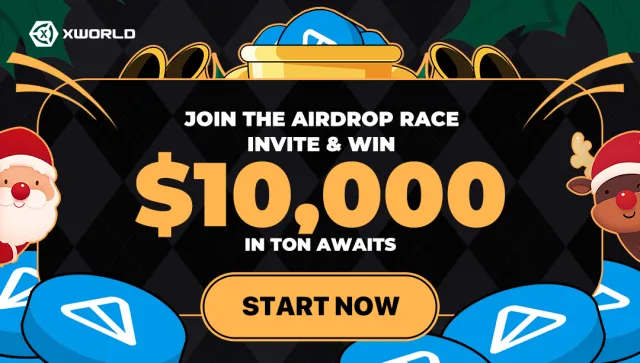
Hustle This Christmas, Unlock 2025 Airdrop Rewards!
Get ready for the XWorld Holiday Leaderboard Challenge, where your hustle not only brings incredible rewards but also sets you up for future 2025 Airdrop surprises! 💰
🗓 Event Duration: December 23, 2024 – January 19, 2025
🏆 Leaderboard Highlights:
Weekly Leaderboard: Updated weekly to showcase the top 10 hustlers!
Monthly Leaderboard: Tracks your total performance throughout the event, featuring the top 20 grinders.
🎯 How to Join the Fun:
Earn $BUILD and climb the leaderboard by:
✅ Completing daily tasks
🎮 Playing games and smashing game missions
🤝 Inviting friends to join the XWorld adventure
✨ Boosting your earnings with Sprite bonuses
👉 Leaderboard Rules:
Weekly Rankings: Based on $BUILD earned during the week.
Monthly Rankings: Calculated from your total $BUILD throughout the event.
Live Updates: Only the Top 100 players are displayed, refreshed every 5 minutes!
👑 Leaderboard Rewards:
💥 Weekly Rewards (Top 10):
🥇 1st Place: 30 TON
🥈 2nd Place: 20 TON
🥉 3rd Place: 15 TON
4th-10th Place: 10 TON each
💎 Monthly Rewards (Top 20):
🥇 1st Place: 150 TON
🥈 2nd Place: 100 TON
🥉 3rd Place: 80 TON
4th-10th Place: 50 TON each
11th-20th Place: 20 TON each
🎁 Special Reminder:
🔥 Your leaderboard performance isn’t just about TON rewards—it’ll play a huge role in future 2025 airdrop opportunities! The higher your ranking, especially your invite performance, the better your chances of being selected for future surprises. 🌟
⚠️ Important Notes:
Play Fair: Stick to XWorld’s community rules. Cheating or shady tactics will get you disqualified! 🚫
All rewards will be distributed within 7 working days after the event ends.
Event Terms: XWorld reserves the final interpretation rights for this event.
📢 Don’t Wait—Start Your Hustle!
Grab your chance to win TON rewards, climb the leaderboard, and secure your future airdrop opportunities in 2025! Let’s hustle this Christmas and beyond! 🎆
🔗 Join the Challenge NOW!
The League of Kingdoms’ Web3 Transformation
Unleashing the Power of Profit, Community, and Fun in Gaming through Blockchain Technology and revolutionizing the Gaming Landscape
In the ever-evolving world of digital gaming, one name stands out as a trailblazer in the industry: League of Kingdoms. This innovative game, listed on the XWORLD platform, is a testament to how Web3 technology can transform the gaming landscape by seamlessly combining profit, community, and fun.
The major titles of Web 3.0 games include Axie Infinity, where you can raise and collect different ‘Axies’, The Sandbox, which aims for open metaverse, and NBA Top Shot, which is a collection of sports player cards and games.
However, most Web 3.0 games at their current state are mainly focused on pursuing “profit” rather than “fun”, and merely emphasize on the fact that game players can acquire in-game item ownership through blockchain and NFT. In addition, as in the case of Axie Infinity, the issue of sustainability continues to be raised.
For a game to have sustainable gameplay and growth, it must not miss the ‘fun’ element as well as the ‘profit’ element. Only when player-focused ‘community’ element is integrated on top of these will it truly be a Web 3.0 game of the players, by the players, for the players.
League of Kingdoms is a 4X strategy game that takes the concept of gaming to a whole new level. The 4X strategy game refers to a strategy game that focuses on “EXplore,” “EXpand,” “EXploit,” and “EXterminate”.
GamePlay
In general, factors such as base construction, technology research, managing troops and resources, scouting surroundings, and rivalry and monster battles are part of the gameplay.
GamePlay of League of Kingdoms
There are a lot of ways to play it, such as plundering other kingdoms or farming monsters for various resources. Because playing with friends is more fun than fighting others, you can also join an Alliance. It also has multiple events that will let you complete various activities each day for unique rewards. The game has four standard resources to collect: Wood, Stone, Corn, Gold, and Crystals. While they can be easily farmed, the latter mostly come from events, quests, and store purchases.
Users who have played existing mobile games such as Clash of Clans and Rise of Kingdoms would find this kind of gameplay familiar.
Game-Changer
While the company took all the profits in Web 2.0 games, League of Kingdoms distributes a portion of the profits back to the players, just like what XWORLD is doing. Through $LOKA and $DST, the game is designed so that the community is enabled and rewarded for making their own game and governance operation through DAO is effectively possible.
League of Kingdoms is the game that has secured both “profit” and “community” along with “fun”. When the game was released, instead of initially disclosing the tokens, it first focused on the excellence and fun of the game to build a sustainable gameplay environment for players to thrive. They have already secured a loyal player base through excellent game quality, and now the team wishes to return to them more rights and rewards for their contributions to the game.
The gameplay is immersive, engaging, and designed to keep players on their toes. But what sets League of Kingdoms apart is its transformation into a Web3.0 game and Decentralized Autonomous Organization (DAO), combining profit with fun and sustainability.
Game Economy (NFT)
The transition to Web3.0 has allowed League of Kingdoms to incorporate blockchain technology into its core mechanics. This integration has led to the creation of a unique game economy, where in-game tokens play a crucial role. These tokens, which can be earned, traded, and used within the game, add a layer of complexity and excitement to the gameplay. They also provide a tangible reward for players’ time and energy, making the gaming experience more profitable and sustainable.
The potential of this type of gameplay is immense. By integrating blockchain technology, League of Kingdoms has opened up new avenues for player engagement and monetization. Players are not just consumers; they are active participants in the game economy, contributing to its growth and evolution. This level of player involvement is unprecedented in the gaming industry and sets a new standard for future games.
1. LAND
LAND represents ownership of certain coordinates of the continent within the game as an NFT. LAND holders can earn a certain portion of the revenue (10%) generated from the coordinate and increase the level of LAND by obtaining LAND development points. Its amount is limited to a total of 65,536 (256×256), and the higher the demand, the higher the value of the LAND will be.
2. Drago
Dragos can be owned or traded as NFTs. Drago boosts combat capabilities by putting magical enhancements on combat forces, and if you have Drago, you can gain $DST and $LOKA. The initially issued Genesis Drago is limited in total quantity and has one of five attributes: fire, wood, ice, light, and darkness.
3. Resources
Food, lumber, stone, and gold, which are important resources in the game, are produced every time the game play time passes, and accumulated resources can be issued as NFT and traded at OpenSea.
Game Economy (Tokens)
League of Kingdoms has two tokens: the governance token $LOKA and the utility token $DST. Representative P2E games that have separated protocol tokens into two in this way include “Axie Infinity” and “Star Atlas.”
In general, the reason for such separation of governance and utility tokens is to separate the inflation of goods that comes from gameplay and the inflation of blockchain governance that comes from staking.
1. LOKA (League of Kingdoms Arena)
LOKA is an in-game governance token that represents voting rights for the League of Kingdoms operations policy. You can get LOKA through gameplay, and receive in-game profits by staking.
$LOKA holders can decide on how to utilize League of Kingdom’s Council Vault (hereinafter referred to as ‘Treasury’) through governance staking. Treasury is incurred in marketplace transaction fees, in-game payments (on-chain payments), LAND sales, NFT upgrades, and bridging. This Treasury can be used in a variety of ways, including token burning, buyback, user compensation for P2E, landowner compensation, etc.
In addition to the usage of Treasury, governance can also vote on various factors in the game, such as land compensation rates. LOKA holders ultimately make decisions to enable long-term growth and sustainability for gameplay.
2. $DST (Dragon Soul Token)
$DST is an in-game utility token that is used to breed and raise Dragos. $DST is mainly used to breed Dragos. Each Drago has its own attributes and ratings, so players need a suitable Drago for every situation. As the number of players increase and the demand for Dragos grows alongside with it, the demand for $DST is also expected to increase.
In conclusion
League of Kingdoms is more than just a game; it’s a game-changer. Its innovative use of Web3 technology, unique game economics, and commitment to player engagement and profitability make it a standout in the gaming industry. As more games follow in its footsteps, we can expect to see a new era of gaming that is more engaging, rewarding, and fun.
XWORLD(xworld.pro), a platform dedicated to promoting high-quality games and apps, recognizes the value that League of Kingdoms brings to the table. XWORLD highly values the balance of profit and fun for all Internet digital citizens and rewards them for the time and energy they contribute. By listing League of Kingdoms, XWORLD is endorsing its innovative approach to gaming and its commitment to providing a rewarding and enjoyable gaming experience.
If you’re a gamer or an internet user interested in the future of gaming, follow XWORLD on Twitter at https://twitter.com/xworld_pro to stay updated on the latest developments in Web3 games, NFTs, and tokenomics. Don’t miss out on the revolution; join the League of Kingdoms and experience the future of gaming today.
Download: https://play.google.com/store/apps/details?id=pro.xworld.app
Enjoy Your Passionate Game Time, Every Second Becomes Your Income.