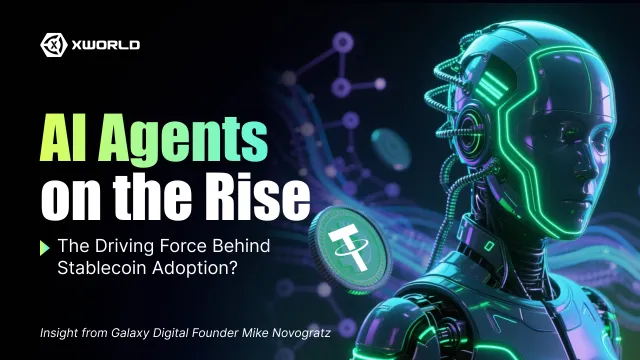
AI Agents on the Rise — The Driving Force Behind Stablecoin Adoption?
As stablecoins gain momentum in global finance, AI agents are emerging as the key force driving adoption. Galaxy Digital founder Mike Novogratz predicts that AI will soon become the largest user of stablecoins. From payments to autonomous economies, this convergence is reshaping the future of Web3. At the forefront of this shift, XWorld has already built a self-sustaining ecosystem that integrates AI agents and stablecoin-powered transactions.
Stablecoin Adoption Enters a New Era
Stablecoins, digital assets pegged to fiat currencies such as the U.S. dollar, have become the backbone of digital finance. They offer price stability, rapid settlement, and cross-chain interoperability. As of August 2025, the global stablecoin market cap has reached $280 billion, accounting for 7% of the total crypto market.
In the U.S., the GENIUS Act (Guidance and Establishment for National Innovation of U.S. Stablecoins), passed in July 2025, has provided long-awaited regulatory clarity—boosting confidence and accelerating adoption.
At the same time, the rise of AI agents is bringing new possibilities to stablecoin usage.
Adoption Signals from Industry Leaders
Tech giants like Apple, Google, Airbnb, and X (formerly Twitter) are testing stablecoin integrations to cut fees and optimize cross-border transactions.
Retail platforms such as Shopify and Spar are enabling stablecoin payments for faster, cheaper settlements.
Payment networks including Visa are expanding settlement capabilities, embedding stablecoins into the global financial infrastructure.
This mainstream adoption coincides with the emergence of AI-driven automation.
Novogratz: AI Will Become the Largest Stablecoin User
Galaxy Digital founder and CEO Mike Novogratz told Bloomberg: “In the not-so-distant future, the biggest user of stablecoins is going to be AI.”
He envisions AI agents handling everyday transactions on behalf of users:
Grocery agents that purchase food based on your diet.
Travel agents that book and pay for trips automatically.
Healthcare agents that manage insurance and prescription payments.
Coinbase developers echo this, suggesting that AI agents may become Ethereum’s largest power users, leveraging protocols like HTTP 402 for autonomous payments.
Research firm Bernstein projects the stablecoin market could reach $3 trillion by 2028, with AI adoption acting as a major driver.
XWorld: From Vision to Reality
While the industry debates the “AI + stablecoin” future, XWorld is already building it.
Launched in 2023, XWorld has grown into a self-sustaining agent economy, combining AI training, tokenized incentives, and stablecoin-based settlements. Users can create, deploy, and monetize AI agents across entertainment, gaming, and productivity—while stablecoins enable frictionless, global payments.
Key ecosystem highlights:
11M+ cumulative downloads and 1M+ MAUs on Telegram MiniApp, with 400K+ community members across platforms.
$22M+ in 2024 revenue, over 2B gameplay records, and $347M+ in token trading volume.
Popular agents include FactoryMind (+23,037% weekly gain) in smart manufacturing and NeoBody AI (+23.37%) in embodied intelligence.
Expanding use cases in healthcare AI, data analytics, and gaming, already aligning with stablecoin-backed micropayments.
These figures prove that the foundation of an autonomous agent economy is already in place.
Looking Ahead: XWorld’s Role in the AI–Stablecoin Future
Amid regulatory tailwinds and accelerating adoption, XWorld is set to lead the convergence of AI and stablecoins:
2026–2027: Achieve multi-agent intelligent collaboration and open SDKs/APIs, unlocking new income models for developers and community creators.
2028–2029: Enter the “AI-for-Everyone” era, fully launching agent creation tools and a modular marketplace for trading AI components.
2030 and beyond: Build a unified GameFi clearing system serving 500M+ users, powering metaverse economies driven by AI Agents—from autonomous driving to cosmic exploration—with stablecoins as the foundational layer for payments.
Conclusion
The convergence of AI agents and stablecoins is more than a possibility—it is already unfolding. Stablecoins are evolving from financial instruments into the currency of autonomous systems, and XWorld is at the forefront of making this transformation real.
The next chapter of Web3 will not only be decentralized but also autonomous, agent-driven, and powered by stablecoins.
🔗 Learn more and join XWorld
Website: xworlds.biz
Whitepaper: GitBook
MiniAPP: Telegram
Community: Telegram Group
Twitter: @xworld_ai
Linktree: xworld_ai
AMA Recap: "DeFAI – Revolutionizing DeFi with AI" – XWorld’s Vision for AI-Powered Gaming Economies
On May 8th, XWorld joined AKEDO, Tomo Wallet, to explore how AI is reshaping decentralized finance (DeFi) and gaming. As the world’s first AI gaming ecosystem, XWorld shared groundbreaking perspectives on agent-driven economies, user-generated content, and the future of Web3. Here are the key takeaways:
🎮 XWorld’s Mission: Where AI Meets Gaming & DeFi
XWorld opened with a bold vision:
"We’re building an open ecosystem where developers, players, and AI agents collaborate to create and monetize content. This isn’t just play-to-earn—it’s a new paradigm where AI drives value for everyone".
Why it matters:
10M+ app downloads and $2B revenue in 2024 prove demand for AI-powered gaming.
🔥 Hot Topics: AI’s Role in DeFi’s Future
1️⃣ "Will AI Define the Next DeFi Wave?"
XWorld’s Answer: "Absolutely. AI brings automation, personalization, and intelligence to rigid systems. Imagine AI agents optimizing yields, assessing risks, or personalizing DeFi interfaces—this is the future we’re building toward".
2️⃣ Key Challenges for AI in DeFi
XWorld posed a critical question to the panel:
"Is the DeFi community ready to trust AI systems?"
Consensus: Transparency and user control are essential. XWorld emphasized:
✅ Human-friendly interfaces – No 50-page whitepapers needed.
✅ Explainable AI – Users should understand how decisions are made.
✅ Community co-creation – Let users shape AI tools, fostering ownership.
"Think of it as a co-op game—AI and humans as teammates".
💡 Community Q&A: Addressing Tough Questions
Q: How does XWorld stabilize older AI agents like Aithur amid market volatility?
A: "While each agent operates independently, XWorld provides ecosystem support—expanding communities, tools, and use cases to drive long-term growth. Early adopters continue seeing rising mining rewards, and new opportunities emerge constantly".
Q: What’s next for XWorld beyond Play-to-Earn?
A: We’re evolving into a Web3 AI gaming ecosystem. Players aren’t just consumers; they’re co-creators. AI agents enable new economies where everyone shares value—whether through games, DeFi integrations, or user-generated content".
🌐 What’s Coming Next?
XWorld teased upcoming expansions:
New AI agent partnerships bridging gaming and DeFi.
Enhanced tools for developers and players to monetize creativity.
Ecosystem growth: "The future is interconnected—no more silos".
🙏 Closing Gratitude
Thank you to AKEDO for hosting, fellow panelists for their insights, and the community for engaging. Follow XWorld to join the AI gaming revolution:
Website | Whitepaper | Twitter | Telegram | Youtube | Linktree
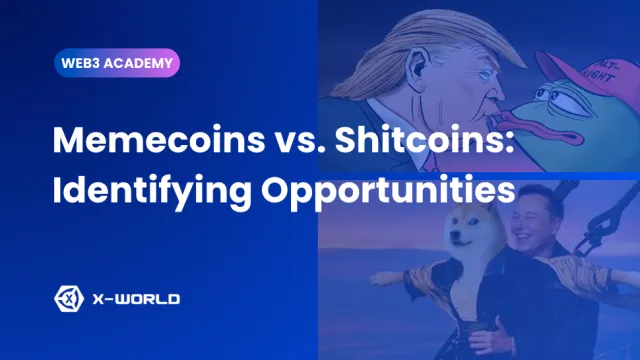
Unveiling the Crypto Craze: Meme Coins vs. Shit Coins-Understanding the Differences and Identifying Opportunities
Discover the Secrets to Navigating the Wild World of Memecoins and Shitcoins with XWORLD’s Expert Guidance
Introduction
In the ever-evolving landscape of cryptocurrencies, two terms have gained significant attention: memecoins and shitcoins. While both may sound similar, they represent distinct categories within the crypto market. Understanding the differences between memecoins and shitcoins is crucial for investors seeking to identify real opportunities.
In this guide, we will delve into the world of memecoins and shitcoins, explore their characteristics, and discover how XWORLD is helping users navigate this volatile market.
What are Memecoins: Riding the Wave of Viral Crypto Success
Memecoins are a unique breed of cryptocurrencies that gain popularity through viral memes and internet culture. They often have a humorous or satirical theme, capturing the attention of online communities. Memecoins leverage the power of social media and community engagement to drive their value. These coins have gained traction due to their ability to generate hype and create a sense of belonging among their supporters.
One notable example is Dogecoin, which started as a joke but gained immense traction, reaching a market capitalization in the billions.
DOGE’s price chart in 2018 after it first reached a $1-billion market capitalization. Source: CoinGecko
Another high-value memecoin is $PEPE, which leverages the iconic Pepe the Frog meme. These memecoins have demonstrated the potential for significant returns, attracting both investors and enthusiasts alike.
PEPE’s market capitalization reaching $1.8 billion. Source: CoinGecko
Decoding Shitcoins: Differentiating the Gems from the Junk
Shitcoins, on the other hand, refer to cryptocurrencies with little to no value or utility. They are often created with the intention of deceiving investors or capitalizing on market trends. Shitcoins lack genuine support and are driven by pump-and-dump schemes, where the creators artificially inflate the price before selling off their holdings, leaving unsuspecting investors with losses. Identifying high-value memecoins and shitcoins requires careful analysis. Factors such as project fundamentals, team credibility, community engagement, and market liquidity play a crucial role in distinguishing the gems from the junk.
According to Analytics Insight, memecoins and shitcoins share some similarities, such as their reliance on social media and community-driven value. However, the main difference lies in their underlying purpose and long-term viability. Memecoins often have a dedicated community and a clear use case, while shitcoins lack substance and are primarily driven by speculative trading.
XWORLD’s Approach: Empowering Users to Make Informed Investment Choices
In the midst of the volatile and diverse crypto market, XWORLD stands as a guiding light for investors. XWORLD provides a safe environment and expert guidance to help users identify memecoins and shitcoins with real potential.
By prioritizing security and trust, XWORLD ensures that users can explore the crypto market with confidence. XWORLD’s team of experts conducts thorough research and analysis to evaluate projects and provide valuable insights. Through comprehensive reports, market updates, and expert opinions, XWORLD equips users with the knowledge needed to make informed investment decisions.
XWORLD’s platform offers a range of features designed to assist users in navigating the crypto market. These include:
Safe Environment: XWORLD prioritizes security measures to protect users’ funds and personal information. By implementing robust security protocols, XWORLD creates a trustworthy platform for users to engage with memecoins and shitcoins.
Expert Analysis: XWORLD’s team of experienced analysts conducts in-depth research on various cryptocurrencies, including memecoins and shitcoins. Their insights help users understand the potential risks and rewards associated with different projects, enabling them to make informed investment choices.
Community Engagement: XWORLD fosters a vibrant community of crypto enthusiasts, providing a platform for users to connect, share insights, and discuss investment strategies. By tapping into the collective wisdom of the community, users can gain valuable perspectives and stay updated on the latest trends.
Finding Opportunities in the Crypto Market: Navigating the Volatility
The crypto market is known for its volatility, presenting both risks and opportunities. To capitalize on the potential of memecoins and shitcoins, investors must stay informed and adopt strategic approaches. XWORLD offers valuable strategies for identifying promising investment opportunities. By monitoring market trends, analyzing project fundamentals, and leveraging community sentiment, investors can uncover hidden gems amidst the ever-changing crypto landscape. XWORLD’s expert insights and analysis provide users with a competitive edge, helping them navigate the market with confidence.
According to Tekedia, understanding the risks associated with shitcoins and memecoins is crucial. Shitcoins often lack a solid foundation and are prone to manipulation, while memecoins can experience extreme volatility due to their reliance on social media trends. XWORLD’s guidance and analysis help users navigate these risks and identify genuine opportunities in the market.
Conclusion
As the crypto market continues to evolve, understanding the differences between memecoins and shitcoins is essential for investors seeking real opportunities. Memecoins harness the power of viral memes and internet culture, while shitcoins lack value and are often driven by deceptive practices.
XWORLD plays a vital role in helping users navigate this complex market by providing a safe environment, expert guidance, and valuable insights. By staying informed and adopting strategic approaches, investors can find opportunities amidst the volatility.
Visit XWORLD’s official website at www.xworld.pro and follow Twitter at @xworld_pro to embark on an exciting journey into the world of memecoins and shitcoins.
XWORLD, a pioneering Web3 App Store, provides a safe and trustworthy platform for users to explore a wide range of dApps and discover the treasure trove of Web3.
Join our community for more:
Website | Twitter | Instagram | Facebook |Litepaper
Enjoy Your Passionate Game Time, Every Second Becomes Your Income.