Embracing Web3: Unlocking the Future of the Internet
Introduction
In the ever-evolving landscape of the internet, a new era is dawning — Web3. This groundbreaking technology promises to revolutionize the way we interact, transact, and create value online.
In this article, we will explore what exactly Web3 is, its key differences from its predecessors, and why it is crucial for everyone to embrace it early. We will also delve into some exciting ways for ordinary internet users to get involved in Web3, including an innovative platform-XWORLD, which offers a safe and rewarding Web3 experience.
So, fasten your seatbelts and get ready to embark on a journey into the future of the internet!
Evolution from Web1 to Web3
To understand the significance of Web3, let’s first take a brief look at its predecessors. Web1, also known as the “read-only” web, was characterized by static websites and limited user interaction. Then came Web2, the era of social media, e-commerce, and user-generated content. While Web2 brought about significant advancements, it also introduced issues like data privacy concerns and centralized control. Now, Web3 emerges as the next evolutionary step, offering decentralized, trustless, and user-centric experiences.
Key Differences and Real-World Examples
Web3 stands out from its predecessors in several ways. Firstly, it leverages blockchain technology, which ensures transparency, immutability, and security. This enables peer-to-peer transactions without intermediaries, empowering individuals to have full control over their data and digital assets. Real-world examples of Web3 applications include decentralized finance (DeFi) platforms like Compound and Uniswap, where users can lend, borrow, and trade cryptocurrencies directly, without relying on traditional financial institutions.
The Unstoppable Future of Web3
Web3 is not just a passing trend; it is the future of the internet. By embracing Web3 early, individuals can position themselves at the forefront of this technological revolution. Web3 offers opportunities for financial inclusion, creative expression, and community-driven decision-making. Moreover, it challenges the existing power structures and promotes a more equitable and decentralized internet. By being an early adopter, you can shape the future and reap the benefits of this unstoppable wave.
Getting Involved in Web3
Now that you understand the importance of Web3, you might be wondering how to get started. Here are some main ways for ordinary internet users to dive into the world of Web3:
1.Educate Yourself: Familiarize yourself with the concepts of blockchain, cryptocurrencies, and decentralized applications (dApps). Explore online resources, attend webinars, and join communities to expand your knowledge.
2. Experiment with dApps: Start using decentralized applications to experience the power of Web3 firsthand.
3. Invest in Cryptocurrencies: Consider investing in cryptocurrencies like Bitcoin, Ethereum, or other promising tokens. This not only allows you to participate in the digital economy but also positions you to benefit from the potential growth of Web3.
4. Support Web3 Projects: Engage with and support Web3 projects that align with your interests and values. Contribute to open-source development, participate in governance, or become an early user of innovative platforms.
5. Experience XWORLD: Your Gateway to Web3: One platform that stands out in the Web3 landscape is XWORLD. It offers a pioneering, safe, and trustable Web3 App Store, providing users with a seamless and rewarding Web3 experience. XWORLD rewards users’ time and attention with high-value assets like Bitcoin, creating an ecosystem where users are incentivized to explore and engage with Web3 applications.
Visit the XWORLD website (www.xworld.pro) and follow Twitter (https://twitter.com/xworld_pro) to learn more about this exciting platform and embark on your Web3 journey today!
Conclusion
Web3 is not just a buzzword; it represents a paradigm shift in how we interact with the internet. By embracing Web3 early, ordinary internet users can become active participants in shaping the future of the digital world. Whether it’s exploring decentralized finance, investing in cryptocurrencies, or supporting Web3 projects, there are numerous ways to get involved.
References
What Is Web3?
What is web3? (Published 2022)
Web3 - Wikipedia
What Is Web3?
XWORLD, a pioneering Web3 App Store, provides a safe and trustworthy platform for users to explore a wide range of dApps and discover the treasure trove of Web3.
So, don’t wait any longer — join the Web3 revolution and unlock the limitless possibilities of the internet’s future!
If you’re an Internet user interested in the future of Information Tech, follow XWORLD on Twitter at https://twitter.com/xworld_pro to stay updated on the latest developments in Web3 games, NFTs, and tokenomics.
Download: https://play.google.com/store/apps/details?id=pro.xworld.app
Join our community for more:
Website | Twitter | Instagram | Facebook |Litepaper
Enjoy Your Passionate Game Time, Every Second Becomes Your Income.
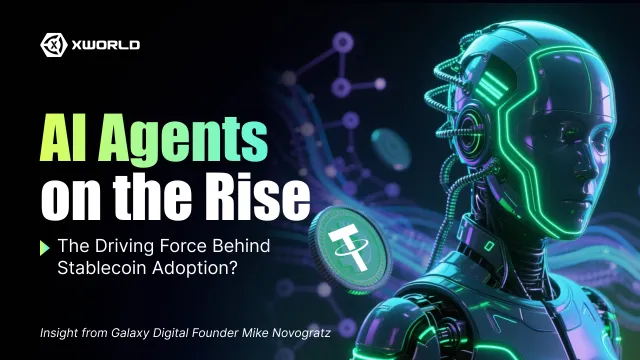
AI Agents on the Rise — The Driving Force Behind Stablecoin Adoption?
As stablecoins gain momentum in global finance, AI agents are emerging as the key force driving adoption. Galaxy Digital founder Mike Novogratz predicts that AI will soon become the largest user of stablecoins. From payments to autonomous economies, this convergence is reshaping the future of Web3. At the forefront of this shift, XWorld has already built a self-sustaining ecosystem that integrates AI agents and stablecoin-powered transactions.
Stablecoin Adoption Enters a New Era
Stablecoins, digital assets pegged to fiat currencies such as the U.S. dollar, have become the backbone of digital finance. They offer price stability, rapid settlement, and cross-chain interoperability. As of August 2025, the global stablecoin market cap has reached $280 billion, accounting for 7% of the total crypto market.
In the U.S., the GENIUS Act (Guidance and Establishment for National Innovation of U.S. Stablecoins), passed in July 2025, has provided long-awaited regulatory clarity—boosting confidence and accelerating adoption.
At the same time, the rise of AI agents is bringing new possibilities to stablecoin usage.
Adoption Signals from Industry Leaders
Tech giants like Apple, Google, Airbnb, and X (formerly Twitter) are testing stablecoin integrations to cut fees and optimize cross-border transactions.
Retail platforms such as Shopify and Spar are enabling stablecoin payments for faster, cheaper settlements.
Payment networks including Visa are expanding settlement capabilities, embedding stablecoins into the global financial infrastructure.
This mainstream adoption coincides with the emergence of AI-driven automation.
Novogratz: AI Will Become the Largest Stablecoin User
Galaxy Digital founder and CEO Mike Novogratz told Bloomberg: “In the not-so-distant future, the biggest user of stablecoins is going to be AI.”
He envisions AI agents handling everyday transactions on behalf of users:
Grocery agents that purchase food based on your diet.
Travel agents that book and pay for trips automatically.
Healthcare agents that manage insurance and prescription payments.
Coinbase developers echo this, suggesting that AI agents may become Ethereum’s largest power users, leveraging protocols like HTTP 402 for autonomous payments.
Research firm Bernstein projects the stablecoin market could reach $3 trillion by 2028, with AI adoption acting as a major driver.
XWorld: From Vision to Reality
While the industry debates the “AI + stablecoin” future, XWorld is already building it.
Launched in 2023, XWorld has grown into a self-sustaining agent economy, combining AI training, tokenized incentives, and stablecoin-based settlements. Users can create, deploy, and monetize AI agents across entertainment, gaming, and productivity—while stablecoins enable frictionless, global payments.
Key ecosystem highlights:
11M+ cumulative downloads and 1M+ MAUs on Telegram MiniApp, with 400K+ community members across platforms.
$22M+ in 2024 revenue, over 2B gameplay records, and $347M+ in token trading volume.
Popular agents include FactoryMind (+23,037% weekly gain) in smart manufacturing and NeoBody AI (+23.37%) in embodied intelligence.
Expanding use cases in healthcare AI, data analytics, and gaming, already aligning with stablecoin-backed micropayments.
These figures prove that the foundation of an autonomous agent economy is already in place.
Looking Ahead: XWorld’s Role in the AI–Stablecoin Future
Amid regulatory tailwinds and accelerating adoption, XWorld is set to lead the convergence of AI and stablecoins:
2026–2027: Achieve multi-agent intelligent collaboration and open SDKs/APIs, unlocking new income models for developers and community creators.
2028–2029: Enter the “AI-for-Everyone” era, fully launching agent creation tools and a modular marketplace for trading AI components.
2030 and beyond: Build a unified GameFi clearing system serving 500M+ users, powering metaverse economies driven by AI Agents—from autonomous driving to cosmic exploration—with stablecoins as the foundational layer for payments.
Conclusion
The convergence of AI agents and stablecoins is more than a possibility—it is already unfolding. Stablecoins are evolving from financial instruments into the currency of autonomous systems, and XWorld is at the forefront of making this transformation real.
The next chapter of Web3 will not only be decentralized but also autonomous, agent-driven, and powered by stablecoins.
🔗 Learn more and join XWorld
Website: xworlds.biz
Whitepaper: GitBook
MiniAPP: Telegram
Community: Telegram Group
Twitter: @xworld_ai
Linktree: xworld_ai
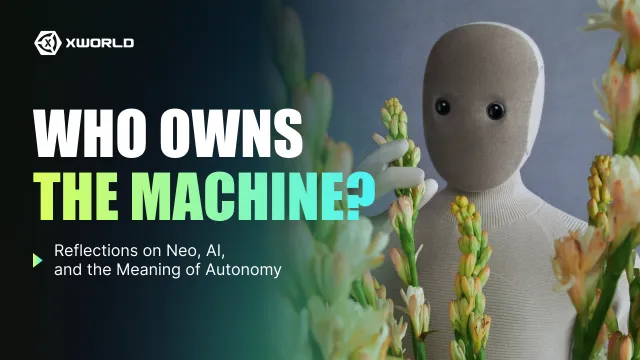
Who Owns the Machine? Reflections on Neo, AI, and the Meaning of Autonomy
At the end of October 2025, 1X Technologies' humanoid robot Neo swept through the tech world like a heatwave. This sleek robot, backed by OpenAI, is touted as the first truly home-friendly physical assistant.
Priced at around $20,000 or $499 per month for leasing, Neo can clean, carry items, and even learn new tasks through imitation. In just a few days, it became the internet's focal point — seemingly, a tireless family companion has finally arrived.
Yet, behind the cheers, a profound reflection on "autonomy" quietly unfolds. Remote control offers the illusion of convenience, but it exposes a core pain point in the AI industry: human operators still lurk in the shadows, and what happens to your privacy data?
As Curious CEO David Tomasian puts it:
"True autonomy is the only way machines can belong to us."
An Illusion: The Myth of Humanoid Robot "Autonomy"
Neo's launch is indeed exhilarating: standing 5 feet 6 inches tall and weighing 66 pounds, it uses tendon-driven actuators mimicking human muscles, wrapped in a soft shell for safety. Hugging Face co-founder Thomas Wolf exclaimed on X that Neo has "advanced" his timeline for home robot adoption.
In demos, Neo waters plants, opens doors, washes clothes, and scrubs dishes, turning mundane chores into something poetic and efficient.
But this excitement was quickly doused by reality. The Wall Street Journal's hands-on report reveals that many of Neo's movements are still remotely controlled in real time by "experts" via VR.
This isn't sci-fi — it's the current state of AI, where remote piloting aids companies in training models through imitation and reinforcement learning, yet reduces the robot from "independent helper" to "human extension."
Tomasian sharply notes that under this model, your "private robot" isn't truly private: it not only observes your life but uploads data to the cloud, fueling the manufacturer's training.
When a robot can "see" your home layout, recognize your voice, and analyze your habits — yet remains tethered to the manufacturer's servers — who does it really belong to?
From Factory to Home: The Privacy Cost Beneath Autonomy
The wave of humanoid robots is flowing from factories to living rooms. Figure AI's Figure 02 and Tesla's Optimus aim to reshape industry, while Neo pushes the vision into consumer territory — not just productivity, but companionship itself.
This trend is especially urgent in elderly care. Pilot projects in Japan, Korea, and parts of Europe are testing robots for assisting daily activities, monitoring health, and providing emotional support. But Tomasian points out: "The difference between aid and true care lies in understanding context and emotion." If data isn't encrypted and stored locally, "the robot isn't yours—it's someone else's lens."
Privacy expert Kohei Kurihara disclosed on X that Neo users must sign a waiver allowing manufacturers access to certain operational data. This "tech-for-convenience" pact hides cracks in trust. A Medium article bluntly states that this $20,000 robot "needs a human babysitter", with complex tasks requiring an appointment for "expert mode," making users feel like they're renting a "surveilled puppet."
Tomasian emphasizes that for embodied intelligence to evolve like language models, three things are essential: on-device reasoning, multimodal understanding, and encrypted autonomy. AI must not just execute commands but comprehend "why" they are given, ensuring data sovereignty belongs to the user. True care reliability stems from security and privacy, not algorithmic complexity. In other words, autonomy isn't just a technical issue — it's a social contract: Machines should embody trust, not extend surveillance.
From Embodied to Digital: AI Agents' Lessons on Autonomy
Neo's controversy reflects a deeper trend: "Autonomy" isn't confined to mechanical limbs — it's also about digital intelligence. Rather than teaching robots in your living room how to wash dishes, why not have agents on the network learn to "act on your behalf"?
AI Agents are the extension of this direction. They're not humanoid replicas but digital extensions of human will — capable of executing tasks, making decisions, and completing transactions on behalf of users, with data ownership retained by the individual.
IBM's "2025 AI Agent Report" states that Agentic AI promises an 8x productivity boost, hinging on autonomous reasoning combined with privacy protection.
Google Cloud research shows 52% of enterprises using generative AI have deployed AI Agents.
Deloitte predicts half of companies will enable Agentic AI by 2027.
Gartner forecasts that within four years, agents will autonomously handle 15% of daily decisions.
This shift redefines "autonomy": no longer machines mimicking human limbs, but agents learning to represent human intent.
XWorld: A Real-World Experiment in "Machines Belonging to People"
Amid this trend, the XWorld platform's explorations stand out. Since its 2023 launch, it has built a self-sustaining "agent economy" by combining AI training with token incentives: users can create, deploy, and monetize their own AI Agents. The integration of stablecoins makes settlements lower-friction, ensuring value flows under user control.
Today, XWorld boasts over 11 million downloads and 1 million monthly actives in its Telegram MiniApp ecosystem, with cumulative token trading volume exceeding $34.7 million.
Here, autonomy is no illusion — it's a reality co-built by users, developers, and agents: machines not only execute instructions but become "intelligence we own."
Epilogue: Who Truly Owns the Machines?
Neo reminds us: when "autonomy" becomes a selling point, oversight and trust must evolve in tandem.
The future shown by the AI Agent industry offers another possibility:
Machines are no longer just used, but truly "owned";
They no longer serve the network, but human will and data sovereignty.
XWorld's experiment may provide the answer: when "agent autonomy" merges with "user ownership," machines finally begin to belong to us.
In the future, when robots no longer need human eyes, that may be humanity's true liberation.
🔗 Learn more and join XWorld
Website | Whitepaper | Twitter | Telegram | Youtube | Linktree