
XWorld:A new generation of ad distribution platform
HOME
ENGLISH
language switcher icon
Slide 1 of 3
August 1, 2023

50+ Web3 and Blockchain Keywords Explained

Web3.0: Web3.0, also known as Web3, refers to the next generation of the internet that incorporates decentralized technologies such as blockchain, cryptocurrencies, and peer-to-peer networks. Web3.0 aims to empower users with more control over their data, privacy, and online interactions. It envisions a more open, transparent, and user-centric internet. Decentralization: Decentralization refers to the distribution of control and decision-making across a network, rather than being held by a central authority. In the context of Web3 and blockchain, decentralization is a key principle that aims to eliminate the need for intermediaries and allows participants to have more control over their data and transactions. Smart Contract: A smart contract is a self-executing contract with the terms of the agreement directly written into code. Smart contracts are deployed on blockchain platforms and automatically execute predefined actions when certain conditions are met. They enable trustless and transparent interactions between parties. Decentralized Finance (DeFi): Decentralized Finance (DeFi) refers to the use of blockchain technology and smart contracts to recreate traditional financial systems in a decentralized manner. DeFi aims to provide financial services such as lending, borrowing, and trading without the need for intermediaries like banks. It enables greater accessibility and transparency in financial transactions. Non-Fungible Token (NFT): A Non-Fungible Token (NFT) is a unique digital asset that represents ownership or proof of authenticity of a specific item or piece of content. NFTs have gained popularity in the art and collectibles space. Each NFT has a unique identifier and cannot be exchanged on a one-to-one basis like cryptocurrencies. Interoperability: Interoperability refers to the ability of different blockchain networks or systems to communicate and interact with each other seamlessly. It is important for enabling data and asset transfer between different blockchains and ensuring compatibility between various chains. Consensus Mechanism: A consensus mechanism is a protocol or algorithm used to achieve agreement among participants in a distributed network. Consensus mechanisms ensure that all nodes in a blockchain network agree on the validity of transactions and the order in which they are added to the blockchain. Examples include Proof of Work (PoW) and Proof of Stake (PoS). Proof of Work (PoW): Consensus mechanism where miners solve complex puzzles to validate transactions, ensuring security and immutability by making tampering computationally expensive. Proof of Stake (PoS): Consensus mechanism where validators create blocks based on staked cryptocurrency, promoting energy efficiency, scalability, and faster block validation without intensive computational puzzles. Distributed Ledger Technology (DLT): Distributed Ledger Technology (DLT) is a broader term that encompasses blockchain technology. It refers to a decentralized and distributed database that records and stores transactions across multiple nodes or computers. Blockchain is a specific type of DLT. Cryptocurrency: Cryptocurrency is a digital or virtual form of currency that uses cryptography for security. It operates on decentralized networks, typically based on blockchain technology. Examples of cryptocurrencies include Bitcoin (BTC) and Ethereum (ETH). Gas: Gas refers to the unit of measurement for the computational effort required to execute transactions or smart contracts on the Ethereum blockchain. Gas is paid in Ether (ETH) and helps prevent spam and abuse by requiring users to pay for the computational resources they consume. Oracles: Oracles are services or mechanisms that provide external data to smart contracts on the blockchain. They act as bridges between the blockchain and the real world, enabling smart contracts to interact with off-chain data sources, such as APIs, to make informed decisions and trigger actions based on real-time information. Cross-Chain: Cross-chain refers to the ability to transfer assets or data between different blockchain networks. It involves interoperability and allows users to move assets seamlessly across different blockchains, facilitating increased liquidity and expanding the possibilities for decentralized applications. Decentralized Autonomous Organization (DAO): A Decentralized Autonomous Organization (DAO) is an organization that operates through smart contracts on a blockchain. It is governed by a set of predefined rules and decisions are made through voting by token holders. DAOs aim to eliminate the need for traditional hierarchical structures and allow for decentralized decision-making. Layer 2 Scaling: Layer 2 scaling solutions are techniques or protocols built on top of existing blockchains to improve scalability and increase transaction throughput. They aim to handle a larger number of transactions off-chain or in a more efficient manner, reducing congestion and lowering transaction costs. Examples of layer 2 scaling solutions include state channels and sidechains. Decentralized Autonomous Organization (DAO): A Decentralized Autonomous Organization (DAO) is an organization that operates through smart contracts on a blockchain. It is governed by a set of predefined rules and decisions are made through voting by token holders. DAOs aim to eliminate the need for traditional hierarchical structures and allow for decentralized decision-making. Layer 2 Scaling: Layer 2 scaling solutions are techniques or protocols built on top of existing blockchains to improve scalability and increase transaction throughput. They aim to handle a larger number of transactions off-chain or in a more efficient manner, reducing congestion and lowering transaction costs. Examples of layer 2 scaling solutions include state channels and sidechains. Permissionless: Permissionless refers to the openness and accessibility of a blockchain network or protocol. In a permissionless network, anyone can participate, validate transactions, and contribute to the network without requiring explicit permission. This characteristic is a fundamental aspect of many blockchain networks, enabling anyone to join and interact with the network without needing approval from a central authority. Hard Fork: A hard fork is a type of upgrade or change to a blockchain protocol that is not backward compatible with older versions. It requires all participants in the network to upgrade to the new version in order to continue participating. Hard forks can result in a split in the blockchain, creating two separate chains with different rules and potentially leading to the creation of a new cryptocurrency. Halving: Halving is an event that occurs in some cryptocurrencies, such as Bitcoin, where the block reward for miners is reduced by half after a certain number of blocks are mined. This event is programmed into the cryptocurrency’s protocol and is designed to control the issuance of new coins and create scarcity over time. Hashing Algorithm: Hashing is a process used in computing to generate a unique and fixed-size string of characters (hash) from input data of any size. In the context of blockchain, hashing is used to create a digital fingerprint of data, such as transactions or blocks, ensuring their integrity and allowing for easy verification. Hashes are used to confirm the completeness and validity of blockchain transactions. Censorship Resistance: Censorship resistance refers to the ability of a system or platform to resist censorship or control by centralized authorities. In Web3, blockchain-based platforms provide censorship resistance by decentralizing control and allowing users to have ownership and control over their data and transactions. This enables freedom of expression and protects against arbitrary censorship or manipulation. Decentralized Exchange (DEX): A decentralized exchange is a type of cryptocurrency exchange that operates on a blockchain network without the need for intermediaries or a central authority. DEXs allow users to trade cryptocurrencies directly with each other, using smart contracts for order matching and execution. They provide increased privacy, security, and control over assets compared to centralized exchanges. Immutable Ledger: An immutable ledger refers to a blockchain’s characteristic of being tamper-resistant and unchangeable once data is added to it. Once a transaction or data is recorded on the blockchain, it becomes part of a permanent and transparent history that cannot be altered or deleted. This property ensures the integrity and trustworthiness of the data stored on the blockchain. Decentralized Exchange (DEX): A decentralized exchange is a type of cryptocurrency exchange that operates on a blockchain network without the need for intermediaries or a central authority. DEXs allow users to trade cryptocurrencies directly with each other, using smart contracts for order matching and execution. They provide increased privacy, security, and control over assets compared to centralized exchanges. Token Standards: Token standards are specific protocols or sets of rules that define the functionality and behavior of tokens on a blockchain. Examples of token standards include ERC-20 for fungible tokens, ERC-721 for non-fungible tokens (NFTs), and ERC-1155 for multi-token standards. Token standards ensure interoperability and compatibility between different tokens and enable developers to build applications that interact with tokens in a standardized way. Decentralized File Storage: Decentralized file storage refers to the storage of data on a distributed network of nodes, rather than relying on a centralized server or provider. Blockchain-based decentralized file storage systems, such as IPFS (InterPlanetary File System) or Filecoin, allow users to store and retrieve data in a secure, distributed, and censorship-resistant manner. Tokenomics: Tokenomics refers to the economic design and structure of a cryptocurrency or token ecosystem. It encompasses factors such as token supply, distribution, utility, governance mechanisms, and incentives. Tokenomics aims to create a sustainable and balanced ecosystem that aligns the interests of token holders, users, and other stakeholders in the network. Zero-knowledge proofs (ZKPs): ZKPs are cryptographic protocols that allow one party (the prover) to prove the knowledge of a certain piece of information to another party (the verifier) without revealing the actual information itself. The goal of zero-knowledge proofs is to convince the verifier of the truthfulness of a statement without disclosing any additional information beyond the validity of the statement. Ethereum: Ethereum is an open-source, blockchain-based platform that enables developers to build and deploy decentralized applications (dApps). It was proposed by Vitalik Buterin in late 2013 and development was crowdfunded in 2014. Ethereum’s blockchain is fundamentally different from Bitcoin’s blockchain. While Bitcoin’s blockchain is used to track ownership of digital currency (bitcoins), the Ethereum blockchain focuses on running programming code of any decentralized application Bitcoin: Bitcoin, often described as a cryptocurrency, a virtual currency or a digital currency, is a type of money that is completely virtual. It’s like an online version of cash. You can use it to buy products and services, but not many shops accept Bitcoin yet and some countries have banned it altogether. Bitcoin was the first cryptocurrency and remains the most important in the market. It was invented in 2008 by an unknown person or group of people using the name Satoshi Nakamoto. ICO: ICO stands for Initial Coin Offering and it’s often used as a fundraiser for new projects. This is where a company looking to raise money to create a new coin, app, or service launches an ICO as a way to raise funds. People who buy into the ICO receive a certain number of tokens in return. ICOs are often compared to IPOs (Initial Public Offerings), but there are some significant differences Public Key: In the world of cryptocurrencies, a public key represents a point on a particular Elliptic Curve (EC) defined in secp256k1. Public keys contain an identification byte, a 32-byte X coordinate, and a 32-byte Y coordinate. They are used in Bitcoin and other cryptocurrencies for generating addresses where funds can be seen Private Key: In cryptocurrencies, a private key allows a user to gain full access to their wallet. The person who holds the private key fully controls the coins in that wallet. For this reason, it should be kept secret. Formally, a private key for Bitcoin (and many other cryptocurrencies) is a series of 32 bytes Stablecoin: Stablecoins are a type of cryptocurrency designed to minimize volatility, a common issue with cryptocurrencies like Bitcoin. They achieve this stability by pegging their market value to an external reference, usually a fiat currency like the US dollar, or a commodity like gold. Some stablecoins maintain reserve assets as collateral, while others use algorithmic formulas to control supply. The primary purpose of stablecoins is to provide a more suitable option for common transactions. Altcoin: The term altcoin refers to all cryptocurrencies other than Bitcoin and, for some, Ethereum. These alternative cryptocurrencies come in various types, each designed for different purposes. While the future value of altcoins is unpredictable, as long as the blockchain they were designed for continues to be used and developed, the altcoins will continue to exist. It’s important to note that while many altcoins offer potential investment opportunities, some are scams or have lost developer and community interest Mainnet: It refers to the main blockchain network of a cryptocurrency, where real transactions and operations take place. It is the live and production-ready network where actual value is exchanged. Mainnet is typically used for real-world applications, and transactions on the mainnet involve real cryptocurrencies. Testnet: on the other hand, is a separate network specifically designed for testing and development purposes. It mimics the functionalities of the mainnet but uses test tokens or simulated cryptocurrencies that have no real-world value. Testnets allow developers and users to experiment, validate, and debug their applications without risking real funds. It provides a safe environment for testing new features, smart contracts, and conducting simulations before deploying on the mainnet. Testnets are crucial for ensuring the reliability and security of applications before they are deployed to the production-ready mainnet. Remix IDE: is an online development environment for writing, testing, and deploying smart contracts on the Ethereum blockchain. It provides a user-friendly interface with a built-in code editor, compiler, debugger, and deployment tools. Remix IDE allows developers to write Solidity smart contracts, interact with contracts using a web3 provider, and test their code using various tools and plugins. It is a popular choice for Ethereum developers due to its simplicity and comprehensive features. Infura/Alchemy: It is a popular service that provides infrastructure and API endpoints for connecting to the Ethereum blockchain. It acts as a web3 provider, allowing developers to interact with the Ethereum network without running a full Ethereum node. Infura simplifies the development process by providing reliable and scalable access to the Ethereum blockchain, eliminating the need for developers to set up and maintain their own infrastructure. It offers various API endpoints, including JSON-RPC and WebSocket, which developers can use to send transactions, retrieve data, and interact with smart contracts. Infura is widely used by developers to integrate Ethereum functionality into their applications and services. Mining: Mining is the process of validating and adding new transactions to a blockchain. It involves solving complex mathematical puzzles to find a new block, which contains a set of transactions. Miners compete with each other to solve these puzzles by using computational power, and the first miner to find the solution gets rewarded with newly minted cryptocurrency tokens. Mining ensures the security, integrity, and decentralization of a blockchain network by preventing double-spending and maintaining consensus among participants. Tokenization: Tokenization is the process of representing real-world assets or rights as digital tokens on a blockchain. It allows for fractional ownership, increased liquidity, and easier transfer of assets. Tokenization has applications in areas such as real estate, art, and finance. Immutable: Immutable means that something is unchangeable or cannot be altered or tampered with. In the context of blockchain, immutability refers to the property of data stored on the blockchain that cannot be modified once it is added to the chain. This ensures the integrity and trustworthiness of the data. Merkle Tree: A hierarchical data structure that enables efficient verification and integrity checks of large datasets. It uses cryptographic hashing to create a tree structure where each node represents the hash of its child nodes, providing an efficient way to verify the integrity of specific data without needing to examine the entire dataset. Byzantine Fault Tolerance: The ability of a distributed system to reach a consensus even in the presence of malicious or faulty nodes. It ensures system resilience by employing redundancy, replication, and consensus algorithms to tolerate failures and prevent malicious actors from compromising the integrity and reliability of the system. ICO (Initial Coin Offering): A fundraising method used by cryptocurrency projects to raise capital. It involves issuing and selling tokens to investors in exchange for cryptocurrencies or fiat currencies, providing early access to the project’s tokens and potential returns on investment. Whitepaper: A detailed document that outlines the concept, technology, goals, and implementation plan of a cryptocurrency project. It provides an in-depth analysis of the project’s vision, technical specifications, tokenomics, and potential impact, serving as a comprehensive guide for investors and stakeholders. Yellowpaper: Similar to a whitepaper, a yellowpaper is a technical document that provides a deeper technical understanding of a cryptocurrency project. It typically delves into the underlying protocols, algorithms, and technical intricacies of the project, providing detailed explanations and specifications for developers and researchers. Fork: A divergence in the blockchain where a single chain splits into two separate chains, resulting in two different versions of the blockchain. Soft Fork: A backward-compatible upgrade to the blockchain protocol where the new rules are more restrictive than the old rules, allowing the new blocks to be accepted by both old and new nodes. Hard Fork: A non-backward-compatible upgrade to the blockchain protocol where the new rules are more permissive than the old rules, resulting in a permanent divergence in the blockchain and two separate chains that are incompatible with each other. XWORLD, a pioneering Web3 App Store, provides a safe and trustworthy platform for users to explore a wide range of dApps and discover the treasure trove of Web3. Visit the XWORLD website (www.xworld.pro) and follow Twitter (https://twitter.com/xworld_pro) to learn more about this exciting platform and embark on your Web3 journey today! Join our community for more: Website | Twitter | Instagram | Facebook |Litepaper Enjoy Your Passionate Game Time, Every Second Becomes Your Income.
Read More
50+ Web3 and Blockchain Keywords Explained
November 9, 2023

SATS rose 250% in two days, what happened to the BRC-20 market?

🚀 XWORLD, the game-changing Web3 App Store & top BRC20 token $SATS, are ready to take the next big leap! 🚀 Join the Quest Treasure Hunt NOW and embark on an epic adventure to hunt for the 1.5 billion $SATS !!!! https://xworld.store/en-US/quest Recently, the BRC-20 token sats has continued to rise. Coingecko data shows that in the past half month, the price of sats has been hovering around 0.00000002 USDT for a long time. In the past two days, the price has climbed rapidly, reaching a maximum of 0.00000007 USDT, with a maximum increase of nearly 250%. What has happened in the BRC-20 market recently? Meme coins that Impossible to mint When it comes to sats, the biggest impression people have on it is its extremely large supply. The total supply of sats is 2,100,000,000,000,000, which is 2,100 trillion, which is 100 million times that of Bitcoin. Therefore, at the beginning of its launch, many users did not believe that this BRC-20 token would eventually be fully minted. But the enthusiasm of users is powerful, and sats, a meme named after Satoshi Nakamoto, was eventually fully minted. On September 24, the casting progress of sats reached 100%, with the total number of castings reaching 21,107,258 times and 36,061 holders. The casting started on March 9, 2023 and took a total of 6 months. Judging from the number of participants, there are enough sats, which to a certain extent represents sufficient "decentralization". Moreover, the token name itself is an "innate advantage", which also gives sats a certain advantage in the competition on the meme track. Meme coins turned into utility tokens As the scale of the sats community expands, UniSat, the largest wallet developer in the BRC 20 ecosystem, has also taken a fancy to this "hot potato". The UniSat team is trying to empower sats and increase application scenarios. (note: UniSat Wallet is a Chrome plug-in wallet for the BTC ecosystem, helping users store, mint and transfer BRC-20 tokens, including buying and selling BTC, NFT, domain names, etc.) The story of Meme coin "empowerment" is not the first time it has happened in the crypto world. Previously, DOGE and SHIB had once triggered heated discussions in the market for "issuing chains". The story this time comes from the fee consumption of swap. In UniSat's latest brc20-swap, sats will be charged as a handling fee, which will cause users to consume a lot of sats. UniSatWallet stated that brc20-swap will charge a 0.3% service fee to all users participating in the transaction. About 1/6 (0.05%) of this fee is collected by UniSat, and the remaining 5/6 (0.25%) is allocated to each trading pair. All liquidity providers. This fee structure is primarily based on the rate scale currently used by UniSwap. Regarding the use of handling fees, UniSat will donate 2% of its income to L1F (Layer1Foundation). In addition, UniSat will open the fully interpreted and verified source code of brc20-swap to facilitate early support of the indexer. At present, the brc-20 protocol and even the entire Ordinals ecosystem are still in their early stages, and UniSat occupies a huge market share and influence. Sats is favored by UniSat and provides itself with great positive expectations. OKX data shows that sats generated approximately US$2 million in trading volume in the past 24 hours. BRC20-swap went online with twists and turns Previously, due to the "original" user experience and poor liquidity, brc-20 tokens still belonged to the "small circle" niche track, and the lack of infrastructure made it difficult for EVM whales to enter. The opening of UniSat's brc20-swap has opened a channel for more users to enter the Bitcoin ecosystem and trade BRC-20 tokens. The launch of this product has also experienced some setbacks. On September 27, UniSat Wallet announced the launch of the brc 20-swap testnet, where users can mint BRC-20 tokens, deposit, trade and increase liquidity on its testnet. On October 10, UniSatWallet announced the release schedule of the brc20-swap mainnet, which is planned to be launched on October 25. On October 22, UniSat itself encountered technical difficulties. Some users discovered that different markets are using different versions of ord, which index different inscription numbers. Before MagicEden, OKX and UniSat Wallet all used the same ordinal number, there was a risk of double spending when trading BRC-20. UniSat later issued a response on . We are monitoring the work of contributors and indexers and will promptly notify our users." On the same day, Magic Eden suspended BRC-20 trading. On October 25, the original scheduled mainnet launch time for brc20-swap has arrived. However, UniSat delayed the launch of the product and postponed its mainnet launch to October 31. At the same time, it stated that during the initial mainnet launch, the team will continue to distribute Prime Access for free; as more users join, the team The performance of the system will be closely monitored and any issues that may arise promptly addressed; after a series of iterations, all features will eventually be made available to all users. On November 1, Beijing time, the brc 20-swap mainnet was officially launched. However, unlike common "permission-free" DEXs, brc20-swap still requires a certain "permission" before trading can be started. Among the first batch of online assets, UniSat has included 14 inscription assets in the first batch of support lists for the brc20-swap mainnet, namely: sats, ordi, trac, oshi, btcs, oxbt, texo, cncl, meme, honk, .bit, vmpx, pepe, mxrc. Specifically, asset open trading adopts an "on-demand transaction" model: only when a new user deposits relevant assets into brc20-swap, the withdrawal request can be used. It seems too early to draw a conclusion on how far the BRC-20 ecology can go. It might as well let the bullets fly for a while and wait for development. XWORLD — Pioneering Web3 Games & Apps Store. Earn Profits & Assets From Your App Usage Time Website | Litepaper | Telegram | Discord | Facebook | X ( Formerly Twitter)
Read More
SATS rose 250% in two days, what happened to the BRC-20 market?
January 17, 2025

Web3 Revolution: How XWorld is Leading the Movement

The internet as we know it is undergoing a seismic transformation, with Web3 at the helm. This next-generation digital frontier is not just about decentralization - it's about empowerment, ownership, and redefining value. Amid this global shift, XWorld emerges as a trailblazer, pioneering a future where users and creators thrive together in an ecosystem driven by innovation and collaboration. The XWorld Vision: A New Paradigm for Web3 Engagement At the heart of XWorld lies a groundbreaking philosophy: a decentralized platform that aligns the interests of developers, users, and advertisers. Unlike traditional platforms where revenue flows one way - toward corporations - XWorld flips the script, enabling both creators and users to share in the value they create. Enter Connect to AD3.0, XWorld’s revolutionary engagement model: For Users: Interact with games, apps, and ads to earn rewards. No subscriptions. No paywalls. Just real, tangible value for your participation. For Developers: Monetize content more sustainably while enjoying heightened user engagement and retention. This ecosystem redefines monetization in a way that’s inclusive, scalable, and sustainable - a blueprint for the Web3 economy. NFTs: The Cornerstone of Digital Ownership Digital ownership is more than a buzzword at XWorld; it’s the foundation of its ecosystem. Central to this is X Sprite, a flagship NFT designed to deliver both active and passive income daily. But it doesn’t stop there: Use X Sprite to access profit-sharing opportunities, complete game quests, or earn investment returns. Complement your strategy with a free NFT, Pet, which boosts your rewards by up to 100% - with zero upfront cost. Together, these NFTs ensure every user, from casual participants to seasoned investors, can unlock the full earning potential of XWorld’s ecosystem. Breaking Barriers in Ads, Games, and Apps XWorld’s Connect to AD3.0 model is a game-changer for Web3 monetization: Developers win big: Over 5,000 projects and 5,100+ KOLs have partnered with XWorld, leveraging its tools to monetize content effectively and retain users. Users thrive: To date, XWorld has distributed $4.8 million in ad revenue directly to users, transforming them from passive viewers into active stakeholders. With $34 million in token trading volume and a growing community of over 11.5 million users, XWorld is setting a new benchmark for decentralized platforms operating at scale. Why XWorld is the Future of Digital Engagement Web3 is about reclaiming ownership, but XWorld takes it a step further by making participation rewarding, accessible, and impactful. Here’s how you can join this movement: Engage with ads that respect your value. Own your gaming journey, from quests to rewards. Unlock rewards for app usage - because your time and attention matter. Join the XWorld Revolution The digital future is being written today, and you can be part of it. Visit XWorld to start earning, creating, and thriving in a decentralized ecosystem. Stay inspired by following XWorld on Twitter. Welcome to XWorld - where every interaction fuels innovation, every connection creates value, and every user plays a vital role in shaping the future. Website | Twitter | Facebook | Telegram | Discord Unlock AD 3.0 – Profit from your influence, time, and online activities!
Read More
Web3 Revolution: How XWorld is Leading the Movement
August 1, 2023

50+ Web3 and Blockchain Keywords Explained

Web3.0: Web3.0, also known as Web3, refers to the next generation of the internet that incorporates decentralized technologies such as blockchain, cryptocurrencies, and peer-to-peer networks. Web3.0 aims to empower users with more control over their data, privacy, and online interactions. It envisions a more open, transparent, and user-centric internet. Decentralization: Decentralization refers to the distribution of control and decision-making across a network, rather than being held by a central authority. In the context of Web3 and blockchain, decentralization is a key principle that aims to eliminate the need for intermediaries and allows participants to have more control over their data and transactions. Smart Contract: A smart contract is a self-executing contract with the terms of the agreement directly written into code. Smart contracts are deployed on blockchain platforms and automatically execute predefined actions when certain conditions are met. They enable trustless and transparent interactions between parties. Decentralized Finance (DeFi): Decentralized Finance (DeFi) refers to the use of blockchain technology and smart contracts to recreate traditional financial systems in a decentralized manner. DeFi aims to provide financial services such as lending, borrowing, and trading without the need for intermediaries like banks. It enables greater accessibility and transparency in financial transactions. Non-Fungible Token (NFT): A Non-Fungible Token (NFT) is a unique digital asset that represents ownership or proof of authenticity of a specific item or piece of content. NFTs have gained popularity in the art and collectibles space. Each NFT has a unique identifier and cannot be exchanged on a one-to-one basis like cryptocurrencies. Interoperability: Interoperability refers to the ability of different blockchain networks or systems to communicate and interact with each other seamlessly. It is important for enabling data and asset transfer between different blockchains and ensuring compatibility between various chains. Consensus Mechanism: A consensus mechanism is a protocol or algorithm used to achieve agreement among participants in a distributed network. Consensus mechanisms ensure that all nodes in a blockchain network agree on the validity of transactions and the order in which they are added to the blockchain. Examples include Proof of Work (PoW) and Proof of Stake (PoS). Proof of Work (PoW): Consensus mechanism where miners solve complex puzzles to validate transactions, ensuring security and immutability by making tampering computationally expensive. Proof of Stake (PoS): Consensus mechanism where validators create blocks based on staked cryptocurrency, promoting energy efficiency, scalability, and faster block validation without intensive computational puzzles. Distributed Ledger Technology (DLT): Distributed Ledger Technology (DLT) is a broader term that encompasses blockchain technology. It refers to a decentralized and distributed database that records and stores transactions across multiple nodes or computers. Blockchain is a specific type of DLT. Cryptocurrency: Cryptocurrency is a digital or virtual form of currency that uses cryptography for security. It operates on decentralized networks, typically based on blockchain technology. Examples of cryptocurrencies include Bitcoin (BTC) and Ethereum (ETH). Gas: Gas refers to the unit of measurement for the computational effort required to execute transactions or smart contracts on the Ethereum blockchain. Gas is paid in Ether (ETH) and helps prevent spam and abuse by requiring users to pay for the computational resources they consume. Oracles: Oracles are services or mechanisms that provide external data to smart contracts on the blockchain. They act as bridges between the blockchain and the real world, enabling smart contracts to interact with off-chain data sources, such as APIs, to make informed decisions and trigger actions based on real-time information. Cross-Chain: Cross-chain refers to the ability to transfer assets or data between different blockchain networks. It involves interoperability and allows users to move assets seamlessly across different blockchains, facilitating increased liquidity and expanding the possibilities for decentralized applications. Decentralized Autonomous Organization (DAO): A Decentralized Autonomous Organization (DAO) is an organization that operates through smart contracts on a blockchain. It is governed by a set of predefined rules and decisions are made through voting by token holders. DAOs aim to eliminate the need for traditional hierarchical structures and allow for decentralized decision-making. Layer 2 Scaling: Layer 2 scaling solutions are techniques or protocols built on top of existing blockchains to improve scalability and increase transaction throughput. They aim to handle a larger number of transactions off-chain or in a more efficient manner, reducing congestion and lowering transaction costs. Examples of layer 2 scaling solutions include state channels and sidechains. Decentralized Autonomous Organization (DAO): A Decentralized Autonomous Organization (DAO) is an organization that operates through smart contracts on a blockchain. It is governed by a set of predefined rules and decisions are made through voting by token holders. DAOs aim to eliminate the need for traditional hierarchical structures and allow for decentralized decision-making. Layer 2 Scaling: Layer 2 scaling solutions are techniques or protocols built on top of existing blockchains to improve scalability and increase transaction throughput. They aim to handle a larger number of transactions off-chain or in a more efficient manner, reducing congestion and lowering transaction costs. Examples of layer 2 scaling solutions include state channels and sidechains. Permissionless: Permissionless refers to the openness and accessibility of a blockchain network or protocol. In a permissionless network, anyone can participate, validate transactions, and contribute to the network without requiring explicit permission. This characteristic is a fundamental aspect of many blockchain networks, enabling anyone to join and interact with the network without needing approval from a central authority. Hard Fork: A hard fork is a type of upgrade or change to a blockchain protocol that is not backward compatible with older versions. It requires all participants in the network to upgrade to the new version in order to continue participating. Hard forks can result in a split in the blockchain, creating two separate chains with different rules and potentially leading to the creation of a new cryptocurrency. Halving: Halving is an event that occurs in some cryptocurrencies, such as Bitcoin, where the block reward for miners is reduced by half after a certain number of blocks are mined. This event is programmed into the cryptocurrency’s protocol and is designed to control the issuance of new coins and create scarcity over time. Hashing Algorithm: Hashing is a process used in computing to generate a unique and fixed-size string of characters (hash) from input data of any size. In the context of blockchain, hashing is used to create a digital fingerprint of data, such as transactions or blocks, ensuring their integrity and allowing for easy verification. Hashes are used to confirm the completeness and validity of blockchain transactions. Censorship Resistance: Censorship resistance refers to the ability of a system or platform to resist censorship or control by centralized authorities. In Web3, blockchain-based platforms provide censorship resistance by decentralizing control and allowing users to have ownership and control over their data and transactions. This enables freedom of expression and protects against arbitrary censorship or manipulation. Decentralized Exchange (DEX): A decentralized exchange is a type of cryptocurrency exchange that operates on a blockchain network without the need for intermediaries or a central authority. DEXs allow users to trade cryptocurrencies directly with each other, using smart contracts for order matching and execution. They provide increased privacy, security, and control over assets compared to centralized exchanges. Immutable Ledger: An immutable ledger refers to a blockchain’s characteristic of being tamper-resistant and unchangeable once data is added to it. Once a transaction or data is recorded on the blockchain, it becomes part of a permanent and transparent history that cannot be altered or deleted. This property ensures the integrity and trustworthiness of the data stored on the blockchain. Decentralized Exchange (DEX): A decentralized exchange is a type of cryptocurrency exchange that operates on a blockchain network without the need for intermediaries or a central authority. DEXs allow users to trade cryptocurrencies directly with each other, using smart contracts for order matching and execution. They provide increased privacy, security, and control over assets compared to centralized exchanges. Token Standards: Token standards are specific protocols or sets of rules that define the functionality and behavior of tokens on a blockchain. Examples of token standards include ERC-20 for fungible tokens, ERC-721 for non-fungible tokens (NFTs), and ERC-1155 for multi-token standards. Token standards ensure interoperability and compatibility between different tokens and enable developers to build applications that interact with tokens in a standardized way. Decentralized File Storage: Decentralized file storage refers to the storage of data on a distributed network of nodes, rather than relying on a centralized server or provider. Blockchain-based decentralized file storage systems, such as IPFS (InterPlanetary File System) or Filecoin, allow users to store and retrieve data in a secure, distributed, and censorship-resistant manner. Tokenomics: Tokenomics refers to the economic design and structure of a cryptocurrency or token ecosystem. It encompasses factors such as token supply, distribution, utility, governance mechanisms, and incentives. Tokenomics aims to create a sustainable and balanced ecosystem that aligns the interests of token holders, users, and other stakeholders in the network. Zero-knowledge proofs (ZKPs): ZKPs are cryptographic protocols that allow one party (the prover) to prove the knowledge of a certain piece of information to another party (the verifier) without revealing the actual information itself. The goal of zero-knowledge proofs is to convince the verifier of the truthfulness of a statement without disclosing any additional information beyond the validity of the statement. Ethereum: Ethereum is an open-source, blockchain-based platform that enables developers to build and deploy decentralized applications (dApps). It was proposed by Vitalik Buterin in late 2013 and development was crowdfunded in 2014. Ethereum’s blockchain is fundamentally different from Bitcoin’s blockchain. While Bitcoin’s blockchain is used to track ownership of digital currency (bitcoins), the Ethereum blockchain focuses on running programming code of any decentralized application Bitcoin: Bitcoin, often described as a cryptocurrency, a virtual currency or a digital currency, is a type of money that is completely virtual. It’s like an online version of cash. You can use it to buy products and services, but not many shops accept Bitcoin yet and some countries have banned it altogether. Bitcoin was the first cryptocurrency and remains the most important in the market. It was invented in 2008 by an unknown person or group of people using the name Satoshi Nakamoto. ICO: ICO stands for Initial Coin Offering and it’s often used as a fundraiser for new projects. This is where a company looking to raise money to create a new coin, app, or service launches an ICO as a way to raise funds. People who buy into the ICO receive a certain number of tokens in return. ICOs are often compared to IPOs (Initial Public Offerings), but there are some significant differences Public Key: In the world of cryptocurrencies, a public key represents a point on a particular Elliptic Curve (EC) defined in secp256k1. Public keys contain an identification byte, a 32-byte X coordinate, and a 32-byte Y coordinate. They are used in Bitcoin and other cryptocurrencies for generating addresses where funds can be seen Private Key: In cryptocurrencies, a private key allows a user to gain full access to their wallet. The person who holds the private key fully controls the coins in that wallet. For this reason, it should be kept secret. Formally, a private key for Bitcoin (and many other cryptocurrencies) is a series of 32 bytes Stablecoin: Stablecoins are a type of cryptocurrency designed to minimize volatility, a common issue with cryptocurrencies like Bitcoin. They achieve this stability by pegging their market value to an external reference, usually a fiat currency like the US dollar, or a commodity like gold. Some stablecoins maintain reserve assets as collateral, while others use algorithmic formulas to control supply. The primary purpose of stablecoins is to provide a more suitable option for common transactions. Altcoin: The term altcoin refers to all cryptocurrencies other than Bitcoin and, for some, Ethereum. These alternative cryptocurrencies come in various types, each designed for different purposes. While the future value of altcoins is unpredictable, as long as the blockchain they were designed for continues to be used and developed, the altcoins will continue to exist. It’s important to note that while many altcoins offer potential investment opportunities, some are scams or have lost developer and community interest Mainnet: It refers to the main blockchain network of a cryptocurrency, where real transactions and operations take place. It is the live and production-ready network where actual value is exchanged. Mainnet is typically used for real-world applications, and transactions on the mainnet involve real cryptocurrencies. Testnet: on the other hand, is a separate network specifically designed for testing and development purposes. It mimics the functionalities of the mainnet but uses test tokens or simulated cryptocurrencies that have no real-world value. Testnets allow developers and users to experiment, validate, and debug their applications without risking real funds. It provides a safe environment for testing new features, smart contracts, and conducting simulations before deploying on the mainnet. Testnets are crucial for ensuring the reliability and security of applications before they are deployed to the production-ready mainnet. Remix IDE: is an online development environment for writing, testing, and deploying smart contracts on the Ethereum blockchain. It provides a user-friendly interface with a built-in code editor, compiler, debugger, and deployment tools. Remix IDE allows developers to write Solidity smart contracts, interact with contracts using a web3 provider, and test their code using various tools and plugins. It is a popular choice for Ethereum developers due to its simplicity and comprehensive features. Infura/Alchemy: It is a popular service that provides infrastructure and API endpoints for connecting to the Ethereum blockchain. It acts as a web3 provider, allowing developers to interact with the Ethereum network without running a full Ethereum node. Infura simplifies the development process by providing reliable and scalable access to the Ethereum blockchain, eliminating the need for developers to set up and maintain their own infrastructure. It offers various API endpoints, including JSON-RPC and WebSocket, which developers can use to send transactions, retrieve data, and interact with smart contracts. Infura is widely used by developers to integrate Ethereum functionality into their applications and services. Mining: Mining is the process of validating and adding new transactions to a blockchain. It involves solving complex mathematical puzzles to find a new block, which contains a set of transactions. Miners compete with each other to solve these puzzles by using computational power, and the first miner to find the solution gets rewarded with newly minted cryptocurrency tokens. Mining ensures the security, integrity, and decentralization of a blockchain network by preventing double-spending and maintaining consensus among participants. Tokenization: Tokenization is the process of representing real-world assets or rights as digital tokens on a blockchain. It allows for fractional ownership, increased liquidity, and easier transfer of assets. Tokenization has applications in areas such as real estate, art, and finance. Immutable: Immutable means that something is unchangeable or cannot be altered or tampered with. In the context of blockchain, immutability refers to the property of data stored on the blockchain that cannot be modified once it is added to the chain. This ensures the integrity and trustworthiness of the data. Merkle Tree: A hierarchical data structure that enables efficient verification and integrity checks of large datasets. It uses cryptographic hashing to create a tree structure where each node represents the hash of its child nodes, providing an efficient way to verify the integrity of specific data without needing to examine the entire dataset. Byzantine Fault Tolerance: The ability of a distributed system to reach a consensus even in the presence of malicious or faulty nodes. It ensures system resilience by employing redundancy, replication, and consensus algorithms to tolerate failures and prevent malicious actors from compromising the integrity and reliability of the system. ICO (Initial Coin Offering): A fundraising method used by cryptocurrency projects to raise capital. It involves issuing and selling tokens to investors in exchange for cryptocurrencies or fiat currencies, providing early access to the project’s tokens and potential returns on investment. Whitepaper: A detailed document that outlines the concept, technology, goals, and implementation plan of a cryptocurrency project. It provides an in-depth analysis of the project’s vision, technical specifications, tokenomics, and potential impact, serving as a comprehensive guide for investors and stakeholders. Yellowpaper: Similar to a whitepaper, a yellowpaper is a technical document that provides a deeper technical understanding of a cryptocurrency project. It typically delves into the underlying protocols, algorithms, and technical intricacies of the project, providing detailed explanations and specifications for developers and researchers. Fork: A divergence in the blockchain where a single chain splits into two separate chains, resulting in two different versions of the blockchain. Soft Fork: A backward-compatible upgrade to the blockchain protocol where the new rules are more restrictive than the old rules, allowing the new blocks to be accepted by both old and new nodes. Hard Fork: A non-backward-compatible upgrade to the blockchain protocol where the new rules are more permissive than the old rules, resulting in a permanent divergence in the blockchain and two separate chains that are incompatible with each other. XWORLD, a pioneering Web3 App Store, provides a safe and trustworthy platform for users to explore a wide range of dApps and discover the treasure trove of Web3. Visit the XWORLD website (www.xworld.pro) and follow Twitter (https://twitter.com/xworld_pro) to learn more about this exciting platform and embark on your Web3 journey today! Join our community for more: Website | Twitter | Instagram | Facebook |Litepaper Enjoy Your Passionate Game Time, Every Second Becomes Your Income.
Read More
50+ Web3 and Blockchain Keywords Explained
November 9, 2023

SATS rose 250% in two days, what happened to the BRC-20 market?

🚀 XWORLD, the game-changing Web3 App Store & top BRC20 token $SATS, are ready to take the next big leap! 🚀 Join the Quest Treasure Hunt NOW and embark on an epic adventure to hunt for the 1.5 billion $SATS !!!! https://xworld.store/en-US/quest Recently, the BRC-20 token sats has continued to rise. Coingecko data shows that in the past half month, the price of sats has been hovering around 0.00000002 USDT for a long time. In the past two days, the price has climbed rapidly, reaching a maximum of 0.00000007 USDT, with a maximum increase of nearly 250%. What has happened in the BRC-20 market recently? Meme coins that Impossible to mint When it comes to sats, the biggest impression people have on it is its extremely large supply. The total supply of sats is 2,100,000,000,000,000, which is 2,100 trillion, which is 100 million times that of Bitcoin. Therefore, at the beginning of its launch, many users did not believe that this BRC-20 token would eventually be fully minted. But the enthusiasm of users is powerful, and sats, a meme named after Satoshi Nakamoto, was eventually fully minted. On September 24, the casting progress of sats reached 100%, with the total number of castings reaching 21,107,258 times and 36,061 holders. The casting started on March 9, 2023 and took a total of 6 months. Judging from the number of participants, there are enough sats, which to a certain extent represents sufficient "decentralization". Moreover, the token name itself is an "innate advantage", which also gives sats a certain advantage in the competition on the meme track. Meme coins turned into utility tokens As the scale of the sats community expands, UniSat, the largest wallet developer in the BRC 20 ecosystem, has also taken a fancy to this "hot potato". The UniSat team is trying to empower sats and increase application scenarios. (note: UniSat Wallet is a Chrome plug-in wallet for the BTC ecosystem, helping users store, mint and transfer BRC-20 tokens, including buying and selling BTC, NFT, domain names, etc.) The story of Meme coin "empowerment" is not the first time it has happened in the crypto world. Previously, DOGE and SHIB had once triggered heated discussions in the market for "issuing chains". The story this time comes from the fee consumption of swap. In UniSat's latest brc20-swap, sats will be charged as a handling fee, which will cause users to consume a lot of sats. UniSatWallet stated that brc20-swap will charge a 0.3% service fee to all users participating in the transaction. About 1/6 (0.05%) of this fee is collected by UniSat, and the remaining 5/6 (0.25%) is allocated to each trading pair. All liquidity providers. This fee structure is primarily based on the rate scale currently used by UniSwap. Regarding the use of handling fees, UniSat will donate 2% of its income to L1F (Layer1Foundation). In addition, UniSat will open the fully interpreted and verified source code of brc20-swap to facilitate early support of the indexer. At present, the brc-20 protocol and even the entire Ordinals ecosystem are still in their early stages, and UniSat occupies a huge market share and influence. Sats is favored by UniSat and provides itself with great positive expectations. OKX data shows that sats generated approximately US$2 million in trading volume in the past 24 hours. BRC20-swap went online with twists and turns Previously, due to the "original" user experience and poor liquidity, brc-20 tokens still belonged to the "small circle" niche track, and the lack of infrastructure made it difficult for EVM whales to enter. The opening of UniSat's brc20-swap has opened a channel for more users to enter the Bitcoin ecosystem and trade BRC-20 tokens. The launch of this product has also experienced some setbacks. On September 27, UniSat Wallet announced the launch of the brc 20-swap testnet, where users can mint BRC-20 tokens, deposit, trade and increase liquidity on its testnet. On October 10, UniSatWallet announced the release schedule of the brc20-swap mainnet, which is planned to be launched on October 25. On October 22, UniSat itself encountered technical difficulties. Some users discovered that different markets are using different versions of ord, which index different inscription numbers. Before MagicEden, OKX and UniSat Wallet all used the same ordinal number, there was a risk of double spending when trading BRC-20. UniSat later issued a response on . We are monitoring the work of contributors and indexers and will promptly notify our users." On the same day, Magic Eden suspended BRC-20 trading. On October 25, the original scheduled mainnet launch time for brc20-swap has arrived. However, UniSat delayed the launch of the product and postponed its mainnet launch to October 31. At the same time, it stated that during the initial mainnet launch, the team will continue to distribute Prime Access for free; as more users join, the team The performance of the system will be closely monitored and any issues that may arise promptly addressed; after a series of iterations, all features will eventually be made available to all users. On November 1, Beijing time, the brc 20-swap mainnet was officially launched. However, unlike common "permission-free" DEXs, brc20-swap still requires a certain "permission" before trading can be started. Among the first batch of online assets, UniSat has included 14 inscription assets in the first batch of support lists for the brc20-swap mainnet, namely: sats, ordi, trac, oshi, btcs, oxbt, texo, cncl, meme, honk, .bit, vmpx, pepe, mxrc. Specifically, asset open trading adopts an "on-demand transaction" model: only when a new user deposits relevant assets into brc20-swap, the withdrawal request can be used. It seems too early to draw a conclusion on how far the BRC-20 ecology can go. It might as well let the bullets fly for a while and wait for development. XWORLD — Pioneering Web3 Games & Apps Store. Earn Profits & Assets From Your App Usage Time Website | Litepaper | Telegram | Discord | Facebook | X ( Formerly Twitter)
Read More
SATS rose 250% in two days, what happened to the BRC-20 market?
January 17, 2025

Web3 Revolution: How XWorld is Leading the Movement

The internet as we know it is undergoing a seismic transformation, with Web3 at the helm. This next-generation digital frontier is not just about decentralization - it's about empowerment, ownership, and redefining value. Amid this global shift, XWorld emerges as a trailblazer, pioneering a future where users and creators thrive together in an ecosystem driven by innovation and collaboration. The XWorld Vision: A New Paradigm for Web3 Engagement At the heart of XWorld lies a groundbreaking philosophy: a decentralized platform that aligns the interests of developers, users, and advertisers. Unlike traditional platforms where revenue flows one way - toward corporations - XWorld flips the script, enabling both creators and users to share in the value they create. Enter Connect to AD3.0, XWorld’s revolutionary engagement model: For Users: Interact with games, apps, and ads to earn rewards. No subscriptions. No paywalls. Just real, tangible value for your participation. For Developers: Monetize content more sustainably while enjoying heightened user engagement and retention. This ecosystem redefines monetization in a way that’s inclusive, scalable, and sustainable - a blueprint for the Web3 economy. NFTs: The Cornerstone of Digital Ownership Digital ownership is more than a buzzword at XWorld; it’s the foundation of its ecosystem. Central to this is X Sprite, a flagship NFT designed to deliver both active and passive income daily. But it doesn’t stop there: Use X Sprite to access profit-sharing opportunities, complete game quests, or earn investment returns. Complement your strategy with a free NFT, Pet, which boosts your rewards by up to 100% - with zero upfront cost. Together, these NFTs ensure every user, from casual participants to seasoned investors, can unlock the full earning potential of XWorld’s ecosystem. Breaking Barriers in Ads, Games, and Apps XWorld’s Connect to AD3.0 model is a game-changer for Web3 monetization: Developers win big: Over 5,000 projects and 5,100+ KOLs have partnered with XWorld, leveraging its tools to monetize content effectively and retain users. Users thrive: To date, XWorld has distributed $4.8 million in ad revenue directly to users, transforming them from passive viewers into active stakeholders. With $34 million in token trading volume and a growing community of over 11.5 million users, XWorld is setting a new benchmark for decentralized platforms operating at scale. Why XWorld is the Future of Digital Engagement Web3 is about reclaiming ownership, but XWorld takes it a step further by making participation rewarding, accessible, and impactful. Here’s how you can join this movement: Engage with ads that respect your value. Own your gaming journey, from quests to rewards. Unlock rewards for app usage - because your time and attention matter. Join the XWorld Revolution The digital future is being written today, and you can be part of it. Visit XWorld to start earning, creating, and thriving in a decentralized ecosystem. Stay inspired by following XWorld on Twitter. Welcome to XWorld - where every interaction fuels innovation, every connection creates value, and every user plays a vital role in shaping the future. Website | Twitter | Facebook | Telegram | Discord Unlock AD 3.0 – Profit from your influence, time, and online activities!
Read More
Web3 Revolution: How XWorld is Leading the Movement
August 1, 2023

50+ Web3 and Blockchain Keywords Explained

Web3.0: Web3.0, also known as Web3, refers to the next generation of the internet that incorporates decentralized technologies such as blockchain, cryptocurrencies, and peer-to-peer networks. Web3.0 aims to empower users with more control over their data, privacy, and online interactions. It envisions a more open, transparent, and user-centric internet. Decentralization: Decentralization refers to the distribution of control and decision-making across a network, rather than being held by a central authority. In the context of Web3 and blockchain, decentralization is a key principle that aims to eliminate the need for intermediaries and allows participants to have more control over their data and transactions. Smart Contract: A smart contract is a self-executing contract with the terms of the agreement directly written into code. Smart contracts are deployed on blockchain platforms and automatically execute predefined actions when certain conditions are met. They enable trustless and transparent interactions between parties. Decentralized Finance (DeFi): Decentralized Finance (DeFi) refers to the use of blockchain technology and smart contracts to recreate traditional financial systems in a decentralized manner. DeFi aims to provide financial services such as lending, borrowing, and trading without the need for intermediaries like banks. It enables greater accessibility and transparency in financial transactions. Non-Fungible Token (NFT): A Non-Fungible Token (NFT) is a unique digital asset that represents ownership or proof of authenticity of a specific item or piece of content. NFTs have gained popularity in the art and collectibles space. Each NFT has a unique identifier and cannot be exchanged on a one-to-one basis like cryptocurrencies. Interoperability: Interoperability refers to the ability of different blockchain networks or systems to communicate and interact with each other seamlessly. It is important for enabling data and asset transfer between different blockchains and ensuring compatibility between various chains. Consensus Mechanism: A consensus mechanism is a protocol or algorithm used to achieve agreement among participants in a distributed network. Consensus mechanisms ensure that all nodes in a blockchain network agree on the validity of transactions and the order in which they are added to the blockchain. Examples include Proof of Work (PoW) and Proof of Stake (PoS). Proof of Work (PoW): Consensus mechanism where miners solve complex puzzles to validate transactions, ensuring security and immutability by making tampering computationally expensive. Proof of Stake (PoS): Consensus mechanism where validators create blocks based on staked cryptocurrency, promoting energy efficiency, scalability, and faster block validation without intensive computational puzzles. Distributed Ledger Technology (DLT): Distributed Ledger Technology (DLT) is a broader term that encompasses blockchain technology. It refers to a decentralized and distributed database that records and stores transactions across multiple nodes or computers. Blockchain is a specific type of DLT. Cryptocurrency: Cryptocurrency is a digital or virtual form of currency that uses cryptography for security. It operates on decentralized networks, typically based on blockchain technology. Examples of cryptocurrencies include Bitcoin (BTC) and Ethereum (ETH). Gas: Gas refers to the unit of measurement for the computational effort required to execute transactions or smart contracts on the Ethereum blockchain. Gas is paid in Ether (ETH) and helps prevent spam and abuse by requiring users to pay for the computational resources they consume. Oracles: Oracles are services or mechanisms that provide external data to smart contracts on the blockchain. They act as bridges between the blockchain and the real world, enabling smart contracts to interact with off-chain data sources, such as APIs, to make informed decisions and trigger actions based on real-time information. Cross-Chain: Cross-chain refers to the ability to transfer assets or data between different blockchain networks. It involves interoperability and allows users to move assets seamlessly across different blockchains, facilitating increased liquidity and expanding the possibilities for decentralized applications. Decentralized Autonomous Organization (DAO): A Decentralized Autonomous Organization (DAO) is an organization that operates through smart contracts on a blockchain. It is governed by a set of predefined rules and decisions are made through voting by token holders. DAOs aim to eliminate the need for traditional hierarchical structures and allow for decentralized decision-making. Layer 2 Scaling: Layer 2 scaling solutions are techniques or protocols built on top of existing blockchains to improve scalability and increase transaction throughput. They aim to handle a larger number of transactions off-chain or in a more efficient manner, reducing congestion and lowering transaction costs. Examples of layer 2 scaling solutions include state channels and sidechains. Decentralized Autonomous Organization (DAO): A Decentralized Autonomous Organization (DAO) is an organization that operates through smart contracts on a blockchain. It is governed by a set of predefined rules and decisions are made through voting by token holders. DAOs aim to eliminate the need for traditional hierarchical structures and allow for decentralized decision-making. Layer 2 Scaling: Layer 2 scaling solutions are techniques or protocols built on top of existing blockchains to improve scalability and increase transaction throughput. They aim to handle a larger number of transactions off-chain or in a more efficient manner, reducing congestion and lowering transaction costs. Examples of layer 2 scaling solutions include state channels and sidechains. Permissionless: Permissionless refers to the openness and accessibility of a blockchain network or protocol. In a permissionless network, anyone can participate, validate transactions, and contribute to the network without requiring explicit permission. This characteristic is a fundamental aspect of many blockchain networks, enabling anyone to join and interact with the network without needing approval from a central authority. Hard Fork: A hard fork is a type of upgrade or change to a blockchain protocol that is not backward compatible with older versions. It requires all participants in the network to upgrade to the new version in order to continue participating. Hard forks can result in a split in the blockchain, creating two separate chains with different rules and potentially leading to the creation of a new cryptocurrency. Halving: Halving is an event that occurs in some cryptocurrencies, such as Bitcoin, where the block reward for miners is reduced by half after a certain number of blocks are mined. This event is programmed into the cryptocurrency’s protocol and is designed to control the issuance of new coins and create scarcity over time. Hashing Algorithm: Hashing is a process used in computing to generate a unique and fixed-size string of characters (hash) from input data of any size. In the context of blockchain, hashing is used to create a digital fingerprint of data, such as transactions or blocks, ensuring their integrity and allowing for easy verification. Hashes are used to confirm the completeness and validity of blockchain transactions. Censorship Resistance: Censorship resistance refers to the ability of a system or platform to resist censorship or control by centralized authorities. In Web3, blockchain-based platforms provide censorship resistance by decentralizing control and allowing users to have ownership and control over their data and transactions. This enables freedom of expression and protects against arbitrary censorship or manipulation. Decentralized Exchange (DEX): A decentralized exchange is a type of cryptocurrency exchange that operates on a blockchain network without the need for intermediaries or a central authority. DEXs allow users to trade cryptocurrencies directly with each other, using smart contracts for order matching and execution. They provide increased privacy, security, and control over assets compared to centralized exchanges. Immutable Ledger: An immutable ledger refers to a blockchain’s characteristic of being tamper-resistant and unchangeable once data is added to it. Once a transaction or data is recorded on the blockchain, it becomes part of a permanent and transparent history that cannot be altered or deleted. This property ensures the integrity and trustworthiness of the data stored on the blockchain. Decentralized Exchange (DEX): A decentralized exchange is a type of cryptocurrency exchange that operates on a blockchain network without the need for intermediaries or a central authority. DEXs allow users to trade cryptocurrencies directly with each other, using smart contracts for order matching and execution. They provide increased privacy, security, and control over assets compared to centralized exchanges. Token Standards: Token standards are specific protocols or sets of rules that define the functionality and behavior of tokens on a blockchain. Examples of token standards include ERC-20 for fungible tokens, ERC-721 for non-fungible tokens (NFTs), and ERC-1155 for multi-token standards. Token standards ensure interoperability and compatibility between different tokens and enable developers to build applications that interact with tokens in a standardized way. Decentralized File Storage: Decentralized file storage refers to the storage of data on a distributed network of nodes, rather than relying on a centralized server or provider. Blockchain-based decentralized file storage systems, such as IPFS (InterPlanetary File System) or Filecoin, allow users to store and retrieve data in a secure, distributed, and censorship-resistant manner. Tokenomics: Tokenomics refers to the economic design and structure of a cryptocurrency or token ecosystem. It encompasses factors such as token supply, distribution, utility, governance mechanisms, and incentives. Tokenomics aims to create a sustainable and balanced ecosystem that aligns the interests of token holders, users, and other stakeholders in the network. Zero-knowledge proofs (ZKPs): ZKPs are cryptographic protocols that allow one party (the prover) to prove the knowledge of a certain piece of information to another party (the verifier) without revealing the actual information itself. The goal of zero-knowledge proofs is to convince the verifier of the truthfulness of a statement without disclosing any additional information beyond the validity of the statement. Ethereum: Ethereum is an open-source, blockchain-based platform that enables developers to build and deploy decentralized applications (dApps). It was proposed by Vitalik Buterin in late 2013 and development was crowdfunded in 2014. Ethereum’s blockchain is fundamentally different from Bitcoin’s blockchain. While Bitcoin’s blockchain is used to track ownership of digital currency (bitcoins), the Ethereum blockchain focuses on running programming code of any decentralized application Bitcoin: Bitcoin, often described as a cryptocurrency, a virtual currency or a digital currency, is a type of money that is completely virtual. It’s like an online version of cash. You can use it to buy products and services, but not many shops accept Bitcoin yet and some countries have banned it altogether. Bitcoin was the first cryptocurrency and remains the most important in the market. It was invented in 2008 by an unknown person or group of people using the name Satoshi Nakamoto. ICO: ICO stands for Initial Coin Offering and it’s often used as a fundraiser for new projects. This is where a company looking to raise money to create a new coin, app, or service launches an ICO as a way to raise funds. People who buy into the ICO receive a certain number of tokens in return. ICOs are often compared to IPOs (Initial Public Offerings), but there are some significant differences Public Key: In the world of cryptocurrencies, a public key represents a point on a particular Elliptic Curve (EC) defined in secp256k1. Public keys contain an identification byte, a 32-byte X coordinate, and a 32-byte Y coordinate. They are used in Bitcoin and other cryptocurrencies for generating addresses where funds can be seen Private Key: In cryptocurrencies, a private key allows a user to gain full access to their wallet. The person who holds the private key fully controls the coins in that wallet. For this reason, it should be kept secret. Formally, a private key for Bitcoin (and many other cryptocurrencies) is a series of 32 bytes Stablecoin: Stablecoins are a type of cryptocurrency designed to minimize volatility, a common issue with cryptocurrencies like Bitcoin. They achieve this stability by pegging their market value to an external reference, usually a fiat currency like the US dollar, or a commodity like gold. Some stablecoins maintain reserve assets as collateral, while others use algorithmic formulas to control supply. The primary purpose of stablecoins is to provide a more suitable option for common transactions. Altcoin: The term altcoin refers to all cryptocurrencies other than Bitcoin and, for some, Ethereum. These alternative cryptocurrencies come in various types, each designed for different purposes. While the future value of altcoins is unpredictable, as long as the blockchain they were designed for continues to be used and developed, the altcoins will continue to exist. It’s important to note that while many altcoins offer potential investment opportunities, some are scams or have lost developer and community interest Mainnet: It refers to the main blockchain network of a cryptocurrency, where real transactions and operations take place. It is the live and production-ready network where actual value is exchanged. Mainnet is typically used for real-world applications, and transactions on the mainnet involve real cryptocurrencies. Testnet: on the other hand, is a separate network specifically designed for testing and development purposes. It mimics the functionalities of the mainnet but uses test tokens or simulated cryptocurrencies that have no real-world value. Testnets allow developers and users to experiment, validate, and debug their applications without risking real funds. It provides a safe environment for testing new features, smart contracts, and conducting simulations before deploying on the mainnet. Testnets are crucial for ensuring the reliability and security of applications before they are deployed to the production-ready mainnet. Remix IDE: is an online development environment for writing, testing, and deploying smart contracts on the Ethereum blockchain. It provides a user-friendly interface with a built-in code editor, compiler, debugger, and deployment tools. Remix IDE allows developers to write Solidity smart contracts, interact with contracts using a web3 provider, and test their code using various tools and plugins. It is a popular choice for Ethereum developers due to its simplicity and comprehensive features. Infura/Alchemy: It is a popular service that provides infrastructure and API endpoints for connecting to the Ethereum blockchain. It acts as a web3 provider, allowing developers to interact with the Ethereum network without running a full Ethereum node. Infura simplifies the development process by providing reliable and scalable access to the Ethereum blockchain, eliminating the need for developers to set up and maintain their own infrastructure. It offers various API endpoints, including JSON-RPC and WebSocket, which developers can use to send transactions, retrieve data, and interact with smart contracts. Infura is widely used by developers to integrate Ethereum functionality into their applications and services. Mining: Mining is the process of validating and adding new transactions to a blockchain. It involves solving complex mathematical puzzles to find a new block, which contains a set of transactions. Miners compete with each other to solve these puzzles by using computational power, and the first miner to find the solution gets rewarded with newly minted cryptocurrency tokens. Mining ensures the security, integrity, and decentralization of a blockchain network by preventing double-spending and maintaining consensus among participants. Tokenization: Tokenization is the process of representing real-world assets or rights as digital tokens on a blockchain. It allows for fractional ownership, increased liquidity, and easier transfer of assets. Tokenization has applications in areas such as real estate, art, and finance. Immutable: Immutable means that something is unchangeable or cannot be altered or tampered with. In the context of blockchain, immutability refers to the property of data stored on the blockchain that cannot be modified once it is added to the chain. This ensures the integrity and trustworthiness of the data. Merkle Tree: A hierarchical data structure that enables efficient verification and integrity checks of large datasets. It uses cryptographic hashing to create a tree structure where each node represents the hash of its child nodes, providing an efficient way to verify the integrity of specific data without needing to examine the entire dataset. Byzantine Fault Tolerance: The ability of a distributed system to reach a consensus even in the presence of malicious or faulty nodes. It ensures system resilience by employing redundancy, replication, and consensus algorithms to tolerate failures and prevent malicious actors from compromising the integrity and reliability of the system. ICO (Initial Coin Offering): A fundraising method used by cryptocurrency projects to raise capital. It involves issuing and selling tokens to investors in exchange for cryptocurrencies or fiat currencies, providing early access to the project’s tokens and potential returns on investment. Whitepaper: A detailed document that outlines the concept, technology, goals, and implementation plan of a cryptocurrency project. It provides an in-depth analysis of the project’s vision, technical specifications, tokenomics, and potential impact, serving as a comprehensive guide for investors and stakeholders. Yellowpaper: Similar to a whitepaper, a yellowpaper is a technical document that provides a deeper technical understanding of a cryptocurrency project. It typically delves into the underlying protocols, algorithms, and technical intricacies of the project, providing detailed explanations and specifications for developers and researchers. Fork: A divergence in the blockchain where a single chain splits into two separate chains, resulting in two different versions of the blockchain. Soft Fork: A backward-compatible upgrade to the blockchain protocol where the new rules are more restrictive than the old rules, allowing the new blocks to be accepted by both old and new nodes. Hard Fork: A non-backward-compatible upgrade to the blockchain protocol where the new rules are more permissive than the old rules, resulting in a permanent divergence in the blockchain and two separate chains that are incompatible with each other. XWORLD, a pioneering Web3 App Store, provides a safe and trustworthy platform for users to explore a wide range of dApps and discover the treasure trove of Web3. Visit the XWORLD website (www.xworld.pro) and follow Twitter (https://twitter.com/xworld_pro) to learn more about this exciting platform and embark on your Web3 journey today! Join our community for more: Website | Twitter | Instagram | Facebook |Litepaper Enjoy Your Passionate Game Time, Every Second Becomes Your Income.
Read More
50+ Web3 and Blockchain Keywords Explained
November 9, 2023

SATS rose 250% in two days, what happened to the BRC-20 market?

🚀 XWORLD, the game-changing Web3 App Store & top BRC20 token $SATS, are ready to take the next big leap! 🚀 Join the Quest Treasure Hunt NOW and embark on an epic adventure to hunt for the 1.5 billion $SATS !!!! https://xworld.store/en-US/quest Recently, the BRC-20 token sats has continued to rise. Coingecko data shows that in the past half month, the price of sats has been hovering around 0.00000002 USDT for a long time. In the past two days, the price has climbed rapidly, reaching a maximum of 0.00000007 USDT, with a maximum increase of nearly 250%. What has happened in the BRC-20 market recently? Meme coins that Impossible to mint When it comes to sats, the biggest impression people have on it is its extremely large supply. The total supply of sats is 2,100,000,000,000,000, which is 2,100 trillion, which is 100 million times that of Bitcoin. Therefore, at the beginning of its launch, many users did not believe that this BRC-20 token would eventually be fully minted. But the enthusiasm of users is powerful, and sats, a meme named after Satoshi Nakamoto, was eventually fully minted. On September 24, the casting progress of sats reached 100%, with the total number of castings reaching 21,107,258 times and 36,061 holders. The casting started on March 9, 2023 and took a total of 6 months. Judging from the number of participants, there are enough sats, which to a certain extent represents sufficient "decentralization". Moreover, the token name itself is an "innate advantage", which also gives sats a certain advantage in the competition on the meme track. Meme coins turned into utility tokens As the scale of the sats community expands, UniSat, the largest wallet developer in the BRC 20 ecosystem, has also taken a fancy to this "hot potato". The UniSat team is trying to empower sats and increase application scenarios. (note: UniSat Wallet is a Chrome plug-in wallet for the BTC ecosystem, helping users store, mint and transfer BRC-20 tokens, including buying and selling BTC, NFT, domain names, etc.) The story of Meme coin "empowerment" is not the first time it has happened in the crypto world. Previously, DOGE and SHIB had once triggered heated discussions in the market for "issuing chains". The story this time comes from the fee consumption of swap. In UniSat's latest brc20-swap, sats will be charged as a handling fee, which will cause users to consume a lot of sats. UniSatWallet stated that brc20-swap will charge a 0.3% service fee to all users participating in the transaction. About 1/6 (0.05%) of this fee is collected by UniSat, and the remaining 5/6 (0.25%) is allocated to each trading pair. All liquidity providers. This fee structure is primarily based on the rate scale currently used by UniSwap. Regarding the use of handling fees, UniSat will donate 2% of its income to L1F (Layer1Foundation). In addition, UniSat will open the fully interpreted and verified source code of brc20-swap to facilitate early support of the indexer. At present, the brc-20 protocol and even the entire Ordinals ecosystem are still in their early stages, and UniSat occupies a huge market share and influence. Sats is favored by UniSat and provides itself with great positive expectations. OKX data shows that sats generated approximately US$2 million in trading volume in the past 24 hours. BRC20-swap went online with twists and turns Previously, due to the "original" user experience and poor liquidity, brc-20 tokens still belonged to the "small circle" niche track, and the lack of infrastructure made it difficult for EVM whales to enter. The opening of UniSat's brc20-swap has opened a channel for more users to enter the Bitcoin ecosystem and trade BRC-20 tokens. The launch of this product has also experienced some setbacks. On September 27, UniSat Wallet announced the launch of the brc 20-swap testnet, where users can mint BRC-20 tokens, deposit, trade and increase liquidity on its testnet. On October 10, UniSatWallet announced the release schedule of the brc20-swap mainnet, which is planned to be launched on October 25. On October 22, UniSat itself encountered technical difficulties. Some users discovered that different markets are using different versions of ord, which index different inscription numbers. Before MagicEden, OKX and UniSat Wallet all used the same ordinal number, there was a risk of double spending when trading BRC-20. UniSat later issued a response on . We are monitoring the work of contributors and indexers and will promptly notify our users." On the same day, Magic Eden suspended BRC-20 trading. On October 25, the original scheduled mainnet launch time for brc20-swap has arrived. However, UniSat delayed the launch of the product and postponed its mainnet launch to October 31. At the same time, it stated that during the initial mainnet launch, the team will continue to distribute Prime Access for free; as more users join, the team The performance of the system will be closely monitored and any issues that may arise promptly addressed; after a series of iterations, all features will eventually be made available to all users. On November 1, Beijing time, the brc 20-swap mainnet was officially launched. However, unlike common "permission-free" DEXs, brc20-swap still requires a certain "permission" before trading can be started. Among the first batch of online assets, UniSat has included 14 inscription assets in the first batch of support lists for the brc20-swap mainnet, namely: sats, ordi, trac, oshi, btcs, oxbt, texo, cncl, meme, honk, .bit, vmpx, pepe, mxrc. Specifically, asset open trading adopts an "on-demand transaction" model: only when a new user deposits relevant assets into brc20-swap, the withdrawal request can be used. It seems too early to draw a conclusion on how far the BRC-20 ecology can go. It might as well let the bullets fly for a while and wait for development. XWORLD — Pioneering Web3 Games & Apps Store. Earn Profits & Assets From Your App Usage Time Website | Litepaper | Telegram | Discord | Facebook | X ( Formerly Twitter)
Read More
SATS rose 250% in two days, what happened to the BRC-20 market?
January 17, 2025

Web3 Revolution: How XWorld is Leading the Movement

The internet as we know it is undergoing a seismic transformation, with Web3 at the helm. This next-generation digital frontier is not just about decentralization - it's about empowerment, ownership, and redefining value. Amid this global shift, XWorld emerges as a trailblazer, pioneering a future where users and creators thrive together in an ecosystem driven by innovation and collaboration. The XWorld Vision: A New Paradigm for Web3 Engagement At the heart of XWorld lies a groundbreaking philosophy: a decentralized platform that aligns the interests of developers, users, and advertisers. Unlike traditional platforms where revenue flows one way - toward corporations - XWorld flips the script, enabling both creators and users to share in the value they create. Enter Connect to AD3.0, XWorld’s revolutionary engagement model: For Users: Interact with games, apps, and ads to earn rewards. No subscriptions. No paywalls. Just real, tangible value for your participation. For Developers: Monetize content more sustainably while enjoying heightened user engagement and retention. This ecosystem redefines monetization in a way that’s inclusive, scalable, and sustainable - a blueprint for the Web3 economy. NFTs: The Cornerstone of Digital Ownership Digital ownership is more than a buzzword at XWorld; it’s the foundation of its ecosystem. Central to this is X Sprite, a flagship NFT designed to deliver both active and passive income daily. But it doesn’t stop there: Use X Sprite to access profit-sharing opportunities, complete game quests, or earn investment returns. Complement your strategy with a free NFT, Pet, which boosts your rewards by up to 100% - with zero upfront cost. Together, these NFTs ensure every user, from casual participants to seasoned investors, can unlock the full earning potential of XWorld’s ecosystem. Breaking Barriers in Ads, Games, and Apps XWorld’s Connect to AD3.0 model is a game-changer for Web3 monetization: Developers win big: Over 5,000 projects and 5,100+ KOLs have partnered with XWorld, leveraging its tools to monetize content effectively and retain users. Users thrive: To date, XWorld has distributed $4.8 million in ad revenue directly to users, transforming them from passive viewers into active stakeholders. With $34 million in token trading volume and a growing community of over 11.5 million users, XWorld is setting a new benchmark for decentralized platforms operating at scale. Why XWorld is the Future of Digital Engagement Web3 is about reclaiming ownership, but XWorld takes it a step further by making participation rewarding, accessible, and impactful. Here’s how you can join this movement: Engage with ads that respect your value. Own your gaming journey, from quests to rewards. Unlock rewards for app usage - because your time and attention matter. Join the XWorld Revolution The digital future is being written today, and you can be part of it. Visit XWorld to start earning, creating, and thriving in a decentralized ecosystem. Stay inspired by following XWorld on Twitter. Welcome to XWorld - where every interaction fuels innovation, every connection creates value, and every user plays a vital role in shaping the future. Website | Twitter | Facebook | Telegram | Discord Unlock AD 3.0 – Profit from your influence, time, and online activities!
Read More
Web3 Revolution: How XWorld is Leading the Movement
AMA Recap: "DeFAI – Revolutionizing DeFi with AI" – XWorld’s Vision for AI-Powered Gaming Economies
July 10, 2025

AMA Recap: "DeFAI – Revolutionizing DeFi with AI" – XWorld’s Vision for AI-Powered Gaming Economies

On May 8th, XWorld joined AKEDO, Tomo Wallet, to explore how AI is reshaping decentralized finance (DeFi) and gaming. As the world’s first AI gaming ecosystem, XWorld shared groundbreaking perspectives on agent-driven economies, user-generated content, and the future of Web3. Here are the key takeaways: 🎮 XWorld’s Mission: Where AI Meets Gaming & DeFi XWorld opened with a bold vision: "We’re building an open ecosystem where developers, players, and AI agents collaborate to create and monetize content. This isn’t just play-to-earn—it’s a new paradigm where AI drives value for everyone". Why it matters: 10M+ app downloads and $2B revenue in 2024 prove demand for AI-powered gaming. 🔥 Hot Topics: AI’s Role in DeFi’s Future 1️⃣ "Will AI Define the Next DeFi Wave?" XWorld’s Answer: "Absolutely. AI brings automation, personalization, and intelligence to rigid systems. Imagine AI agents optimizing yields, assessing risks, or personalizing DeFi interfaces—this is the future we’re building toward". 2️⃣ Key Challenges for AI in DeFi XWorld posed a critical question to the panel: "Is the DeFi community ready to trust AI systems?" Consensus: Transparency and user control are essential. XWorld emphasized: ✅ Human-friendly interfaces – No 50-page whitepapers needed. ✅ Explainable AI – Users should understand how decisions are made. ✅ Community co-creation – Let users shape AI tools, fostering ownership. "Think of it as a co-op game—AI and humans as teammates". 💡 Community Q&A: Addressing Tough Questions Q: How does XWorld stabilize older AI agents like Aithur amid market volatility? A: "While each agent operates independently, XWorld provides ecosystem support—expanding communities, tools, and use cases to drive long-term growth. Early adopters continue seeing rising mining rewards, and new opportunities emerge constantly". Q: What’s next for XWorld beyond Play-to-Earn? A: We’re evolving into a Web3 AI gaming ecosystem. Players aren’t just consumers; they’re co-creators. AI agents enable new economies where everyone shares value—whether through games, DeFi integrations, or user-generated content". 🌐 What’s Coming Next? XWorld teased upcoming expansions: New AI agent partnerships bridging gaming and DeFi. Enhanced tools for developers and players to monetize creativity. Ecosystem growth: "The future is interconnected—no more silos". 🙏 Closing Gratitude Thank you to AKEDO for hosting, fellow panelists for their insights, and the community for engaging. Follow XWorld to join the AI gaming revolution: Website | Whitepaper | Twitter | Telegram | Youtube | Linktree
After OpenAI’s Big Move, Will FanGPT Be the “Next NVIDIA” of Web3?
June 19, 2025

After OpenAI’s Big Move, Will FanGPT Be the “Next NVIDIA” of Web3?

🌌 Missed NVIDIA and OpenAI? Don’t miss this one. With official OpenAI collaboration, celebrity AI twins, and a Web3-native incentive mechanism, FanGPT might just become the next breakout consensus anchor for AI × Web3. 🔥 The AI Twin Economy Is Here—and FanGPT Is Leading the Charge When OpenAI unveiled GPT-4o, the internet went wild. Real-time multimodal reasoning, voice-like responsiveness, massive price drops, and open APIs—this wasn’t just an upgrade. It was a redistribution of AI access on a global scale. And for the first time, this power isn’t just reserved for the tech giants. The golden window for AI × Web3 is now wide open. A new frontier is forming fast: AI personalities × creator economies × tokenized engagement. At the forefront of this movement is FanGPT, launched in collaboration with XWorld. But FanGPT isn’t just a chatbot—it’s a reimagination of how influence, attention, and value flow in the creator economy. One where every KOL (key opinion leader) has a fully autonomous AI twin. One where every fan becomes a co-creator and stakeholder. 💥 What Is FanGPT—and Why It Might Be Web3’s New AI Attention Gateway FanGPT is the first platform globally to fuse celebrity IP, OpenAI’s GPT-4 technology, and real-time AI personality customization—supported by the XWorld AI Agent framework and official OpenAI API access. In simple terms, FanGPT enables: 🎤 AI-powered digital twins for creators 🤖 24/7 real-time interactions with unique personality traits 🌐 Web3-native incentive systems that reward fan engagement 💬 Decentralized personality sovereignty, breaking the algorithm’s gatekeeping It’s not another ChatGPT interface—it’s a full operating system for the next generation of digital identity, fan interaction, and monetization. 🚨 Why Now? Why FanGPT? ✅ 1. OpenAI Just Unlocked a New Playing Field With GPT-4o’s capabilities now public, and costs halved, AI innovation is finally within reach for indie devs, creators, and startups worldwide. That’s massive. ✅ 2. Web3 Needs Real, Sticky AI Use Cases The space is shifting from infrastructure to user-facing applications. FanGPT is the perfect onramp—a creator-focused platform where AI agents meet real-world demand and real community value. ✅ 3. $FGPT Has the Potential to Become a Standard for “Personality Assets” As more KOLs onboard and more fans engage, $FGPT becomes the native currency of attention. With plugins, content co-creation, and IP monetization features on the roadmap, it’s positioned to anchor a growing creator-AI economy. 🌟 The FanGPT Mission: “Connect All Influence. Stay Online, Forever.” Today, creator-fan relationships are fragmented. Content is algorithmically throttled. Creators are trapped in platform silos. Influence is commodified. FanGPT aims to change that. By giving every creator an AI twin—always online, always in voice, always on-brand—it returns sovereignty to the creator, and value to the fan. No gatekeepers. No downtime. This is not just another tool—it’s an emotional, economic, and cultural shift in how we define identity and influence in the age of AI. 📈 What’s Next: From Conversation to Creator-Driven Ecosystem FanGPT is laying the foundation for a full-stack AI × IP × Web3 creator economy, including: 🧩 Plugin ecosystem for custom knowledge, merch tools, and monetization flows 🌍 Multilingual personality systems to engage fans across regions 🛒 AI-powered e-commerce & community task systems 💎 NFT + $FGPT reward layers to turn interaction into ownership "Every KOL will have an AI Agent working for them. FanGPT is building the infrastructure for the next generation of personality economics" — Noah, Co-Founder of XWorld ✅ Why It’s Still Early for $FGPT FanGPT is in pre-public release with growing creator onboarding, content matrix expansion, and early community momentum. For builders, creators, and degens alike, $FGPT is not just another token—it’s a new asset class for personality capital. As more creators launch their AI twins, $FGPT scales with the ecosystem—not hype. 🎯 Ready to Step Into the Second Universe? 🚀 Join the community: Telegram: https://t.me/fangpt_ai X (Twitter): https://x.com/Fan_GPT 🌐 Website: Coming Soon Don’t miss this new gateway to AI-powered attention. FanGPT might just be your second chance. Powered by XWorld — official OpenAI partner and pioneer in Web3 AI Agents. 🔗 Learn more and join XWorld Website | Whitepaper | MiniAPP | Twitter | Telegram | Linktree
New Feature: Agent Liquidity Mining Is LIVE!
June 13, 2025

New Feature: Agent Liquidity Mining Is LIVE!

XWorld is excited to unveil Agent Liquidity Mining — a brand-new mechanism to reward long-term holders and strengthen the ecosystem! 🌊 What Is Liquidity Mining? By pairing your Agent Token with an equal amount of $WORLD, you can add liquidity and enjoy multiple rewards: 🔹 Up to 40% Annualized Yield Rewards grow with time — the longer you stay in, the higher the APR (up to 40% after 12 months). 🔹 Earn Transaction Fees Earn a share of trading fees generated from the liquidity pool, based on your contribution ratio. 🔹 Flexible Management Create, partially withdraw, or fully remove your liquidity at any time. Unclaimed rewards will be automatically collected when you withdraw. 💡 Reward Details Annualized Yield (APR) Distributed monthly on the 1st (UTC+0) in off-chain $WORLD. Yield increases linearly each month, up to a maximum of 40% APR. Transaction Fees Can be claimed manually at any time (gas fees apply), or automatically upon full withdrawal. 📌 Who Can Join? For the best user experience, liquidity mining is only available to AI Agents with a market cap ≥ $1.5M Trying to join early? You'll see this message: "To ensure optimal functionality, liquidity mining is only open to AI Agents with a market cap of 2M or higher". 🛠 Feature Highlights Access the feature directly via your Agent Details Page Create positions with just a few clicks View total position value, real-time APR, and unclaimed rewards Sort and manage multiple liquidity positions with ease All actions (add/remove/claim) supported with secure on-chain confirmation 🧪 Why This Matters This is a key step in our mission to: ✅ Encourage long-term holding ✅ Boost liquidity and token stability ✅ Reward our early believers and ecosystem contributors Agent Liquidity Mining is a smart move to earn rewards while strengthening the ecosystem. Let your Agent work smarter, join now and make the most of your $WORLD! 🔗 Learn more and join XWorld Website | Whitepaper | MiniAPP | Twitter | Telegram | Linktree
Highlights from the XWorld × Socialynx User Co-Creation Session
May 28, 2025

Highlights from the XWorld × Socialynx User Co-Creation Session

Recently, XWorld and its content tool platform Socialynx hosted an online product feedback and co-creation session under the theme “Optimizing Through Community.” The event brought together KOLs, KOCs, and active users to engage in open dialogue around three core topics: AI-powered content creation, token mechanism improvements, and user experience enhancement. The session sparked honest conversations and yielded valuable insights that will directly influence future product development. 🔍 Core Discussion Areas: Building trust and transparency around the XWorld platform Expanding and optimizing Socialynx’s AI content creation capabilities Improving token system logic and user experience flow 🧠 Topic 1: Transparency as the Foundation of Trust Early in the session, some new users expressed confusion about XWorld’s monetization model. While KOLs have worked to explain the platform’s revenue-sharing system—where ad profits are redistributed to users—participants agreed that a more structured and transparent information framework is essential. This includes clearly communicating how the platform works and helping Web3 newcomers understand the value exchange and earning logic behind XWorld. 🎨 Topic 2: Socialynx AI Tools—Toward Openness and Versatility Participants showed strong interest in Socialynx’s AI-powered content tools, offering a range of suggestions to expand their impact: Personalized content generation tailored to different platforms (e.g., TikTok, YouTube) and creator styles Ready-to-use, highly shareable formats like memes, reactions, and listicles Lightweight content creation tools accessible to regular users (e.g., auto-generated video titles, descriptions, captions) Real-time trend detection and keyword suggestions to help users tap into viral moments Automated comment reply and follower-boosting features to support account growth The takeaway? AI shouldn’t just be a utility—it should be a creative partner that enhances user output and broadens their reach. 💰 Topic 3: Refining the Token Experience—Balancing Utility with Simplicity Discussions around the token system centered on both logic and usability. KOLs raised concerns about daily earning caps, liquidity dynamics, and pricing mechanisms. In addition, participants flagged several experience issues: Lack of flexibility in investment configuration under a single account Confusing token slot logic that feels unintuitive Slow customer support response times, often taking 2–3 weeks to resolve issues Suggestions included: Introducing gamified features such as tasks, quests, and seasonal events Streamlining token mining logic to reduce user confusion Establishing service-level agreements (SLAs) for customer support with clearer turnaround expectations 📈 What’s Next: Socialynx Product Roadmap Informed by Real Feedback Based on this session’s input, the Socialynx team is exploring the following roadmap items: Launch of simplified AI content creation kits for regular users New templates including memes, reaction videos, and viral-friendly formats Growth automation features like auto-replies and trend alerts Improved token UX to minimize confusion and remove unnecessary friction Transparency dashboards and onboarding resources to help new users build confidence Faster customer support systems with committed response times 👂 Listening Builds Better Products At XWorld and Socialynx, we believe the best products aren’t built in isolation—they’re co-created with the community. This session not only delivered actionable insights, but also affirmed our users’ deep interest and trust in the long-term vision. We’re grateful for every voice that contributed, and we’ll continue to listen, adapt, and build with intention.
1 Billion AI Interactions a Day? XWorld Is Turning That Into a Web3 Reality
May 16, 2025

1 Billion AI Interactions a Day? XWorld Is Turning That Into a Web3 Reality

With over $22M in revenue, 2B+ gameplay records, and an open Agent-driven economy, XWorld is laying the groundwork for the next evolution of decentralized AI. While many gamers are still grinding for gear or chasing leaderboard ranks, a silent revolution is underway—one where AI plays the game for you, earns on your behalf, and turns interaction into income. This isn't science fiction. It’s the future being actively built by XWorld, a next-generation platform where anyone can create, train, and monetize intelligent AI Agents in an open Web3 ecosystem. Since its launch in 2023, XWorld has combined AI training engines, behavioral data protocols, and tokenized incentives to form an intelligent, self-sustaining agent economy—already backed by over 10M downloads, 200+ game developer integrations, and a fast-growing user base. Don’t Grind—Train Your AI to Do It for You XWorld’s most disruptive feature is turning AI Agents into fully tradable, trainable, and monetizable on-chain assets. In minutes, users can: Train Agents to compete in PvP, optimize battle strategies, or farm gold Deploy them across genres like MOBA, FPS, or RPG games Earn tokens through automated gameplay, leaderboard climbs, and quest completions These AI Agents are not bots or cheats—they are legally tradable, modular digital assets. Players can stake NFTs to power their Agents, earn revenue through battle performance, or even sell their behavior models in open markets. In this paradigm, you become the coach, the manager—and the beneficiary. From Gameplay to Asset: Data as Capital in the XWorld Economy At the core of XWorld is GamerDNA, an AI-powered decentralized protocol that transforms every interaction—every match played, strategy learned, or content created—into an on-chain reputation profile. Win rates, participation depth, content contributions, and economic impact are recorded These metrics form a dynamic score that unlocks higher-yield tasks, premium Agent staking tiers, and revenue-sharing opportunities Most importantly, the data remains user-owned and monetizable In short: your gaming activity is no longer locked in a platform—it’s your asset, and your credit profile. Multi-Track Monetization: XWorld’s Economic Model Is Already Working Unlike many token-first projects, XWorld has already proven its commercial model: Over 2 billion gameplay data records have been accumulated for AI model training $22M+ in revenue (2024) demonstrates real demand for AI + data + content convergence Players are rewarded for training Agents, contributing behavioral data, and building on-chain reputations Meanwhile, core infrastructure modules are already live or under deployment: Launchpad is in internal beta, allowing users to publish personalized Agent tasks for execution IAO (Initial Agent Offering) enables fair, tokenized Agent launches tied to locked liquidity pools $World token economy is being built as the core utility asset for staking, rewards, and compute resources XWorld isn’t just a concept—it has real users, real revenue, and real distribution—and it’s quickly moving toward a new paradigm: AI Agent as Asset. Scaling Toward 1 Billion Daily AI Interactions XWorld’s long-term roadmap outlines a decade-long evolution from a tool platform to a full-blown Agent collaboration ecosystem: 2023: Launched the platform and successfully onboarded early users, reaching over 1 million downloads and 500K+ MAU, while validating user growth and the ad incentive model. 2024: Scaled rapidly on top of early traction—surpassing 10 million total downloads, generating over $22 million in revenue, growing the cross-platform community to 400K+ users, and expanding ecosystem partnerships across gaming, AI, and Web3 verticals. 2025: AI training engine and Launchpad deployment, user-defined Agent templates go live 2026: Launch of $World/$BUILD dual-token system, AI-driven task and ad personalization 2027: Cross-Agent collaboration, SDK/API integration, Creator-to-Earn fund launch 2028–2029: Full no-code Agent creation tools and module marketplace launched 2030–2032: Deep integration of AI, Creator Economy, and GameFi into a unified clearing system 2033–2035: Agent-powered metaverse tooling, 1B+ daily AI interactions, and 500M+ users connected globally This isn’t a hype project—it’s a decade-long paradigm shift, with real traction and a path to become the intelligent infrastructure layer of Web3. Platform for Developers, Profits for Players, Infrastructure for the Future Whether you’re: A Web2 gamer exploring ways to make money with AI A creator building reusable gaming content Or a Web3 developer launching Agent-powered dApps XWorld provides real tools and real incentives: Start mining compute power and earn from AI training Deploy your Agent in competitive games and earn from wins Publish Agent templates or monetizable plug-ins in the marketplace Launch new Agent tokens through IAO models In this world, you don’t just play—you let AI play, earn, and build with you. The Next Web3 Breakout: From AI Entertainment to AI Economy AI is changing how content is created. Web3 is changing how value is distributed. XWorld combines both to unlock the AI-native economy of the future. This isn’t just a platform. It’s a blueprint for how AI will work on your behalf in the open economy. No coding needed. No elite gamer status required. Just the will to play, train, and earn—and you’re in. 🔗 Learn more and join XWorld Website | Whitepaper | MiniAPP | Twitter | Telegram | Linktree
Socialynx Beta to Launch End of April: A Decentralized AI KOL Alliance
April 24, 2025

Socialynx Beta to Launch End of April: A Decentralized AI KOL Alliance

Internal sources from the XWorld ecosystem confirm that Socialynx, a next-generation AI-powered content platform tailored for Web3 creators, will officially enter its Beta testing phase at the end of April 2025. Positioned at the intersection of AI and decentralized content infrastructure, Socialynx is designed to serve creators, KOLs, and Web3-native projects. It offers an all-in-one solution that combines intelligent content generation, multi-platform publishing, and tokenized monetization - empowering creators to turn influence into ownership. “We’re not just building a tool - we’re building your AI creative partner, ready to support you at every step of your content journey" - Founding Team of Socialynx. Key Platform Capabilities AI-generated content based on custom keywords, optimized for Telegram, Facebook, Twitter, Lens, and other Web3 platforms Scheduled publishing with built-in performance analytics Seamless content tokenization and revenue-sharing capabilities via NFTs The upcoming Beta program will offer early access to Web3 influencers, DAOs, project teams, and emerging creators. Participants will be invited to test the platform’s full feature set and provide input on product development. Key Milestones Whitelist registration opens: April 25, 2025 Beta feature launch: April 29, 2025 The launch of Socialynx represents a meaningful step forward in the convergence of artificial intelligence and decentralized media. By transforming content into composable, ownable assets, Socialynx is redefining what it means to be a creator in the Web3 era. Socialynx is currently preparing for its first beta phase, with the Telegram bot set to be the initial launch point. Interested creators and collaborators are encouraged to follow their socials and stay tuned for early access updates and future announcements. 🔗 Join them on Telegram: https://t.me/socialynx_agent 🔗 Follow on X: https://x.com/socialynx_ai
XWorld Hits 1M MAUs: The Fastest-Growing Web3 Platform Goes Global
March 28, 2025

XWorld Hits 1M MAUs: The Fastest-Growing Web3 Platform Goes Global

In the rapidly evolving Web3 landscape, XWorld has emerged as a dominant force, redefining user engagement through its unique blend of gamification, decentralized finance, and digital ownership. The platform's exponential growth trajectory and strategic market penetration position it at the forefront of the next-generation internet revolution. Unprecedented Growth Metrics: A New Benchmark for Web3 Success 1M+ monthly active users on Telegram MiniApp, demonstrating strong retention in a competitive market 11M+ cumulative downloads on Google Play, reflecting mass-market appeal beyond crypto-native audiences $34.7M+ in token trading volume, validating robust economic activity $4.8M+ in shared ad revenue, pioneering the AD 3.0 model that rewards user attention Strategic alliances with 5,160+ Web3 projects and 5,523+ KOLs, creating a powerful network effect Strategic Global Expansion: Building Localized Web3 Ecosystems XWorld has executed a targeted market entry strategy across high-potential regions: Asia-Pacific Dominance: Indonesia: Featured in Detik, Liputan6, and Republika Thailand: Coverage in Matichon and Khaosod Vietnam: Recognized by Tiền Phong, Zing News, and VnEconomy Russia: Profiled in Kontur.ru This media footprint has been translated into localized user acquisition and enhanced platform credibility, establishing XWorld as a trusted Web3 gateway in emerging markets. Next-Generation Web3 Engagement Framework XWorld's success stems from its multi-layered value proposition: Gamified Economics: Mini-games with real yield opportunities User-Centric Monetization: AD 3.0 model that redistributes advertising value Digital Ownership: Integrated NFT ecosystems with practical utility AI-Powered Earning: Innovative mining mechanisms The Road Ahead: Japan, South Korea, and Beyond With imminent expansion into Japan and South Korea – two of the world's most sophisticated digital economies – XWorld is: Developing culturally adapted engagement models Establishing local media partnerships Building regional community hubs This expansion will further cement XWorld's position as the Web3 platform bridging emerging and mature digital economies. Join the Web3 Revolution XWorld represents more than a platform – it's a paradigm shift in digital ownership and value distribution. As the project continues to scale globally, early participants stand to benefit from: First-mover advantages in new markets Growing ecosystem rewards Evolving governance opportunities Be part of the movement reshaping the future of the internet. 🔗 Connect with XWorld: Website | Twitter | Facebook | Telegram | Discord The Web3 revolution isn't coming – it's here. XWorld is leading it.
The Future of Digital Advertising: From Centralized Monopoly to User Empowerment with XWORLD
October 28, 2024

The Future of Digital Advertising: From Centralized Monopoly to User Empowerment with XWORLD

What was once one of the best-hidden secrets of the online world is not so secret anymore. The seemingly "free" internet comes at a cost: losing control over how our personal information is used. While we browse, our behavior and personal data are collected, analyzed, and monetized, turning us into the product without our consent. Shifting the Paradigm of the Attention Economy User data and their attention are the most valuable commodities in the digital age. Unfortunately, that sets the stage for an unfair fight, as traditional digital advertising models are often skewed in favor of large corporations. Internet giants like Google and Facebook dominate the digital ad space, generating billions of dollars by monetizing user information. To illustrate, Meta's ad revenue in Q1 2024 was $35.6 billion, while Google raked in $80.5 billion during the same period. This success relies on turning user behavior-searches, social interactions, and location data-into profitable insights for advertisers. However, as legacy platforms compete fiercely for user attention through tactics like infinite scrolling, personalized recommendations, and push notifications, users are often left with no control over how their data is used. While ordinary users feel helpless in this monopolized environment, the recent Web3 revolution may bring us new possibilities. Let's take a closer look at how Web3 technology could change the digital advertising space. Web3 and Decentralization: A New Digital Ecosystem Web3 technology brings an opportunity to create a more equitable digital ecosystem. This new concept of digital advertising allows users to maintain control over their data, enabling them to choose how their information is used and to profit from their engagement. Key features of this new, Web3-powered advertising model include: Data Ownership: Users retain full ownership of their data and can choose to use it as they see fit. Tokenized Incentives: Users are rewarded for their attention and participation, turning digital interactions into real-world value. Fair Revenue Distribution: Both developers and users receive a fair share of ad revenue. Several emerging platforms are utilizing Web3 concepts to move away from the centralized monopoly and give control back to the users. For instance, an application called XWORLD is attempting to put these ideas into practice. XWORLD is an advertising distribution platform built on Web3 principles, primarily focused on distributing games and apps. It provides game and app recommendations and, more importantly, seeks to distribute a portion of the advertising revenue directly to users. If this model succeeds, it could signal a radical shift in the entire industry. With nearly 5.5 million total users and over 600K daily users, XWORLD is among the leaders of this digital revolution revolution. The core innovation behind XWORLD lies in the new value distribution. Rather than centralizing ad revenue, XWORLD rewards users for their participation and attention. This system redistributes a portion of the advertising revenue generated from game/app promotions to users, empowering them to monetize their digital interactions. The platform is built on the belief that users should be compensated for the value they bring to the digital space, thus creating a more balanced ad ecosystem. Almost $3 million of shared ad revenue through the XWORLD platform so far certainly proves that this concept can succeed. However, bringing the new decentralized version of the Internet to people is not without challenges: User Education: As many users are new to these concepts, it's essential to provide them with educational resources to ensure they understand how to take advantage of these platforms. Technological Maturity: With blockchain technology still developing, Web3-based platforms need to be built to scale with the growing demand for decentralized applications. Regulatory Landscape: Governments are yet to adapt to Web3 technologies, so there's work to be done to create legal frameworks that will foster a sustainable, decentralized advertising ecosystem. A Transparent and Fair Future By decentralizing value distribution and fairly rewarding all the participants, a dynamic Web3-based ecosystem will bring a new standard for fairness, transparency, and efficiency to the attention economy. Users no longer have to accept being exploited for their attention. Instead, they can actively participate and benefit from the value they bring to the table. Website | Twitter | Facebook | Telegram | Discord Unlock AD 3.0 – Profit from your influence, time, and online activities!
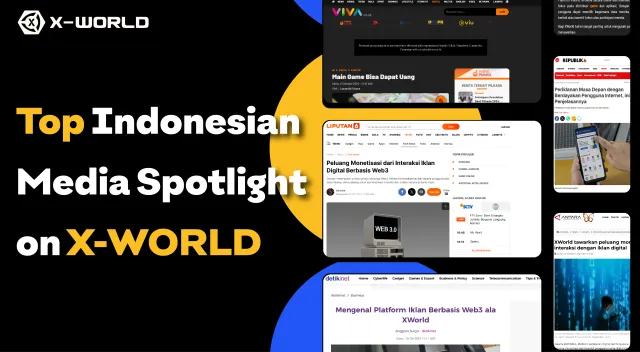
XWORLD is Disrupting Digital Advertising: From Big Tech Control to User Power!
October 22, 2024

XWORLD is Disrupting Digital Advertising: From Big Tech Control to User Power!

The internet has long operated on a hidden cost: your data. In 2024, tech giants like Meta and Google made billions from advertising, using personal information without your direct benefit. But XWORLD is revolutionizing the landscape! With over 5.5 million users and $3 million in shared revenue, we’re empowering you to take control of your data and earn rewards for your engagement. Top Indonesian Media Spotlight on XWORLD XWORLD’s innovation has earned recognition from leading Indonesian outlets such as Detik, Liputan6, Republika, AntaraNews, JawaPos, and Viva, showcasing our role in reshaping Web3 and digital advertising. This shift to a decentralized, user-driven model represents the future of digital entertainment. By redistributing ad revenue directly to users, we’ve made it possible for individuals to profit from their attention and participation in Web3 apps and games. Join XWORLD today and be part of the revolution! Together, we are creating a limitless universe of monetization opportunities in the digital world. Website | Twitter | Facebook | Telegram | Discord Unlock AD 3.0 – Profit from your influence, time, and online activities!
XWORLD’s Leap Forward: Introducing the Web3 Task Bounty Function for Community Contributors
October 31, 2023

XWORLD’s Leap Forward: Introducing the Web3 Task Bounty Function for Community Contributors

In the realm of digital gaming and app monetization, XWORLD is taking bold strides to redefine the landscape. With its innovative approach to Web3, XWORLD is setting new standards in how we interact with digital platforms. Now, the platform is adding another feather to its cap, introducing a new Web3 task bounty function dedicated to rewarding the early contributors in their community. Since its launch in November 2022, XWORLD has made significant headway in the digital space, attracting over a million Web2 and Web3 Internet users. Tens of thousands of game applications have found their home on this platform, creating a vibrant ecosystem that brings together gamers, developers, and enthusiasts. Each of these contributors has played a vital role in the growth and evolution of XWORLD, and their efforts are about to be recognized. The new Web3 task bounty function is XWORLD’s way of giving back to its community. It’s a reward system designed to acknowledge the contributions of the early users who have helped shape the platform. But it’s not just about recognition; it’s about fostering a sense of ownership and participation among the community members. In a traditional Web2 setup, user contributions often go unnoticed. Users interact with platforms and applications but have little stake in their growth or success. XWORLD is flipping this narrative with its Web3 approach. By introducing a task bounty function, it ensures that every contribution, every interaction, has the potential to be rewarded. But how does this task bounty function work? In simple terms, it’s a reward system based on community involvement. Users can earn rewards by completing tasks that contribute to the platform’s growth, such as promoting the platform, reporting bugs, or creating content. The more a user contributes, the more they stand to earn. This approach underscores XWORLD’s commitment to its community. It understands that the platform’s growth is intrinsically tied to the participation and contributions of its users. By rewarding these contributions, XWORLD not only acknowledges their value but also encourages further participation. XWORLD’s task bounty function is more than just a reward system; it’s a testament to the platform’s vision. A vision where users are more than just consumers; they are stakeholders. Where every interaction has the potential to create value. Where the lines between gaming, socializing, and earning are blurred. As XWORLD continues to innovate, it’s clear that the platform is not just keeping pace with the Web3 revolution; it’s leading it. It’s setting a new standard for how platforms should interact with their communities, and how users can benefit from their digital experiences. So, are you ready to be part of this revolution? Are you ready to join a platform that values your contributions and rewards your involvement? If so, then it’s time to join the XWORLD community. To stay updated on all the latest developments and to be part of XWORLD’s exciting journey, follow them on Twitter at https://twitter.com/xworld_pro. Contribute, participate, earn, and become a part of the XWORLD revolution. Welcome to XWORLD, where your contributions matter. XWORLD New-Gen Games & Apps Monetization Platform Website | Twitter | Instagram | Facebook |Litepaper
XWORLD Has Updated 52 Versions in Alpha Test, For A Stunning Release
October 23, 2023

XWORLD Has Updated 52 Versions in Alpha Test, For A Stunning Release

XWORLD, the top-tier games, and apps recommendation platform, has recently released 52 versions for alpha testing. These versions have been carefully developed and refined to ensure a stunning release in the near future. XWORLD aims to provide users with a curated selection of the best games and apps available, ensuring an exceptional user experience. Stay tuned for the exciting release! X-World Version Update Records (Last 10 updates) Client 3.1.34 Release time: 2023/10/20 Optimization — Acceleration of $BUILD mining with H5 games participating in Optimization — Home page UI optimization New — Flash sale product notices added to homepage and game selection page Client 3.1.33 Release time: 2023/10/13 Optimization — Some UI details Optimization — Adjust the digging $BUILD boot style Added — Pop-up window of new user digs $BUILD prompt Added — Novice task guide (dig $BUILD guide) Fix — Handle human detection timeout issue Optimization — Smartlook screen recording logic Client 3.1.32 Optimization — Adjust some UI details Optimization — Added pop-up prompts for blank/error on network alliance task download page Optimization — Deal with the problem that some mobile phones cannot open permissions Optimization — The wallet balance increases currency switching, and the wallet hides tokens with a balance of 0 by default Client 3.1.31 App Store Path Adjustment Modify the minimum amount for forced wallet creation and backup wallet to 0.2 USD. Remove new user interest guidance Remove fresco and reduce package size Client 3.1.30 Fix the problem of integrating Smarlook Fixed the problem of incorrect loading of images in the game recommendation list Client 3.1.29 Added — Game recommendation list supports video playback Added — First transaction build adds withdrawal guidance Added — Smartlook (tool for recording user behavior) Optimization — Add pre-cache for novice pop-up window Optimization — add external link style to community posts Optimization — Add security prompt in permission guidance pop-up window Optimization — When returning to the audit status in the background, the Client adds audit judgment and reports it Optimization — Change the threshold for creating a wallet to 0.05 USD. Fix — Deal with the problem that the prop store is not displayed when the application is first opened after installation Fix — Deal with issue with video sound still playing after exiting video post Fix — Meizu phone failed to navigate to the application usage permission page set by the system Optimize other UI experiences and handle other issues Client 3.1.28 Added the function of sending pop-up windows in the background Application display status bar/navigation bar Optimize some UI displays and fix known issues Client 3.1.27 Add gaid to obtain retry mechanism Optimized web3 zone revision Adjust some UI and fix known issues Client 3.1.26 Added push notification to support icon display function Added the function of displaying/hiding small red dots in all bottom tabs of the homepage Added deep chain support to jump internal product/post/event details page Added the function of selecting interests for new users after registration Added functions for novice tasks and guidance Optimize the experience of changing the personal page address URL to the page path (Client multilingual processing) Optimize the experience of displaying balance for users who have not created a wallet Optimize the experience of following the author from the post details page and then returning to update the following status Optimize the experience of displaying high build guides on the library page once a day Fix the issue of selecting image permissions for android13 Fix the problem that the UUIDs reported by the exposure of community list items are all the same Fix the problem that clicking tab refresh fails Fix the problem of anr caused by web3 wallet initialization Fixed the issue of 403 error (restoring wallet function) when accessing links on some mobile phones Modify the app icon Client 3.1.25 Deep Chain supports jumping to fan list Payment/binding deep chain modification, payment interface parameter modification Client 3.1.24 Add functions for editing and deleting posts Add web3 page and the following tabs on the homepage Add the function of viewing larger images to the community map Add application to expose and report in the foreground The unified password for payment function is the wallet password Post search adds recommended games that can be associated Optimize the process of posting and selecting images Add follow/unfollow author function to post details page Add the function of clicking the post user avatar to jump to the guest status page Client 3.1.23 Change package name, signature, and configuration again Audit logic change Added Client Settings page Other issues to deal with XWORLD New-Gen Games & Apps Monetization Platform Earn Profits & Assets from Your App Usage Time Website | Twitter | Instagram | Facebook |Litepaper
XWORLD’s Community Launches, Bringing Exciting Content and Fun Application Recommendations to Users
August 7, 2023

XWORLD’s Community Launches, Bringing Exciting Content and Fun Application Recommendations to Users

Welcome to the future of digital interaction! XWORLD is thrilled to announce the launch of our vibrant community, where users like you can immerse themselves in a world of exciting content, cutting-edge games, and innovative Web3 applications. In this article, we’ll delve into why we decided to create this community, the captivating content you can expect, and how you can actively engage with fellow users and share your favorite games and apps. Get ready to embark on an exhilarating journey through the realms of XWORLD! 1.Embracing the Power of Community in Web3 In the ever-evolving landscape of the internet, community has become the lifeblood of Web3. At XWORLD, we believe that the true essence of Web3 lies in its ability to be created, earned, and owned by the people. By launching our community, we aim to foster a sense of belonging and empowerment among our users, allowing them to shape their digital experiences and contribute to the growth of XWORLD. 2.Engaging Content: Unleashing the Frontier of Games, Apps, and Web3 Prepare to be captivated by the diverse and fascinating content that awaits you in the XWORLD community. We are committed to curating the most interesting and cutting-edge games, apps, and Web3 innovations, ensuring that you stay at the forefront of digital entertainment. From immersive virtual reality experiences to mind-bending augmented reality games, XWORLD has it all. Our team of experts scours the digital landscape to bring you the latest and greatest, so you can indulge in endless hours of excitement and exploration. 3.Connect, Communicate, and Recommend One of the most exciting aspects of the XWORLD community is the opportunity to connect and communicate with like-minded individuals who share your passion for gaming and digital experiences. Engage in lively discussions, exchange tips and tricks, and forge new friendships with fellow users and gamers. The comment area is your playground, where you can share your thoughts, recommendations, and discoveries. Have a game or app that you absolutely love? Don’t keep it to yourself! Spread the joy by recommending it to others and watch as the XWORLD community thrives on shared experiences. 4.Unleash Your Creativity: Be a Part of the XWORLD Story At XWORLD, we firmly believe that our community is not just about consuming content but also about creating it. We encourage our users to unleash their creativity and contribute to the XWORLD story. Whether it’s designing your own game, developing an innovative app, or sharing your unique perspectives through blog posts or videos, the possibilities are endless. XWORLD is your canvas, and we can’t wait to see the masterpieces you create. 5.Data-Driven Decision-Making: Shaping the Future of XWORLD As a marketing manager, I understand the importance of data-driven decision-making. At XWORLD, we are committed to continuously improving our offerings based on user feedback and preferences. We analyze data meticulously to understand what excites our community, what they want more of, and how we can enhance their experience. Your voice matters, and by actively participating in the XWORLD community, you become an integral part of shaping the future of our platform. Join the XWORLD Community Today! Are you ready to embark on an exhilarating journey through the realms of XWORLD? Visit our official website at www.xworld.pro to explore the wonders that await you. Stay up to date with the latest news, updates, and exciting releases by following XWORLD on Twitter at https://twitter.com/xworld_pro. The XWORLD community is eagerly waiting to welcome you with open arms. Together, let’s redefine the boundaries of digital entertainment and create a future where the power lies in the hands of the people. Join us today and be a part of something extraordinary! In conclusion, XWORLD’s community launch marks a significant milestone in our journey to revolutionize the digital entertainment landscape. By embracing the power of community, curating engaging content, and encouraging active participation, we aim to provide an unparalleled digital experience for ordinary internet users like you. Join us today and unlock a world of endless possibilities in the realms of games, apps, and Web3 innovations. Together, let’s shape the future of XWORLD and redefine the way we connect, create, and experience digital entertainment. Website | Twitter | Instagram | Facebook |Litepaper Enjoy Your Passionate Game Time, Every Second Becomes Your Income.