
XWorld:Platform distribusi periklanan generasi baru
Rumah
Indonesia
language switcher icon
Slide 1 of 3
August 1, 2023

50+ Web3 and Blockchain Keywords Explained

Web3.0: Web3.0, also known as Web3, refers to the next generation of the internet that incorporates decentralized technologies such as blockchain, cryptocurrencies, and peer-to-peer networks. Web3.0 aims to empower users with more control over their data, privacy, and online interactions. It envisions a more open, transparent, and user-centric internet. Decentralization: Decentralization refers to the distribution of control and decision-making across a network, rather than being held by a central authority. In the context of Web3 and blockchain, decentralization is a key principle that aims to eliminate the need for intermediaries and allows participants to have more control over their data and transactions. Smart Contract: A smart contract is a self-executing contract with the terms of the agreement directly written into code. Smart contracts are deployed on blockchain platforms and automatically execute predefined actions when certain conditions are met. They enable trustless and transparent interactions between parties. Decentralized Finance (DeFi): Decentralized Finance (DeFi) refers to the use of blockchain technology and smart contracts to recreate traditional financial systems in a decentralized manner. DeFi aims to provide financial services such as lending, borrowing, and trading without the need for intermediaries like banks. It enables greater accessibility and transparency in financial transactions. Non-Fungible Token (NFT): A Non-Fungible Token (NFT) is a unique digital asset that represents ownership or proof of authenticity of a specific item or piece of content. NFTs have gained popularity in the art and collectibles space. Each NFT has a unique identifier and cannot be exchanged on a one-to-one basis like cryptocurrencies. Interoperability: Interoperability refers to the ability of different blockchain networks or systems to communicate and interact with each other seamlessly. It is important for enabling data and asset transfer between different blockchains and ensuring compatibility between various chains. Consensus Mechanism: A consensus mechanism is a protocol or algorithm used to achieve agreement among participants in a distributed network. Consensus mechanisms ensure that all nodes in a blockchain network agree on the validity of transactions and the order in which they are added to the blockchain. Examples include Proof of Work (PoW) and Proof of Stake (PoS). Proof of Work (PoW): Consensus mechanism where miners solve complex puzzles to validate transactions, ensuring security and immutability by making tampering computationally expensive. Proof of Stake (PoS): Consensus mechanism where validators create blocks based on staked cryptocurrency, promoting energy efficiency, scalability, and faster block validation without intensive computational puzzles. Distributed Ledger Technology (DLT): Distributed Ledger Technology (DLT) is a broader term that encompasses blockchain technology. It refers to a decentralized and distributed database that records and stores transactions across multiple nodes or computers. Blockchain is a specific type of DLT. Cryptocurrency: Cryptocurrency is a digital or virtual form of currency that uses cryptography for security. It operates on decentralized networks, typically based on blockchain technology. Examples of cryptocurrencies include Bitcoin (BTC) and Ethereum (ETH). Gas: Gas refers to the unit of measurement for the computational effort required to execute transactions or smart contracts on the Ethereum blockchain. Gas is paid in Ether (ETH) and helps prevent spam and abuse by requiring users to pay for the computational resources they consume. Oracles: Oracles are services or mechanisms that provide external data to smart contracts on the blockchain. They act as bridges between the blockchain and the real world, enabling smart contracts to interact with off-chain data sources, such as APIs, to make informed decisions and trigger actions based on real-time information. Cross-Chain: Cross-chain refers to the ability to transfer assets or data between different blockchain networks. It involves interoperability and allows users to move assets seamlessly across different blockchains, facilitating increased liquidity and expanding the possibilities for decentralized applications. Decentralized Autonomous Organization (DAO): A Decentralized Autonomous Organization (DAO) is an organization that operates through smart contracts on a blockchain. It is governed by a set of predefined rules and decisions are made through voting by token holders. DAOs aim to eliminate the need for traditional hierarchical structures and allow for decentralized decision-making. Layer 2 Scaling: Layer 2 scaling solutions are techniques or protocols built on top of existing blockchains to improve scalability and increase transaction throughput. They aim to handle a larger number of transactions off-chain or in a more efficient manner, reducing congestion and lowering transaction costs. Examples of layer 2 scaling solutions include state channels and sidechains. Decentralized Autonomous Organization (DAO): A Decentralized Autonomous Organization (DAO) is an organization that operates through smart contracts on a blockchain. It is governed by a set of predefined rules and decisions are made through voting by token holders. DAOs aim to eliminate the need for traditional hierarchical structures and allow for decentralized decision-making. Layer 2 Scaling: Layer 2 scaling solutions are techniques or protocols built on top of existing blockchains to improve scalability and increase transaction throughput. They aim to handle a larger number of transactions off-chain or in a more efficient manner, reducing congestion and lowering transaction costs. Examples of layer 2 scaling solutions include state channels and sidechains. Permissionless: Permissionless refers to the openness and accessibility of a blockchain network or protocol. In a permissionless network, anyone can participate, validate transactions, and contribute to the network without requiring explicit permission. This characteristic is a fundamental aspect of many blockchain networks, enabling anyone to join and interact with the network without needing approval from a central authority. Hard Fork: A hard fork is a type of upgrade or change to a blockchain protocol that is not backward compatible with older versions. It requires all participants in the network to upgrade to the new version in order to continue participating. Hard forks can result in a split in the blockchain, creating two separate chains with different rules and potentially leading to the creation of a new cryptocurrency. Halving: Halving is an event that occurs in some cryptocurrencies, such as Bitcoin, where the block reward for miners is reduced by half after a certain number of blocks are mined. This event is programmed into the cryptocurrency’s protocol and is designed to control the issuance of new coins and create scarcity over time. Hashing Algorithm: Hashing is a process used in computing to generate a unique and fixed-size string of characters (hash) from input data of any size. In the context of blockchain, hashing is used to create a digital fingerprint of data, such as transactions or blocks, ensuring their integrity and allowing for easy verification. Hashes are used to confirm the completeness and validity of blockchain transactions. Censorship Resistance: Censorship resistance refers to the ability of a system or platform to resist censorship or control by centralized authorities. In Web3, blockchain-based platforms provide censorship resistance by decentralizing control and allowing users to have ownership and control over their data and transactions. This enables freedom of expression and protects against arbitrary censorship or manipulation. Decentralized Exchange (DEX): A decentralized exchange is a type of cryptocurrency exchange that operates on a blockchain network without the need for intermediaries or a central authority. DEXs allow users to trade cryptocurrencies directly with each other, using smart contracts for order matching and execution. They provide increased privacy, security, and control over assets compared to centralized exchanges. Immutable Ledger: An immutable ledger refers to a blockchain’s characteristic of being tamper-resistant and unchangeable once data is added to it. Once a transaction or data is recorded on the blockchain, it becomes part of a permanent and transparent history that cannot be altered or deleted. This property ensures the integrity and trustworthiness of the data stored on the blockchain. Decentralized Exchange (DEX): A decentralized exchange is a type of cryptocurrency exchange that operates on a blockchain network without the need for intermediaries or a central authority. DEXs allow users to trade cryptocurrencies directly with each other, using smart contracts for order matching and execution. They provide increased privacy, security, and control over assets compared to centralized exchanges. Token Standards: Token standards are specific protocols or sets of rules that define the functionality and behavior of tokens on a blockchain. Examples of token standards include ERC-20 for fungible tokens, ERC-721 for non-fungible tokens (NFTs), and ERC-1155 for multi-token standards. Token standards ensure interoperability and compatibility between different tokens and enable developers to build applications that interact with tokens in a standardized way. Decentralized File Storage: Decentralized file storage refers to the storage of data on a distributed network of nodes, rather than relying on a centralized server or provider. Blockchain-based decentralized file storage systems, such as IPFS (InterPlanetary File System) or Filecoin, allow users to store and retrieve data in a secure, distributed, and censorship-resistant manner. Tokenomics: Tokenomics refers to the economic design and structure of a cryptocurrency or token ecosystem. It encompasses factors such as token supply, distribution, utility, governance mechanisms, and incentives. Tokenomics aims to create a sustainable and balanced ecosystem that aligns the interests of token holders, users, and other stakeholders in the network. Zero-knowledge proofs (ZKPs): ZKPs are cryptographic protocols that allow one party (the prover) to prove the knowledge of a certain piece of information to another party (the verifier) without revealing the actual information itself. The goal of zero-knowledge proofs is to convince the verifier of the truthfulness of a statement without disclosing any additional information beyond the validity of the statement. Ethereum: Ethereum is an open-source, blockchain-based platform that enables developers to build and deploy decentralized applications (dApps). It was proposed by Vitalik Buterin in late 2013 and development was crowdfunded in 2014. Ethereum’s blockchain is fundamentally different from Bitcoin’s blockchain. While Bitcoin’s blockchain is used to track ownership of digital currency (bitcoins), the Ethereum blockchain focuses on running programming code of any decentralized application Bitcoin: Bitcoin, often described as a cryptocurrency, a virtual currency or a digital currency, is a type of money that is completely virtual. It’s like an online version of cash. You can use it to buy products and services, but not many shops accept Bitcoin yet and some countries have banned it altogether. Bitcoin was the first cryptocurrency and remains the most important in the market. It was invented in 2008 by an unknown person or group of people using the name Satoshi Nakamoto. ICO: ICO stands for Initial Coin Offering and it’s often used as a fundraiser for new projects. This is where a company looking to raise money to create a new coin, app, or service launches an ICO as a way to raise funds. People who buy into the ICO receive a certain number of tokens in return. ICOs are often compared to IPOs (Initial Public Offerings), but there are some significant differences Public Key: In the world of cryptocurrencies, a public key represents a point on a particular Elliptic Curve (EC) defined in secp256k1. Public keys contain an identification byte, a 32-byte X coordinate, and a 32-byte Y coordinate. They are used in Bitcoin and other cryptocurrencies for generating addresses where funds can be seen Private Key: In cryptocurrencies, a private key allows a user to gain full access to their wallet. The person who holds the private key fully controls the coins in that wallet. For this reason, it should be kept secret. Formally, a private key for Bitcoin (and many other cryptocurrencies) is a series of 32 bytes Stablecoin: Stablecoins are a type of cryptocurrency designed to minimize volatility, a common issue with cryptocurrencies like Bitcoin. They achieve this stability by pegging their market value to an external reference, usually a fiat currency like the US dollar, or a commodity like gold. Some stablecoins maintain reserve assets as collateral, while others use algorithmic formulas to control supply. The primary purpose of stablecoins is to provide a more suitable option for common transactions. Altcoin: The term altcoin refers to all cryptocurrencies other than Bitcoin and, for some, Ethereum. These alternative cryptocurrencies come in various types, each designed for different purposes. While the future value of altcoins is unpredictable, as long as the blockchain they were designed for continues to be used and developed, the altcoins will continue to exist. It’s important to note that while many altcoins offer potential investment opportunities, some are scams or have lost developer and community interest Mainnet: It refers to the main blockchain network of a cryptocurrency, where real transactions and operations take place. It is the live and production-ready network where actual value is exchanged. Mainnet is typically used for real-world applications, and transactions on the mainnet involve real cryptocurrencies. Testnet: on the other hand, is a separate network specifically designed for testing and development purposes. It mimics the functionalities of the mainnet but uses test tokens or simulated cryptocurrencies that have no real-world value. Testnets allow developers and users to experiment, validate, and debug their applications without risking real funds. It provides a safe environment for testing new features, smart contracts, and conducting simulations before deploying on the mainnet. Testnets are crucial for ensuring the reliability and security of applications before they are deployed to the production-ready mainnet. Remix IDE: is an online development environment for writing, testing, and deploying smart contracts on the Ethereum blockchain. It provides a user-friendly interface with a built-in code editor, compiler, debugger, and deployment tools. Remix IDE allows developers to write Solidity smart contracts, interact with contracts using a web3 provider, and test their code using various tools and plugins. It is a popular choice for Ethereum developers due to its simplicity and comprehensive features. Infura/Alchemy: It is a popular service that provides infrastructure and API endpoints for connecting to the Ethereum blockchain. It acts as a web3 provider, allowing developers to interact with the Ethereum network without running a full Ethereum node. Infura simplifies the development process by providing reliable and scalable access to the Ethereum blockchain, eliminating the need for developers to set up and maintain their own infrastructure. It offers various API endpoints, including JSON-RPC and WebSocket, which developers can use to send transactions, retrieve data, and interact with smart contracts. Infura is widely used by developers to integrate Ethereum functionality into their applications and services. Mining: Mining is the process of validating and adding new transactions to a blockchain. It involves solving complex mathematical puzzles to find a new block, which contains a set of transactions. Miners compete with each other to solve these puzzles by using computational power, and the first miner to find the solution gets rewarded with newly minted cryptocurrency tokens. Mining ensures the security, integrity, and decentralization of a blockchain network by preventing double-spending and maintaining consensus among participants. Tokenization: Tokenization is the process of representing real-world assets or rights as digital tokens on a blockchain. It allows for fractional ownership, increased liquidity, and easier transfer of assets. Tokenization has applications in areas such as real estate, art, and finance. Immutable: Immutable means that something is unchangeable or cannot be altered or tampered with. In the context of blockchain, immutability refers to the property of data stored on the blockchain that cannot be modified once it is added to the chain. This ensures the integrity and trustworthiness of the data. Merkle Tree: A hierarchical data structure that enables efficient verification and integrity checks of large datasets. It uses cryptographic hashing to create a tree structure where each node represents the hash of its child nodes, providing an efficient way to verify the integrity of specific data without needing to examine the entire dataset. Byzantine Fault Tolerance: The ability of a distributed system to reach a consensus even in the presence of malicious or faulty nodes. It ensures system resilience by employing redundancy, replication, and consensus algorithms to tolerate failures and prevent malicious actors from compromising the integrity and reliability of the system. ICO (Initial Coin Offering): A fundraising method used by cryptocurrency projects to raise capital. It involves issuing and selling tokens to investors in exchange for cryptocurrencies or fiat currencies, providing early access to the project’s tokens and potential returns on investment. Whitepaper: A detailed document that outlines the concept, technology, goals, and implementation plan of a cryptocurrency project. It provides an in-depth analysis of the project’s vision, technical specifications, tokenomics, and potential impact, serving as a comprehensive guide for investors and stakeholders. Yellowpaper: Similar to a whitepaper, a yellowpaper is a technical document that provides a deeper technical understanding of a cryptocurrency project. It typically delves into the underlying protocols, algorithms, and technical intricacies of the project, providing detailed explanations and specifications for developers and researchers. Fork: A divergence in the blockchain where a single chain splits into two separate chains, resulting in two different versions of the blockchain. Soft Fork: A backward-compatible upgrade to the blockchain protocol where the new rules are more restrictive than the old rules, allowing the new blocks to be accepted by both old and new nodes. Hard Fork: A non-backward-compatible upgrade to the blockchain protocol where the new rules are more permissive than the old rules, resulting in a permanent divergence in the blockchain and two separate chains that are incompatible with each other. XWORLD, a pioneering Web3 App Store, provides a safe and trustworthy platform for users to explore a wide range of dApps and discover the treasure trove of Web3. Visit the XWORLD website (www.xworld.pro) and follow Twitter (https://twitter.com/xworld_pro) to learn more about this exciting platform and embark on your Web3 journey today! Join our community for more: Website | Twitter | Instagram | Facebook |Litepaper Enjoy Your Passionate Game Time, Every Second Becomes Your Income.
Baca Lebih Lanjut
50+ Web3 and Blockchain Keywords Explained
December 23, 2024

Hustle This Christmas, Unlock 2025 Airdrop Rewards!

Get ready for the XWorld Holiday Leaderboard Challenge, where your hustle not only brings incredible rewards but also sets you up for future 2025 Airdrop surprises! 💰 🗓 Event Duration: December 23, 2024 – January 19, 2025 🏆 Leaderboard Highlights: Weekly Leaderboard: Updated weekly to showcase the top 10 hustlers! Monthly Leaderboard: Tracks your total performance throughout the event, featuring the top 20 grinders. 🎯 How to Join the Fun: Earn $BUILD and climb the leaderboard by: ✅ Completing daily tasks 🎮 Playing games and smashing game missions 🤝 Inviting friends to join the XWorld adventure ✨ Boosting your earnings with Sprite bonuses 👉 Leaderboard Rules: Weekly Rankings: Based on $BUILD earned during the week. Monthly Rankings: Calculated from your total $BUILD throughout the event. Live Updates: Only the Top 100 players are displayed, refreshed every 5 minutes! 👑 Leaderboard Rewards: 💥 Weekly Rewards (Top 10): 🥇 1st Place: 30 TON 🥈 2nd Place: 20 TON 🥉 3rd Place: 15 TON 4th-10th Place: 10 TON each 💎 Monthly Rewards (Top 20): 🥇 1st Place: 150 TON 🥈 2nd Place: 100 TON 🥉 3rd Place: 80 TON 4th-10th Place: 50 TON each 11th-20th Place: 20 TON each 🎁 Special Reminder: 🔥 Your leaderboard performance isn’t just about TON rewards—it’ll play a huge role in future 2025 airdrop opportunities! The higher your ranking, especially your invite performance, the better your chances of being selected for future surprises. 🌟 ⚠️ Important Notes: Play Fair: Stick to XWorld’s community rules. Cheating or shady tactics will get you disqualified! 🚫 All rewards will be distributed within 7 working days after the event ends. Event Terms: XWorld reserves the final interpretation rights for this event. 📢 Don’t Wait—Start Your Hustle! Grab your chance to win TON rewards, climb the leaderboard, and secure your future airdrop opportunities in 2025! Let’s hustle this Christmas and beyond! 🎆 🔗 Join the Challenge NOW!
Baca Lebih Lanjut
Hustle This Christmas, Unlock 2025 Airdrop Rewards!
June 19, 2025

After OpenAI’s Big Move, Will FanGPT Be the “Next NVIDIA” of Web3?

🌌 Missed NVIDIA and OpenAI? Don’t miss this one. With official OpenAI collaboration, celebrity AI twins, and a Web3-native incentive mechanism, FanGPT might just become the next breakout consensus anchor for AI × Web3. 🔥 The AI Twin Economy Is Here—and FanGPT Is Leading the Charge When OpenAI unveiled GPT-4o, the internet went wild. Real-time multimodal reasoning, voice-like responsiveness, massive price drops, and open APIs—this wasn’t just an upgrade. It was a redistribution of AI access on a global scale. And for the first time, this power isn’t just reserved for the tech giants. The golden window for AI × Web3 is now wide open. A new frontier is forming fast: AI personalities × creator economies × tokenized engagement. At the forefront of this movement is FanGPT, launched in collaboration with XWorld. But FanGPT isn’t just a chatbot—it’s a reimagination of how influence, attention, and value flow in the creator economy. One where every KOL (key opinion leader) has a fully autonomous AI twin. One where every fan becomes a co-creator and stakeholder. 💥 What Is FanGPT—and Why It Might Be Web3’s New AI Attention Gateway FanGPT is the first platform globally to fuse celebrity IP, OpenAI’s GPT-4 technology, and real-time AI personality customization—supported by the XWorld AI Agent framework and official OpenAI API access. In simple terms, FanGPT enables: 🎤 AI-powered digital twins for creators 🤖 24/7 real-time interactions with unique personality traits 🌐 Web3-native incentive systems that reward fan engagement 💬 Decentralized personality sovereignty, breaking the algorithm’s gatekeeping It’s not another ChatGPT interface—it’s a full operating system for the next generation of digital identity, fan interaction, and monetization. 🚨 Why Now? Why FanGPT? ✅ 1. OpenAI Just Unlocked a New Playing Field With GPT-4o’s capabilities now public, and costs halved, AI innovation is finally within reach for indie devs, creators, and startups worldwide. That’s massive. ✅ 2. Web3 Needs Real, Sticky AI Use Cases The space is shifting from infrastructure to user-facing applications. FanGPT is the perfect onramp—a creator-focused platform where AI agents meet real-world demand and real community value. ✅ 3. $FGPT Has the Potential to Become a Standard for “Personality Assets” As more KOLs onboard and more fans engage, $FGPT becomes the native currency of attention. With plugins, content co-creation, and IP monetization features on the roadmap, it’s positioned to anchor a growing creator-AI economy. 🌟 The FanGPT Mission: “Connect All Influence. Stay Online, Forever.” Today, creator-fan relationships are fragmented. Content is algorithmically throttled. Creators are trapped in platform silos. Influence is commodified. FanGPT aims to change that. By giving every creator an AI twin—always online, always in voice, always on-brand—it returns sovereignty to the creator, and value to the fan. No gatekeepers. No downtime. This is not just another tool—it’s an emotional, economic, and cultural shift in how we define identity and influence in the age of AI. 📈 What’s Next: From Conversation to Creator-Driven Ecosystem FanGPT is laying the foundation for a full-stack AI × IP × Web3 creator economy, including: 🧩 Plugin ecosystem for custom knowledge, merch tools, and monetization flows 🌍 Multilingual personality systems to engage fans across regions 🛒 AI-powered e-commerce & community task systems 💎 NFT + $FGPT reward layers to turn interaction into ownership "Every KOL will have an AI Agent working for them. FanGPT is building the infrastructure for the next generation of personality economics" — Noah, Co-Founder of XWorld ✅ Why It’s Still Early for $FGPT FanGPT is in pre-public release with growing creator onboarding, content matrix expansion, and early community momentum. For builders, creators, and degens alike, $FGPT is not just another token—it’s a new asset class for personality capital. As more creators launch their AI twins, $FGPT scales with the ecosystem—not hype. 🎯 Ready to Step Into the Second Universe? 🚀 Join the community: Telegram: https://t.me/fangpt_ai X (Twitter): https://x.com/Fan_GPT 🌐 Website: Coming Soon Don’t miss this new gateway to AI-powered attention. FanGPT might just be your second chance. Powered by XWorld — official OpenAI partner and pioneer in Web3 AI Agents. 🔗 Learn more and join XWorld Website | Whitepaper | MiniAPP | Twitter | Telegram | Linktree
Baca Lebih Lanjut
After OpenAI’s Big Move, Will FanGPT Be the “Next NVIDIA” of Web3?
August 1, 2023

50+ Web3 and Blockchain Keywords Explained

Web3.0: Web3.0, also known as Web3, refers to the next generation of the internet that incorporates decentralized technologies such as blockchain, cryptocurrencies, and peer-to-peer networks. Web3.0 aims to empower users with more control over their data, privacy, and online interactions. It envisions a more open, transparent, and user-centric internet. Decentralization: Decentralization refers to the distribution of control and decision-making across a network, rather than being held by a central authority. In the context of Web3 and blockchain, decentralization is a key principle that aims to eliminate the need for intermediaries and allows participants to have more control over their data and transactions. Smart Contract: A smart contract is a self-executing contract with the terms of the agreement directly written into code. Smart contracts are deployed on blockchain platforms and automatically execute predefined actions when certain conditions are met. They enable trustless and transparent interactions between parties. Decentralized Finance (DeFi): Decentralized Finance (DeFi) refers to the use of blockchain technology and smart contracts to recreate traditional financial systems in a decentralized manner. DeFi aims to provide financial services such as lending, borrowing, and trading without the need for intermediaries like banks. It enables greater accessibility and transparency in financial transactions. Non-Fungible Token (NFT): A Non-Fungible Token (NFT) is a unique digital asset that represents ownership or proof of authenticity of a specific item or piece of content. NFTs have gained popularity in the art and collectibles space. Each NFT has a unique identifier and cannot be exchanged on a one-to-one basis like cryptocurrencies. Interoperability: Interoperability refers to the ability of different blockchain networks or systems to communicate and interact with each other seamlessly. It is important for enabling data and asset transfer between different blockchains and ensuring compatibility between various chains. Consensus Mechanism: A consensus mechanism is a protocol or algorithm used to achieve agreement among participants in a distributed network. Consensus mechanisms ensure that all nodes in a blockchain network agree on the validity of transactions and the order in which they are added to the blockchain. Examples include Proof of Work (PoW) and Proof of Stake (PoS). Proof of Work (PoW): Consensus mechanism where miners solve complex puzzles to validate transactions, ensuring security and immutability by making tampering computationally expensive. Proof of Stake (PoS): Consensus mechanism where validators create blocks based on staked cryptocurrency, promoting energy efficiency, scalability, and faster block validation without intensive computational puzzles. Distributed Ledger Technology (DLT): Distributed Ledger Technology (DLT) is a broader term that encompasses blockchain technology. It refers to a decentralized and distributed database that records and stores transactions across multiple nodes or computers. Blockchain is a specific type of DLT. Cryptocurrency: Cryptocurrency is a digital or virtual form of currency that uses cryptography for security. It operates on decentralized networks, typically based on blockchain technology. Examples of cryptocurrencies include Bitcoin (BTC) and Ethereum (ETH). Gas: Gas refers to the unit of measurement for the computational effort required to execute transactions or smart contracts on the Ethereum blockchain. Gas is paid in Ether (ETH) and helps prevent spam and abuse by requiring users to pay for the computational resources they consume. Oracles: Oracles are services or mechanisms that provide external data to smart contracts on the blockchain. They act as bridges between the blockchain and the real world, enabling smart contracts to interact with off-chain data sources, such as APIs, to make informed decisions and trigger actions based on real-time information. Cross-Chain: Cross-chain refers to the ability to transfer assets or data between different blockchain networks. It involves interoperability and allows users to move assets seamlessly across different blockchains, facilitating increased liquidity and expanding the possibilities for decentralized applications. Decentralized Autonomous Organization (DAO): A Decentralized Autonomous Organization (DAO) is an organization that operates through smart contracts on a blockchain. It is governed by a set of predefined rules and decisions are made through voting by token holders. DAOs aim to eliminate the need for traditional hierarchical structures and allow for decentralized decision-making. Layer 2 Scaling: Layer 2 scaling solutions are techniques or protocols built on top of existing blockchains to improve scalability and increase transaction throughput. They aim to handle a larger number of transactions off-chain or in a more efficient manner, reducing congestion and lowering transaction costs. Examples of layer 2 scaling solutions include state channels and sidechains. Decentralized Autonomous Organization (DAO): A Decentralized Autonomous Organization (DAO) is an organization that operates through smart contracts on a blockchain. It is governed by a set of predefined rules and decisions are made through voting by token holders. DAOs aim to eliminate the need for traditional hierarchical structures and allow for decentralized decision-making. Layer 2 Scaling: Layer 2 scaling solutions are techniques or protocols built on top of existing blockchains to improve scalability and increase transaction throughput. They aim to handle a larger number of transactions off-chain or in a more efficient manner, reducing congestion and lowering transaction costs. Examples of layer 2 scaling solutions include state channels and sidechains. Permissionless: Permissionless refers to the openness and accessibility of a blockchain network or protocol. In a permissionless network, anyone can participate, validate transactions, and contribute to the network without requiring explicit permission. This characteristic is a fundamental aspect of many blockchain networks, enabling anyone to join and interact with the network without needing approval from a central authority. Hard Fork: A hard fork is a type of upgrade or change to a blockchain protocol that is not backward compatible with older versions. It requires all participants in the network to upgrade to the new version in order to continue participating. Hard forks can result in a split in the blockchain, creating two separate chains with different rules and potentially leading to the creation of a new cryptocurrency. Halving: Halving is an event that occurs in some cryptocurrencies, such as Bitcoin, where the block reward for miners is reduced by half after a certain number of blocks are mined. This event is programmed into the cryptocurrency’s protocol and is designed to control the issuance of new coins and create scarcity over time. Hashing Algorithm: Hashing is a process used in computing to generate a unique and fixed-size string of characters (hash) from input data of any size. In the context of blockchain, hashing is used to create a digital fingerprint of data, such as transactions or blocks, ensuring their integrity and allowing for easy verification. Hashes are used to confirm the completeness and validity of blockchain transactions. Censorship Resistance: Censorship resistance refers to the ability of a system or platform to resist censorship or control by centralized authorities. In Web3, blockchain-based platforms provide censorship resistance by decentralizing control and allowing users to have ownership and control over their data and transactions. This enables freedom of expression and protects against arbitrary censorship or manipulation. Decentralized Exchange (DEX): A decentralized exchange is a type of cryptocurrency exchange that operates on a blockchain network without the need for intermediaries or a central authority. DEXs allow users to trade cryptocurrencies directly with each other, using smart contracts for order matching and execution. They provide increased privacy, security, and control over assets compared to centralized exchanges. Immutable Ledger: An immutable ledger refers to a blockchain’s characteristic of being tamper-resistant and unchangeable once data is added to it. Once a transaction or data is recorded on the blockchain, it becomes part of a permanent and transparent history that cannot be altered or deleted. This property ensures the integrity and trustworthiness of the data stored on the blockchain. Decentralized Exchange (DEX): A decentralized exchange is a type of cryptocurrency exchange that operates on a blockchain network without the need for intermediaries or a central authority. DEXs allow users to trade cryptocurrencies directly with each other, using smart contracts for order matching and execution. They provide increased privacy, security, and control over assets compared to centralized exchanges. Token Standards: Token standards are specific protocols or sets of rules that define the functionality and behavior of tokens on a blockchain. Examples of token standards include ERC-20 for fungible tokens, ERC-721 for non-fungible tokens (NFTs), and ERC-1155 for multi-token standards. Token standards ensure interoperability and compatibility between different tokens and enable developers to build applications that interact with tokens in a standardized way. Decentralized File Storage: Decentralized file storage refers to the storage of data on a distributed network of nodes, rather than relying on a centralized server or provider. Blockchain-based decentralized file storage systems, such as IPFS (InterPlanetary File System) or Filecoin, allow users to store and retrieve data in a secure, distributed, and censorship-resistant manner. Tokenomics: Tokenomics refers to the economic design and structure of a cryptocurrency or token ecosystem. It encompasses factors such as token supply, distribution, utility, governance mechanisms, and incentives. Tokenomics aims to create a sustainable and balanced ecosystem that aligns the interests of token holders, users, and other stakeholders in the network. Zero-knowledge proofs (ZKPs): ZKPs are cryptographic protocols that allow one party (the prover) to prove the knowledge of a certain piece of information to another party (the verifier) without revealing the actual information itself. The goal of zero-knowledge proofs is to convince the verifier of the truthfulness of a statement without disclosing any additional information beyond the validity of the statement. Ethereum: Ethereum is an open-source, blockchain-based platform that enables developers to build and deploy decentralized applications (dApps). It was proposed by Vitalik Buterin in late 2013 and development was crowdfunded in 2014. Ethereum’s blockchain is fundamentally different from Bitcoin’s blockchain. While Bitcoin’s blockchain is used to track ownership of digital currency (bitcoins), the Ethereum blockchain focuses on running programming code of any decentralized application Bitcoin: Bitcoin, often described as a cryptocurrency, a virtual currency or a digital currency, is a type of money that is completely virtual. It’s like an online version of cash. You can use it to buy products and services, but not many shops accept Bitcoin yet and some countries have banned it altogether. Bitcoin was the first cryptocurrency and remains the most important in the market. It was invented in 2008 by an unknown person or group of people using the name Satoshi Nakamoto. ICO: ICO stands for Initial Coin Offering and it’s often used as a fundraiser for new projects. This is where a company looking to raise money to create a new coin, app, or service launches an ICO as a way to raise funds. People who buy into the ICO receive a certain number of tokens in return. ICOs are often compared to IPOs (Initial Public Offerings), but there are some significant differences Public Key: In the world of cryptocurrencies, a public key represents a point on a particular Elliptic Curve (EC) defined in secp256k1. Public keys contain an identification byte, a 32-byte X coordinate, and a 32-byte Y coordinate. They are used in Bitcoin and other cryptocurrencies for generating addresses where funds can be seen Private Key: In cryptocurrencies, a private key allows a user to gain full access to their wallet. The person who holds the private key fully controls the coins in that wallet. For this reason, it should be kept secret. Formally, a private key for Bitcoin (and many other cryptocurrencies) is a series of 32 bytes Stablecoin: Stablecoins are a type of cryptocurrency designed to minimize volatility, a common issue with cryptocurrencies like Bitcoin. They achieve this stability by pegging their market value to an external reference, usually a fiat currency like the US dollar, or a commodity like gold. Some stablecoins maintain reserve assets as collateral, while others use algorithmic formulas to control supply. The primary purpose of stablecoins is to provide a more suitable option for common transactions. Altcoin: The term altcoin refers to all cryptocurrencies other than Bitcoin and, for some, Ethereum. These alternative cryptocurrencies come in various types, each designed for different purposes. While the future value of altcoins is unpredictable, as long as the blockchain they were designed for continues to be used and developed, the altcoins will continue to exist. It’s important to note that while many altcoins offer potential investment opportunities, some are scams or have lost developer and community interest Mainnet: It refers to the main blockchain network of a cryptocurrency, where real transactions and operations take place. It is the live and production-ready network where actual value is exchanged. Mainnet is typically used for real-world applications, and transactions on the mainnet involve real cryptocurrencies. Testnet: on the other hand, is a separate network specifically designed for testing and development purposes. It mimics the functionalities of the mainnet but uses test tokens or simulated cryptocurrencies that have no real-world value. Testnets allow developers and users to experiment, validate, and debug their applications without risking real funds. It provides a safe environment for testing new features, smart contracts, and conducting simulations before deploying on the mainnet. Testnets are crucial for ensuring the reliability and security of applications before they are deployed to the production-ready mainnet. Remix IDE: is an online development environment for writing, testing, and deploying smart contracts on the Ethereum blockchain. It provides a user-friendly interface with a built-in code editor, compiler, debugger, and deployment tools. Remix IDE allows developers to write Solidity smart contracts, interact with contracts using a web3 provider, and test their code using various tools and plugins. It is a popular choice for Ethereum developers due to its simplicity and comprehensive features. Infura/Alchemy: It is a popular service that provides infrastructure and API endpoints for connecting to the Ethereum blockchain. It acts as a web3 provider, allowing developers to interact with the Ethereum network without running a full Ethereum node. Infura simplifies the development process by providing reliable and scalable access to the Ethereum blockchain, eliminating the need for developers to set up and maintain their own infrastructure. It offers various API endpoints, including JSON-RPC and WebSocket, which developers can use to send transactions, retrieve data, and interact with smart contracts. Infura is widely used by developers to integrate Ethereum functionality into their applications and services. Mining: Mining is the process of validating and adding new transactions to a blockchain. It involves solving complex mathematical puzzles to find a new block, which contains a set of transactions. Miners compete with each other to solve these puzzles by using computational power, and the first miner to find the solution gets rewarded with newly minted cryptocurrency tokens. Mining ensures the security, integrity, and decentralization of a blockchain network by preventing double-spending and maintaining consensus among participants. Tokenization: Tokenization is the process of representing real-world assets or rights as digital tokens on a blockchain. It allows for fractional ownership, increased liquidity, and easier transfer of assets. Tokenization has applications in areas such as real estate, art, and finance. Immutable: Immutable means that something is unchangeable or cannot be altered or tampered with. In the context of blockchain, immutability refers to the property of data stored on the blockchain that cannot be modified once it is added to the chain. This ensures the integrity and trustworthiness of the data. Merkle Tree: A hierarchical data structure that enables efficient verification and integrity checks of large datasets. It uses cryptographic hashing to create a tree structure where each node represents the hash of its child nodes, providing an efficient way to verify the integrity of specific data without needing to examine the entire dataset. Byzantine Fault Tolerance: The ability of a distributed system to reach a consensus even in the presence of malicious or faulty nodes. It ensures system resilience by employing redundancy, replication, and consensus algorithms to tolerate failures and prevent malicious actors from compromising the integrity and reliability of the system. ICO (Initial Coin Offering): A fundraising method used by cryptocurrency projects to raise capital. It involves issuing and selling tokens to investors in exchange for cryptocurrencies or fiat currencies, providing early access to the project’s tokens and potential returns on investment. Whitepaper: A detailed document that outlines the concept, technology, goals, and implementation plan of a cryptocurrency project. It provides an in-depth analysis of the project’s vision, technical specifications, tokenomics, and potential impact, serving as a comprehensive guide for investors and stakeholders. Yellowpaper: Similar to a whitepaper, a yellowpaper is a technical document that provides a deeper technical understanding of a cryptocurrency project. It typically delves into the underlying protocols, algorithms, and technical intricacies of the project, providing detailed explanations and specifications for developers and researchers. Fork: A divergence in the blockchain where a single chain splits into two separate chains, resulting in two different versions of the blockchain. Soft Fork: A backward-compatible upgrade to the blockchain protocol where the new rules are more restrictive than the old rules, allowing the new blocks to be accepted by both old and new nodes. Hard Fork: A non-backward-compatible upgrade to the blockchain protocol where the new rules are more permissive than the old rules, resulting in a permanent divergence in the blockchain and two separate chains that are incompatible with each other. XWORLD, a pioneering Web3 App Store, provides a safe and trustworthy platform for users to explore a wide range of dApps and discover the treasure trove of Web3. Visit the XWORLD website (www.xworld.pro) and follow Twitter (https://twitter.com/xworld_pro) to learn more about this exciting platform and embark on your Web3 journey today! Join our community for more: Website | Twitter | Instagram | Facebook |Litepaper Enjoy Your Passionate Game Time, Every Second Becomes Your Income.
Baca Lebih Lanjut
50+ Web3 and Blockchain Keywords Explained
December 23, 2024

Hustle This Christmas, Unlock 2025 Airdrop Rewards!

Get ready for the XWorld Holiday Leaderboard Challenge, where your hustle not only brings incredible rewards but also sets you up for future 2025 Airdrop surprises! 💰 🗓 Event Duration: December 23, 2024 – January 19, 2025 🏆 Leaderboard Highlights: Weekly Leaderboard: Updated weekly to showcase the top 10 hustlers! Monthly Leaderboard: Tracks your total performance throughout the event, featuring the top 20 grinders. 🎯 How to Join the Fun: Earn $BUILD and climb the leaderboard by: ✅ Completing daily tasks 🎮 Playing games and smashing game missions 🤝 Inviting friends to join the XWorld adventure ✨ Boosting your earnings with Sprite bonuses 👉 Leaderboard Rules: Weekly Rankings: Based on $BUILD earned during the week. Monthly Rankings: Calculated from your total $BUILD throughout the event. Live Updates: Only the Top 100 players are displayed, refreshed every 5 minutes! 👑 Leaderboard Rewards: 💥 Weekly Rewards (Top 10): 🥇 1st Place: 30 TON 🥈 2nd Place: 20 TON 🥉 3rd Place: 15 TON 4th-10th Place: 10 TON each 💎 Monthly Rewards (Top 20): 🥇 1st Place: 150 TON 🥈 2nd Place: 100 TON 🥉 3rd Place: 80 TON 4th-10th Place: 50 TON each 11th-20th Place: 20 TON each 🎁 Special Reminder: 🔥 Your leaderboard performance isn’t just about TON rewards—it’ll play a huge role in future 2025 airdrop opportunities! The higher your ranking, especially your invite performance, the better your chances of being selected for future surprises. 🌟 ⚠️ Important Notes: Play Fair: Stick to XWorld’s community rules. Cheating or shady tactics will get you disqualified! 🚫 All rewards will be distributed within 7 working days after the event ends. Event Terms: XWorld reserves the final interpretation rights for this event. 📢 Don’t Wait—Start Your Hustle! Grab your chance to win TON rewards, climb the leaderboard, and secure your future airdrop opportunities in 2025! Let’s hustle this Christmas and beyond! 🎆 🔗 Join the Challenge NOW!
Baca Lebih Lanjut
Hustle This Christmas, Unlock 2025 Airdrop Rewards!
June 19, 2025

After OpenAI’s Big Move, Will FanGPT Be the “Next NVIDIA” of Web3?

🌌 Missed NVIDIA and OpenAI? Don’t miss this one. With official OpenAI collaboration, celebrity AI twins, and a Web3-native incentive mechanism, FanGPT might just become the next breakout consensus anchor for AI × Web3. 🔥 The AI Twin Economy Is Here—and FanGPT Is Leading the Charge When OpenAI unveiled GPT-4o, the internet went wild. Real-time multimodal reasoning, voice-like responsiveness, massive price drops, and open APIs—this wasn’t just an upgrade. It was a redistribution of AI access on a global scale. And for the first time, this power isn’t just reserved for the tech giants. The golden window for AI × Web3 is now wide open. A new frontier is forming fast: AI personalities × creator economies × tokenized engagement. At the forefront of this movement is FanGPT, launched in collaboration with XWorld. But FanGPT isn’t just a chatbot—it’s a reimagination of how influence, attention, and value flow in the creator economy. One where every KOL (key opinion leader) has a fully autonomous AI twin. One where every fan becomes a co-creator and stakeholder. 💥 What Is FanGPT—and Why It Might Be Web3’s New AI Attention Gateway FanGPT is the first platform globally to fuse celebrity IP, OpenAI’s GPT-4 technology, and real-time AI personality customization—supported by the XWorld AI Agent framework and official OpenAI API access. In simple terms, FanGPT enables: 🎤 AI-powered digital twins for creators 🤖 24/7 real-time interactions with unique personality traits 🌐 Web3-native incentive systems that reward fan engagement 💬 Decentralized personality sovereignty, breaking the algorithm’s gatekeeping It’s not another ChatGPT interface—it’s a full operating system for the next generation of digital identity, fan interaction, and monetization. 🚨 Why Now? Why FanGPT? ✅ 1. OpenAI Just Unlocked a New Playing Field With GPT-4o’s capabilities now public, and costs halved, AI innovation is finally within reach for indie devs, creators, and startups worldwide. That’s massive. ✅ 2. Web3 Needs Real, Sticky AI Use Cases The space is shifting from infrastructure to user-facing applications. FanGPT is the perfect onramp—a creator-focused platform where AI agents meet real-world demand and real community value. ✅ 3. $FGPT Has the Potential to Become a Standard for “Personality Assets” As more KOLs onboard and more fans engage, $FGPT becomes the native currency of attention. With plugins, content co-creation, and IP monetization features on the roadmap, it’s positioned to anchor a growing creator-AI economy. 🌟 The FanGPT Mission: “Connect All Influence. Stay Online, Forever.” Today, creator-fan relationships are fragmented. Content is algorithmically throttled. Creators are trapped in platform silos. Influence is commodified. FanGPT aims to change that. By giving every creator an AI twin—always online, always in voice, always on-brand—it returns sovereignty to the creator, and value to the fan. No gatekeepers. No downtime. This is not just another tool—it’s an emotional, economic, and cultural shift in how we define identity and influence in the age of AI. 📈 What’s Next: From Conversation to Creator-Driven Ecosystem FanGPT is laying the foundation for a full-stack AI × IP × Web3 creator economy, including: 🧩 Plugin ecosystem for custom knowledge, merch tools, and monetization flows 🌍 Multilingual personality systems to engage fans across regions 🛒 AI-powered e-commerce & community task systems 💎 NFT + $FGPT reward layers to turn interaction into ownership "Every KOL will have an AI Agent working for them. FanGPT is building the infrastructure for the next generation of personality economics" — Noah, Co-Founder of XWorld ✅ Why It’s Still Early for $FGPT FanGPT is in pre-public release with growing creator onboarding, content matrix expansion, and early community momentum. For builders, creators, and degens alike, $FGPT is not just another token—it’s a new asset class for personality capital. As more creators launch their AI twins, $FGPT scales with the ecosystem—not hype. 🎯 Ready to Step Into the Second Universe? 🚀 Join the community: Telegram: https://t.me/fangpt_ai X (Twitter): https://x.com/Fan_GPT 🌐 Website: Coming Soon Don’t miss this new gateway to AI-powered attention. FanGPT might just be your second chance. Powered by XWorld — official OpenAI partner and pioneer in Web3 AI Agents. 🔗 Learn more and join XWorld Website | Whitepaper | MiniAPP | Twitter | Telegram | Linktree
Baca Lebih Lanjut
After OpenAI’s Big Move, Will FanGPT Be the “Next NVIDIA” of Web3?
August 1, 2023

50+ Web3 and Blockchain Keywords Explained

Web3.0: Web3.0, also known as Web3, refers to the next generation of the internet that incorporates decentralized technologies such as blockchain, cryptocurrencies, and peer-to-peer networks. Web3.0 aims to empower users with more control over their data, privacy, and online interactions. It envisions a more open, transparent, and user-centric internet. Decentralization: Decentralization refers to the distribution of control and decision-making across a network, rather than being held by a central authority. In the context of Web3 and blockchain, decentralization is a key principle that aims to eliminate the need for intermediaries and allows participants to have more control over their data and transactions. Smart Contract: A smart contract is a self-executing contract with the terms of the agreement directly written into code. Smart contracts are deployed on blockchain platforms and automatically execute predefined actions when certain conditions are met. They enable trustless and transparent interactions between parties. Decentralized Finance (DeFi): Decentralized Finance (DeFi) refers to the use of blockchain technology and smart contracts to recreate traditional financial systems in a decentralized manner. DeFi aims to provide financial services such as lending, borrowing, and trading without the need for intermediaries like banks. It enables greater accessibility and transparency in financial transactions. Non-Fungible Token (NFT): A Non-Fungible Token (NFT) is a unique digital asset that represents ownership or proof of authenticity of a specific item or piece of content. NFTs have gained popularity in the art and collectibles space. Each NFT has a unique identifier and cannot be exchanged on a one-to-one basis like cryptocurrencies. Interoperability: Interoperability refers to the ability of different blockchain networks or systems to communicate and interact with each other seamlessly. It is important for enabling data and asset transfer between different blockchains and ensuring compatibility between various chains. Consensus Mechanism: A consensus mechanism is a protocol or algorithm used to achieve agreement among participants in a distributed network. Consensus mechanisms ensure that all nodes in a blockchain network agree on the validity of transactions and the order in which they are added to the blockchain. Examples include Proof of Work (PoW) and Proof of Stake (PoS). Proof of Work (PoW): Consensus mechanism where miners solve complex puzzles to validate transactions, ensuring security and immutability by making tampering computationally expensive. Proof of Stake (PoS): Consensus mechanism where validators create blocks based on staked cryptocurrency, promoting energy efficiency, scalability, and faster block validation without intensive computational puzzles. Distributed Ledger Technology (DLT): Distributed Ledger Technology (DLT) is a broader term that encompasses blockchain technology. It refers to a decentralized and distributed database that records and stores transactions across multiple nodes or computers. Blockchain is a specific type of DLT. Cryptocurrency: Cryptocurrency is a digital or virtual form of currency that uses cryptography for security. It operates on decentralized networks, typically based on blockchain technology. Examples of cryptocurrencies include Bitcoin (BTC) and Ethereum (ETH). Gas: Gas refers to the unit of measurement for the computational effort required to execute transactions or smart contracts on the Ethereum blockchain. Gas is paid in Ether (ETH) and helps prevent spam and abuse by requiring users to pay for the computational resources they consume. Oracles: Oracles are services or mechanisms that provide external data to smart contracts on the blockchain. They act as bridges between the blockchain and the real world, enabling smart contracts to interact with off-chain data sources, such as APIs, to make informed decisions and trigger actions based on real-time information. Cross-Chain: Cross-chain refers to the ability to transfer assets or data between different blockchain networks. It involves interoperability and allows users to move assets seamlessly across different blockchains, facilitating increased liquidity and expanding the possibilities for decentralized applications. Decentralized Autonomous Organization (DAO): A Decentralized Autonomous Organization (DAO) is an organization that operates through smart contracts on a blockchain. It is governed by a set of predefined rules and decisions are made through voting by token holders. DAOs aim to eliminate the need for traditional hierarchical structures and allow for decentralized decision-making. Layer 2 Scaling: Layer 2 scaling solutions are techniques or protocols built on top of existing blockchains to improve scalability and increase transaction throughput. They aim to handle a larger number of transactions off-chain or in a more efficient manner, reducing congestion and lowering transaction costs. Examples of layer 2 scaling solutions include state channels and sidechains. Decentralized Autonomous Organization (DAO): A Decentralized Autonomous Organization (DAO) is an organization that operates through smart contracts on a blockchain. It is governed by a set of predefined rules and decisions are made through voting by token holders. DAOs aim to eliminate the need for traditional hierarchical structures and allow for decentralized decision-making. Layer 2 Scaling: Layer 2 scaling solutions are techniques or protocols built on top of existing blockchains to improve scalability and increase transaction throughput. They aim to handle a larger number of transactions off-chain or in a more efficient manner, reducing congestion and lowering transaction costs. Examples of layer 2 scaling solutions include state channels and sidechains. Permissionless: Permissionless refers to the openness and accessibility of a blockchain network or protocol. In a permissionless network, anyone can participate, validate transactions, and contribute to the network without requiring explicit permission. This characteristic is a fundamental aspect of many blockchain networks, enabling anyone to join and interact with the network without needing approval from a central authority. Hard Fork: A hard fork is a type of upgrade or change to a blockchain protocol that is not backward compatible with older versions. It requires all participants in the network to upgrade to the new version in order to continue participating. Hard forks can result in a split in the blockchain, creating two separate chains with different rules and potentially leading to the creation of a new cryptocurrency. Halving: Halving is an event that occurs in some cryptocurrencies, such as Bitcoin, where the block reward for miners is reduced by half after a certain number of blocks are mined. This event is programmed into the cryptocurrency’s protocol and is designed to control the issuance of new coins and create scarcity over time. Hashing Algorithm: Hashing is a process used in computing to generate a unique and fixed-size string of characters (hash) from input data of any size. In the context of blockchain, hashing is used to create a digital fingerprint of data, such as transactions or blocks, ensuring their integrity and allowing for easy verification. Hashes are used to confirm the completeness and validity of blockchain transactions. Censorship Resistance: Censorship resistance refers to the ability of a system or platform to resist censorship or control by centralized authorities. In Web3, blockchain-based platforms provide censorship resistance by decentralizing control and allowing users to have ownership and control over their data and transactions. This enables freedom of expression and protects against arbitrary censorship or manipulation. Decentralized Exchange (DEX): A decentralized exchange is a type of cryptocurrency exchange that operates on a blockchain network without the need for intermediaries or a central authority. DEXs allow users to trade cryptocurrencies directly with each other, using smart contracts for order matching and execution. They provide increased privacy, security, and control over assets compared to centralized exchanges. Immutable Ledger: An immutable ledger refers to a blockchain’s characteristic of being tamper-resistant and unchangeable once data is added to it. Once a transaction or data is recorded on the blockchain, it becomes part of a permanent and transparent history that cannot be altered or deleted. This property ensures the integrity and trustworthiness of the data stored on the blockchain. Decentralized Exchange (DEX): A decentralized exchange is a type of cryptocurrency exchange that operates on a blockchain network without the need for intermediaries or a central authority. DEXs allow users to trade cryptocurrencies directly with each other, using smart contracts for order matching and execution. They provide increased privacy, security, and control over assets compared to centralized exchanges. Token Standards: Token standards are specific protocols or sets of rules that define the functionality and behavior of tokens on a blockchain. Examples of token standards include ERC-20 for fungible tokens, ERC-721 for non-fungible tokens (NFTs), and ERC-1155 for multi-token standards. Token standards ensure interoperability and compatibility between different tokens and enable developers to build applications that interact with tokens in a standardized way. Decentralized File Storage: Decentralized file storage refers to the storage of data on a distributed network of nodes, rather than relying on a centralized server or provider. Blockchain-based decentralized file storage systems, such as IPFS (InterPlanetary File System) or Filecoin, allow users to store and retrieve data in a secure, distributed, and censorship-resistant manner. Tokenomics: Tokenomics refers to the economic design and structure of a cryptocurrency or token ecosystem. It encompasses factors such as token supply, distribution, utility, governance mechanisms, and incentives. Tokenomics aims to create a sustainable and balanced ecosystem that aligns the interests of token holders, users, and other stakeholders in the network. Zero-knowledge proofs (ZKPs): ZKPs are cryptographic protocols that allow one party (the prover) to prove the knowledge of a certain piece of information to another party (the verifier) without revealing the actual information itself. The goal of zero-knowledge proofs is to convince the verifier of the truthfulness of a statement without disclosing any additional information beyond the validity of the statement. Ethereum: Ethereum is an open-source, blockchain-based platform that enables developers to build and deploy decentralized applications (dApps). It was proposed by Vitalik Buterin in late 2013 and development was crowdfunded in 2014. Ethereum’s blockchain is fundamentally different from Bitcoin’s blockchain. While Bitcoin’s blockchain is used to track ownership of digital currency (bitcoins), the Ethereum blockchain focuses on running programming code of any decentralized application Bitcoin: Bitcoin, often described as a cryptocurrency, a virtual currency or a digital currency, is a type of money that is completely virtual. It’s like an online version of cash. You can use it to buy products and services, but not many shops accept Bitcoin yet and some countries have banned it altogether. Bitcoin was the first cryptocurrency and remains the most important in the market. It was invented in 2008 by an unknown person or group of people using the name Satoshi Nakamoto. ICO: ICO stands for Initial Coin Offering and it’s often used as a fundraiser for new projects. This is where a company looking to raise money to create a new coin, app, or service launches an ICO as a way to raise funds. People who buy into the ICO receive a certain number of tokens in return. ICOs are often compared to IPOs (Initial Public Offerings), but there are some significant differences Public Key: In the world of cryptocurrencies, a public key represents a point on a particular Elliptic Curve (EC) defined in secp256k1. Public keys contain an identification byte, a 32-byte X coordinate, and a 32-byte Y coordinate. They are used in Bitcoin and other cryptocurrencies for generating addresses where funds can be seen Private Key: In cryptocurrencies, a private key allows a user to gain full access to their wallet. The person who holds the private key fully controls the coins in that wallet. For this reason, it should be kept secret. Formally, a private key for Bitcoin (and many other cryptocurrencies) is a series of 32 bytes Stablecoin: Stablecoins are a type of cryptocurrency designed to minimize volatility, a common issue with cryptocurrencies like Bitcoin. They achieve this stability by pegging their market value to an external reference, usually a fiat currency like the US dollar, or a commodity like gold. Some stablecoins maintain reserve assets as collateral, while others use algorithmic formulas to control supply. The primary purpose of stablecoins is to provide a more suitable option for common transactions. Altcoin: The term altcoin refers to all cryptocurrencies other than Bitcoin and, for some, Ethereum. These alternative cryptocurrencies come in various types, each designed for different purposes. While the future value of altcoins is unpredictable, as long as the blockchain they were designed for continues to be used and developed, the altcoins will continue to exist. It’s important to note that while many altcoins offer potential investment opportunities, some are scams or have lost developer and community interest Mainnet: It refers to the main blockchain network of a cryptocurrency, where real transactions and operations take place. It is the live and production-ready network where actual value is exchanged. Mainnet is typically used for real-world applications, and transactions on the mainnet involve real cryptocurrencies. Testnet: on the other hand, is a separate network specifically designed for testing and development purposes. It mimics the functionalities of the mainnet but uses test tokens or simulated cryptocurrencies that have no real-world value. Testnets allow developers and users to experiment, validate, and debug their applications without risking real funds. It provides a safe environment for testing new features, smart contracts, and conducting simulations before deploying on the mainnet. Testnets are crucial for ensuring the reliability and security of applications before they are deployed to the production-ready mainnet. Remix IDE: is an online development environment for writing, testing, and deploying smart contracts on the Ethereum blockchain. It provides a user-friendly interface with a built-in code editor, compiler, debugger, and deployment tools. Remix IDE allows developers to write Solidity smart contracts, interact with contracts using a web3 provider, and test their code using various tools and plugins. It is a popular choice for Ethereum developers due to its simplicity and comprehensive features. Infura/Alchemy: It is a popular service that provides infrastructure and API endpoints for connecting to the Ethereum blockchain. It acts as a web3 provider, allowing developers to interact with the Ethereum network without running a full Ethereum node. Infura simplifies the development process by providing reliable and scalable access to the Ethereum blockchain, eliminating the need for developers to set up and maintain their own infrastructure. It offers various API endpoints, including JSON-RPC and WebSocket, which developers can use to send transactions, retrieve data, and interact with smart contracts. Infura is widely used by developers to integrate Ethereum functionality into their applications and services. Mining: Mining is the process of validating and adding new transactions to a blockchain. It involves solving complex mathematical puzzles to find a new block, which contains a set of transactions. Miners compete with each other to solve these puzzles by using computational power, and the first miner to find the solution gets rewarded with newly minted cryptocurrency tokens. Mining ensures the security, integrity, and decentralization of a blockchain network by preventing double-spending and maintaining consensus among participants. Tokenization: Tokenization is the process of representing real-world assets or rights as digital tokens on a blockchain. It allows for fractional ownership, increased liquidity, and easier transfer of assets. Tokenization has applications in areas such as real estate, art, and finance. Immutable: Immutable means that something is unchangeable or cannot be altered or tampered with. In the context of blockchain, immutability refers to the property of data stored on the blockchain that cannot be modified once it is added to the chain. This ensures the integrity and trustworthiness of the data. Merkle Tree: A hierarchical data structure that enables efficient verification and integrity checks of large datasets. It uses cryptographic hashing to create a tree structure where each node represents the hash of its child nodes, providing an efficient way to verify the integrity of specific data without needing to examine the entire dataset. Byzantine Fault Tolerance: The ability of a distributed system to reach a consensus even in the presence of malicious or faulty nodes. It ensures system resilience by employing redundancy, replication, and consensus algorithms to tolerate failures and prevent malicious actors from compromising the integrity and reliability of the system. ICO (Initial Coin Offering): A fundraising method used by cryptocurrency projects to raise capital. It involves issuing and selling tokens to investors in exchange for cryptocurrencies or fiat currencies, providing early access to the project’s tokens and potential returns on investment. Whitepaper: A detailed document that outlines the concept, technology, goals, and implementation plan of a cryptocurrency project. It provides an in-depth analysis of the project’s vision, technical specifications, tokenomics, and potential impact, serving as a comprehensive guide for investors and stakeholders. Yellowpaper: Similar to a whitepaper, a yellowpaper is a technical document that provides a deeper technical understanding of a cryptocurrency project. It typically delves into the underlying protocols, algorithms, and technical intricacies of the project, providing detailed explanations and specifications for developers and researchers. Fork: A divergence in the blockchain where a single chain splits into two separate chains, resulting in two different versions of the blockchain. Soft Fork: A backward-compatible upgrade to the blockchain protocol where the new rules are more restrictive than the old rules, allowing the new blocks to be accepted by both old and new nodes. Hard Fork: A non-backward-compatible upgrade to the blockchain protocol where the new rules are more permissive than the old rules, resulting in a permanent divergence in the blockchain and two separate chains that are incompatible with each other. XWORLD, a pioneering Web3 App Store, provides a safe and trustworthy platform for users to explore a wide range of dApps and discover the treasure trove of Web3. Visit the XWORLD website (www.xworld.pro) and follow Twitter (https://twitter.com/xworld_pro) to learn more about this exciting platform and embark on your Web3 journey today! Join our community for more: Website | Twitter | Instagram | Facebook |Litepaper Enjoy Your Passionate Game Time, Every Second Becomes Your Income.
Baca Lebih Lanjut
50+ Web3 and Blockchain Keywords Explained
December 23, 2024

Hustle This Christmas, Unlock 2025 Airdrop Rewards!

Get ready for the XWorld Holiday Leaderboard Challenge, where your hustle not only brings incredible rewards but also sets you up for future 2025 Airdrop surprises! 💰 🗓 Event Duration: December 23, 2024 – January 19, 2025 🏆 Leaderboard Highlights: Weekly Leaderboard: Updated weekly to showcase the top 10 hustlers! Monthly Leaderboard: Tracks your total performance throughout the event, featuring the top 20 grinders. 🎯 How to Join the Fun: Earn $BUILD and climb the leaderboard by: ✅ Completing daily tasks 🎮 Playing games and smashing game missions 🤝 Inviting friends to join the XWorld adventure ✨ Boosting your earnings with Sprite bonuses 👉 Leaderboard Rules: Weekly Rankings: Based on $BUILD earned during the week. Monthly Rankings: Calculated from your total $BUILD throughout the event. Live Updates: Only the Top 100 players are displayed, refreshed every 5 minutes! 👑 Leaderboard Rewards: 💥 Weekly Rewards (Top 10): 🥇 1st Place: 30 TON 🥈 2nd Place: 20 TON 🥉 3rd Place: 15 TON 4th-10th Place: 10 TON each 💎 Monthly Rewards (Top 20): 🥇 1st Place: 150 TON 🥈 2nd Place: 100 TON 🥉 3rd Place: 80 TON 4th-10th Place: 50 TON each 11th-20th Place: 20 TON each 🎁 Special Reminder: 🔥 Your leaderboard performance isn’t just about TON rewards—it’ll play a huge role in future 2025 airdrop opportunities! The higher your ranking, especially your invite performance, the better your chances of being selected for future surprises. 🌟 ⚠️ Important Notes: Play Fair: Stick to XWorld’s community rules. Cheating or shady tactics will get you disqualified! 🚫 All rewards will be distributed within 7 working days after the event ends. Event Terms: XWorld reserves the final interpretation rights for this event. 📢 Don’t Wait—Start Your Hustle! Grab your chance to win TON rewards, climb the leaderboard, and secure your future airdrop opportunities in 2025! Let’s hustle this Christmas and beyond! 🎆 🔗 Join the Challenge NOW!
Baca Lebih Lanjut
Hustle This Christmas, Unlock 2025 Airdrop Rewards!
June 19, 2025

After OpenAI’s Big Move, Will FanGPT Be the “Next NVIDIA” of Web3?

🌌 Missed NVIDIA and OpenAI? Don’t miss this one. With official OpenAI collaboration, celebrity AI twins, and a Web3-native incentive mechanism, FanGPT might just become the next breakout consensus anchor for AI × Web3. 🔥 The AI Twin Economy Is Here—and FanGPT Is Leading the Charge When OpenAI unveiled GPT-4o, the internet went wild. Real-time multimodal reasoning, voice-like responsiveness, massive price drops, and open APIs—this wasn’t just an upgrade. It was a redistribution of AI access on a global scale. And for the first time, this power isn’t just reserved for the tech giants. The golden window for AI × Web3 is now wide open. A new frontier is forming fast: AI personalities × creator economies × tokenized engagement. At the forefront of this movement is FanGPT, launched in collaboration with XWorld. But FanGPT isn’t just a chatbot—it’s a reimagination of how influence, attention, and value flow in the creator economy. One where every KOL (key opinion leader) has a fully autonomous AI twin. One where every fan becomes a co-creator and stakeholder. 💥 What Is FanGPT—and Why It Might Be Web3’s New AI Attention Gateway FanGPT is the first platform globally to fuse celebrity IP, OpenAI’s GPT-4 technology, and real-time AI personality customization—supported by the XWorld AI Agent framework and official OpenAI API access. In simple terms, FanGPT enables: 🎤 AI-powered digital twins for creators 🤖 24/7 real-time interactions with unique personality traits 🌐 Web3-native incentive systems that reward fan engagement 💬 Decentralized personality sovereignty, breaking the algorithm’s gatekeeping It’s not another ChatGPT interface—it’s a full operating system for the next generation of digital identity, fan interaction, and monetization. 🚨 Why Now? Why FanGPT? ✅ 1. OpenAI Just Unlocked a New Playing Field With GPT-4o’s capabilities now public, and costs halved, AI innovation is finally within reach for indie devs, creators, and startups worldwide. That’s massive. ✅ 2. Web3 Needs Real, Sticky AI Use Cases The space is shifting from infrastructure to user-facing applications. FanGPT is the perfect onramp—a creator-focused platform where AI agents meet real-world demand and real community value. ✅ 3. $FGPT Has the Potential to Become a Standard for “Personality Assets” As more KOLs onboard and more fans engage, $FGPT becomes the native currency of attention. With plugins, content co-creation, and IP monetization features on the roadmap, it’s positioned to anchor a growing creator-AI economy. 🌟 The FanGPT Mission: “Connect All Influence. Stay Online, Forever.” Today, creator-fan relationships are fragmented. Content is algorithmically throttled. Creators are trapped in platform silos. Influence is commodified. FanGPT aims to change that. By giving every creator an AI twin—always online, always in voice, always on-brand—it returns sovereignty to the creator, and value to the fan. No gatekeepers. No downtime. This is not just another tool—it’s an emotional, economic, and cultural shift in how we define identity and influence in the age of AI. 📈 What’s Next: From Conversation to Creator-Driven Ecosystem FanGPT is laying the foundation for a full-stack AI × IP × Web3 creator economy, including: 🧩 Plugin ecosystem for custom knowledge, merch tools, and monetization flows 🌍 Multilingual personality systems to engage fans across regions 🛒 AI-powered e-commerce & community task systems 💎 NFT + $FGPT reward layers to turn interaction into ownership "Every KOL will have an AI Agent working for them. FanGPT is building the infrastructure for the next generation of personality economics" — Noah, Co-Founder of XWorld ✅ Why It’s Still Early for $FGPT FanGPT is in pre-public release with growing creator onboarding, content matrix expansion, and early community momentum. For builders, creators, and degens alike, $FGPT is not just another token—it’s a new asset class for personality capital. As more creators launch their AI twins, $FGPT scales with the ecosystem—not hype. 🎯 Ready to Step Into the Second Universe? 🚀 Join the community: Telegram: https://t.me/fangpt_ai X (Twitter): https://x.com/Fan_GPT 🌐 Website: Coming Soon Don’t miss this new gateway to AI-powered attention. FanGPT might just be your second chance. Powered by XWorld — official OpenAI partner and pioneer in Web3 AI Agents. 🔗 Learn more and join XWorld Website | Whitepaper | MiniAPP | Twitter | Telegram | Linktree
Baca Lebih Lanjut
After OpenAI’s Big Move, Will FanGPT Be the “Next NVIDIA” of Web3?
🚀 Power Jackpot Run | Countdown Mining Jackpot Now Live!
August 27, 2025

🚀 Power Jackpot Run | Countdown Mining Jackpot Now Live!

What if mining rewards came with an extra layer of excitement? With Power Jackpot Run, FactoryMind turns every purchase of Standard Hashpower into not just mining income—but also a chance to hit the Jackpot. Your mining rewards stay untouched. The Jackpot is pure upside. ⏰ Event Period Starting August 28 👥 Eligible Users Round 1: All users who purchase FactoryMind Agent ($FMND) Standard Hashpower 🛠 How to Join Simply buy Standard Hashpower, you’re in automatically No limits. The more you buy, the more chances you get 💰 Prize Pool Mechanics Funding Source 10% $WORLD from every purchase goes directly into the prize pool The other 90% is distributed normally—your mining income is unaffected Countdown Rules Initial timer: 6 hours Every new purchase: +30 minutes Timer capped at 12 hours When the countdown hits zero → rewards are settled instantly 🏆 Reward Distribution Ultimate Jackpot (50%) → Awarded to the final buyer Shared Reward (30%) → Proportional to purchase size Carry-Over (20%) → Rolled into the next round 📌 Example Scenario Suppose in one round: User A buys 2,000 $WORLD User B buys 1,000 $WORLD User C buys 200 $WORLD (and happens to be the last buyer) Prize Pool = (2,000×10%) + (1,000×10%) + (200×10%) = 320 $WORLD Settlement: User C (last buyer): Jackpot = 50% = 160 $WORLD Shared Reward (96 $WORLD): A = 62.5% → 60 $WORLD B = 31.25% → 30 $WORLD C = 6.25% → 6 $WORLD Next Round Carry-Over = 64 $WORLD 👉 Final outcome: A earns 60 $WORLD B earns 30 $WORLD C earns 166 $WORLD total 🎉 🔑 Why Join? ✅ Extra Jackpot rewards, mining income unaffected ✅ More purchases = higher chances ✅ Early entry matters—token price may rise ✅ Unlimited participation across multiple rounds 🧭 How to Get Started Entry: Agent Details Page Countdown reminders: Telegram Group ⚠️ Important Notes 🚫 Any form of cheating, including fake invites, bot accounts, or spam behavior, will result in disqualification. 🛡️ XWorld reserves the right to interpret and adjust the event rules at any time. ⚠️ Risk Notice This event involves digital assets. Token prices may fluctuate, and outcomes cannot be guaranteed. Please evaluate your risk tolerance before participating. 👉 Join the Jackpot Run now
XWorld Easter Egg Quest: Call Your Crew & Crack the Code!
April 21, 2025

XWorld Easter Egg Quest: Call Your Crew & Crack the Code!

Easter is here, and so are the rewards! Join our Easter Quest and unlock 1,200,000+ $BUILD by completing just 3 simple tasks! 🐰✨ 📅 Event Time: April 21, 2025 - May 18, 2025 🎯 How to Participate ✅ 1. Telegram Daily Check-in Say “gm” in our #off-topic channel to earn XP! ✅ 2. Join the X-Sprite Invitation Campaign Invite friends to mint X-Sprites and earn 30% back per mint! 📸 Post your Invite Page + UID in the comments to qualify 🔗 Campaign link ✅ 3. Repost & Follow Repost this tweet and follow @xworld_ai 🎁 Easter Rewards Leaderboard Prize 🏆 Top 10 active users on the Telegram leaderboard will win: 🥇 1st – 30,000 $BUILD 🥈 2nd – 20,000 $BUILD 🥉 3rd – 15,000 $BUILD 🎖 4th–10th – 5,000 $BUILD each 💬 Comment Participation Bonus: 5 lucky users from the tweet comment section will each win 10,000 $BUILD! 🥚 Giftcode Drop Trigger: The 1,000,000 $BUILD giftcode will be released once we hit: 👉 1,000 comments or 1,000 reposts on the tweet! Let’s make it happen! 🌍 JOIN NOW Community Link 👉 https://t.me/xworld_officialgroup Follow us on X: https://x.com/xworld_ai ⚠️ Important Notes 🚫 Any form of cheating, including fake invites, bot accounts, or spam behavior, will result in disqualification. 🎁 Gift codes and bonus rewards will be distributed within 7 working days after the event ends. 🛡️ XWorld reserves the right to interpret and adjust the event rules at any time.
Dig into the Future: AI & Mining Rewards Await!
March 19, 2025

Dig into the Future: AI & Mining Rewards Await!

📅 Event Duration: March 18, 2025 – April 15, 2025 🏆 Event Rewards 1. Daily Check-in & Community Engagement The Top 10 most active users (highest XP) will win special $BUILD ranking rewards at the end of the event! 🥇 1st Place: 30,000 BUILD 🥈 2nd Place: 20,000 BUILD 🥉 3rd Place: 15,000 BUILD 🎖 4th-10th Place: 5,000 BUILD each 2. Follow @xworld_ai on X & Join the Quiz! 9 lucky winners earning 10,000 $BUILD each! 3.Community Milestone Rewards – Unlock Gift Codes! Retweet our event post & tag your friends, We’ll unlock milestone rewards! 🔹 50K X Followers → 100K BUILD gift code 🔹 60K X Followers → 200K BUILD gift code 🔹 100K X Followers → ???K BUILD gift code ⚡️ How to Join✅ ✅ Daily Check-in: Say “Gm” in the #off-topic chat & Stay Active in our telegram group every day to earn XP points! ✅ Follow us on X https://x.com/xworld_ai and retweet our event post ✅ Join the Quiz on X : Comment with your answer + UID under the quiz posts. 3 winners per post will each receive 10,000 $BUILD! ⚡️Time: March 18, 2025 – April 15, 2025 🌍 JOIN NOW Community Link👉 https://t.me/xworld_officialgroup Follow us on X: https://x.com/xworld_ai ⚠️Important Notes: No cheating: Spamming, fake accounts, or manipulation will lead to disqualification. Winners must complete all interactive tasks. If not, their rewards will be revoked. Winners will be announced within 3 working days, and rewards will be distributed within 7 working days. X-WORLD reserves the final interpretation of the event rule.
XWORLD AI Odyssey: Check-in & Level Up
February 24, 2025

XWORLD AI Odyssey: Check-in & Level Up

📅 Event Duration: February 21 - March 10, 2025 🎯 How to Participate: 1️⃣ Daily Check-in: check in the #off-topic channel and stay active to earn XP. The most active community members will earn token rewards + AI Agent Early Access! 2️⃣ Follow Us on X (Twitter): https://x.com/xworld_ai 3️⃣ Join Channel Polls: Participate in community voting events. 4️⃣ Join Topic Discussions: Share your insights about AI Agent in #Activity-zone—we’ll randomly select 5 users to receive XWorld AI Agent Early Access! 🎁 Event Rewards: 🏆 XP Ranking Rewards: 10 Early Access spots + 100K BUILD rewards 🥇 1st Place: 30,000 BUILD + One Early Access spot 🥈 2nd Place: 20,000 BUILD+ One Early Access spot 🥉 3rd Place: 15,000 BUILD+ One Early Access spot 🎖 4th-10th Place: each will receive 5,000 BUILD + One Early Access spot 💬 Discussion Rewards: 5 randomly selected users from the topic discussions will win Early Access! 🎁 Community Milestone Rewards: The more participants, the bigger the rewards! 300 participants: Unlock 200,000 BUILD gift codes. 500 participants: Unlock 300,000 BUILD gift codes. 1,000 participants: ??? Ultimate Grand Prize Gift Code! 🚀 Join now https://t.me/xworld_officialgroup ⚠️ Important Notes: 1️⃣ Each participant can receive a maximum of one Early Access spot—non-transferable. 2️⃣ Early Access Eligibility will be distributed after the official Early Access registration opens. 3️⃣ No cheating: Spamming, fake accounts, or manipulation will result in disqualification. 🚫 4️⃣ Winners must complete all required tasks to claim rewards. Winners will be announced within 3 working days, and rewards will be distributed within 7 working days. 5️⃣ X-WORLD reserves the final interpretation of the event rules.

Hustle This Christmas, Unlock 2025 Airdrop Rewards!
December 23, 2024

Hustle This Christmas, Unlock 2025 Airdrop Rewards!

Get ready for the XWorld Holiday Leaderboard Challenge, where your hustle not only brings incredible rewards but also sets you up for future 2025 Airdrop surprises! 💰 🗓 Event Duration: December 23, 2024 – January 19, 2025 🏆 Leaderboard Highlights: Weekly Leaderboard: Updated weekly to showcase the top 10 hustlers! Monthly Leaderboard: Tracks your total performance throughout the event, featuring the top 20 grinders. 🎯 How to Join the Fun: Earn $BUILD and climb the leaderboard by: ✅ Completing daily tasks 🎮 Playing games and smashing game missions 🤝 Inviting friends to join the XWorld adventure ✨ Boosting your earnings with Sprite bonuses 👉 Leaderboard Rules: Weekly Rankings: Based on $BUILD earned during the week. Monthly Rankings: Calculated from your total $BUILD throughout the event. Live Updates: Only the Top 100 players are displayed, refreshed every 5 minutes! 👑 Leaderboard Rewards: 💥 Weekly Rewards (Top 10): 🥇 1st Place: 30 TON 🥈 2nd Place: 20 TON 🥉 3rd Place: 15 TON 4th-10th Place: 10 TON each 💎 Monthly Rewards (Top 20): 🥇 1st Place: 150 TON 🥈 2nd Place: 100 TON 🥉 3rd Place: 80 TON 4th-10th Place: 50 TON each 11th-20th Place: 20 TON each 🎁 Special Reminder: 🔥 Your leaderboard performance isn’t just about TON rewards—it’ll play a huge role in future 2025 airdrop opportunities! The higher your ranking, especially your invite performance, the better your chances of being selected for future surprises. 🌟 ⚠️ Important Notes: Play Fair: Stick to XWorld’s community rules. Cheating or shady tactics will get you disqualified! 🚫 All rewards will be distributed within 7 working days after the event ends. Event Terms: XWorld reserves the final interpretation rights for this event. 📢 Don’t Wait—Start Your Hustle! Grab your chance to win TON rewards, climb the leaderboard, and secure your future airdrop opportunities in 2025! Let’s hustle this Christmas and beyond! 🎆 🔗 Join the Challenge NOW!
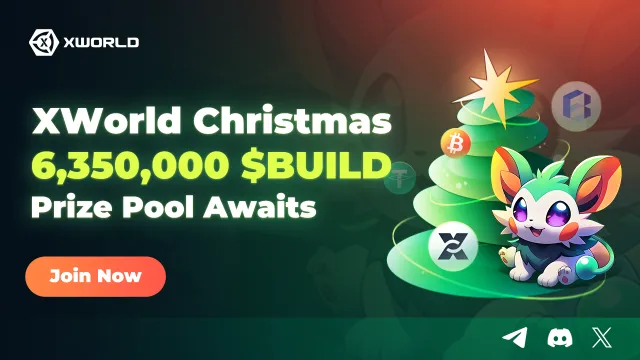
XWorld Christmas Event: 6,350,000 $BUILD Prize Pool Awaits!
December 10, 2024

XWorld Christmas Event: 6,350,000 $BUILD Prize Pool Awaits!

XWorld brings cheer this Christmas! Inspired by the magic of the season, join us to celebrate, connect, and create unforgettable moments together! 📅 Event Duration December 10, 2024 - December 30, 2024 🎁 Reward 1: Social King for Telegram We’ll select the Top 10 most active users in the Telegram community to win: 🥇 1st: 30 USDT 🥈 2nd: 20 USDT 🥉 3rd: 15 USDT 4th-10th: 5 USDT each 🎁 Reward 2: Social King for Discord Top 5 active users in the Discord community will win: Social King title + 10,000 $BUILD each 👑 🎁 Reward 3: Telegram Random Draw Complete interactive tasks to enter the Telegram random draw. 20 lucky users will win 20 $WORLD each! 🎉 🎁 Reward 4: 5,000,000 $BUILD Prize Pool Telegram Channel reaches 35,000 subscribers: 1,000,000 $BUILD of giftcodes shared with 10,000 people Telegram Channel reaches 40,000 subscribers: 1,500,000 $BUILD of giftcodes shared with 2,000 people Telegram Channel reaches 50,000 subscribers: 2,500,000 $BUILD of giftcodes shared with 1,000 people 📝 How to Participate in Tasks: ✅ Daily Check-ins: Send gm in our community #off-topic channel to check in. ✅ Subscribe to Telegram Channel (enable notifications for hidden gift codes). ✅ Visit MiniAPP ✅ Level Up Your Pet to Level 10 ✅ Follow Official Twitter ✅ Join Telegram Group ✅ Join Discord Server ✅ Share Event Link and invite friends to join! ✅ Spread Christmas Cheer: Send Happy Christmas in our community #activity-zone channel. ⚠️ Important Notes: Social King rewards for Telegram and Discord are mutually exclusive. Telegram Random Draw winners and Social King winners cannot be the same. Alternate winners will be chosen if needed. No cheating: Spamming, fake accounts, or manipulation will lead to disqualification. 🚫 Winners must complete all interactive tasks. If not, their rewards will be revoked. Winners will be announced within 3 working days, and rewards will be distributed within 7 working days. X-WORLD reserves the final interpretation of the event rule.
X-World TestNet Rewards Program——Step by Step
August 1, 2023

X-World TestNet Rewards Program——Step by Step

Hey guys!👋 Your favourite buddy is excited to bring you some super good news!😍 XWorld will be hosting a testnet event. Believe me😎, just like you, I’m filled with anticipation for this event! This competition will bring you abundant rewards and airdrops🍬. We have prepared meticulously for a long time to ensure the progress of this testnet will run smoothly. Those of you who are behind the screen, are you excited? Get ready to show your skills and compete with your fellow buddies! Of course, we’re not here to cause trouble, so let’s get straight to the point! Test Network Reward Rules: Follow our twitter and participate in Zealy mission for more Zealy XP: Twitter:https://twitter.com/xworld_pro Zealy:https://zealy.io/c/xworld/questboard Every Zealy XP will convert 1:1 to Xworld Points. Redeem XWORLD Token \ NFT\ other partner tokens based on Points airdrop calculation. About X-WORLD Points: XWorld Points is an incentive point for the XWorld test network account. The corresponding points are obtained according to the accumulated contribution and task completion of the user, and the corresponding tokens ($BUILD\$WORLD) will be exchanged after the launch of the XWorld main network according to the number of points. After the main network is launched, and you complete the exchange of all tokens, your XWorld Points will not be deleted, and will be kept on the main network. In the future, we will airdrop NFT and partner tokens to reward our early participating users. Reminders: Stay active and participate in our community activities. Spread xworld and invite your friends to join us. The more Zealy XP you accumulate, the more XWorld Points you will receive. Register your XWorld account at https://www.xworld.pro and post your submission on Zealy. After the first round of the community competition, we will notify all participants through community announcements, and your XWorld Points will be directly recorded on your official XWorld website account based on the Zealy XP you have obtained on a 1:1 basis. Fair play is essential — cheating or hacking attempts are strictly prohibited! We will closely monitor any such attempts, and any individuals involved will face airdrop disqualification and a ban from our community. X-WORLD Enjoying Passionate Game Time, Every Sec Becomes Your Income. Website | Twitter | Instagram | Facebook |Litepaper
XWORLD Gaming Festival: Unleash the Gamer Within and Dive into a Digital Wonderland
July 31, 2023

XWORLD Gaming Festival: Unleash the Gamer Within and Dive into a Digital Wonderland

Are you ready to embark on an unforgettable journey through the realm of gaming? Brace yourselves, dear gaming and digital citizens, for XWORLD is set to host the most sensational gaming festival of the year! Get ready to dive into a virtual wonderland that will take your gaming experience to new heights. From exhilarating gameplay to rare benefits, this is one event you cannot afford to miss! The ultimate gaming extravaganza for enthusiasts, with exclusive early access, rare benefits, and a chance to win over $40,000 in rewards! 1. XWORLD Game Conference: A Gateway to Gaming Paradise Imagine stepping into a world where every game is at your fingertips. At the XWORLD Game Conference, you will have early access to play the newest, hottest, and funniest games before anyone else. This is your chance to become a trailblazer in the gaming community, and be among the first to unravel the secrets of immersive gameplay. Whether you’re a fan of action-packed adventures, mind-boggling puzzles, or heart-pounding battles, XWORLD has it all. Step into a digital universe that promises infinite excitement and everlasting memories. 2. Uniting Gaming Giants for Unparalleled Rewards In a groundbreaking collaboration, XWORLD has partnered with renowned game developers Genshin Impact, Honkai: Star Rail, FreeFire, and League of Legends to bring you an unprecedented gaming extravaganza. Brace yourself for the ultimate reward: rare game skins and other in-game benefits worth a staggering $30,000! Can you imagine owning the most coveted skins, unlocking secret features, and gaining an edge over your fellow gamers? At XWORLD’s gaming festival, this dream becomes a reality. Experience the thrill of exclusive rewards that will enhance your gameplay and take your skills to the next level. 3. Content Creation Contest: Unleash Your Inner Creative Genius Calling all talented content creators! XWORLD’s gaming festival is not only about playing games, but also about celebrating creativity within the gaming community. Participate in our stunning content creation contest, and stand a chance to win over $10,000 in rewards! Whether you’re a streamer, a video editor, or a master storyteller, this is your golden opportunity to showcase your skills to the world. Let your imagination soar as you create mesmerizing content that captures the essence of gaming. The rewards up for grabs are not just monetary but also a chance to be recognized by millions of gaming enthusiasts and industry professionals. But Wait, There’s More! The XWORLD Gaming Festival isn’t just limited to these incredible offerings. Prepare to be mesmerized by thrilling tournaments, captivating panel discussions with industry experts, and enticing giveaways. This festival is all about celebrating the vibrant gaming community and providing an avenue for gamers of all levels to connect, learn, and have the time of their lives! Take Action Now and Join the XWORLD Journey! Are you excited to be a part of this exhilarating gaming extravaganza? Follow XWORLD on Twitter (https://twitter.com/xworld_pro) to stay updated with the latest news, updates, and insider information about the XWORLD Gaming Festival. Mark your calendars and get ready to immerse yourself in a world where gaming dreams come true! May the thrill of gaming, the joy of exploration, and the electrifying energy of XWORLD’s Gaming Festival guide you through an unforgettable experience. This is your chance to step into a digital wonderland and unleash your inner gamer. From exclusive early access to rare benefits and a content creation contest, the rewards are plentiful and the excitement is immeasurable. Don’t miss out on the adventure of a lifetime — follow XWORLD on Twitter and join the gaming revolution today! X-WORLD Enjoy Your Passionate Game Time, Every Second Becomes Your Income. Website | Twitter | Instagram | Facebook |Litepaper